

Introduction
Have you ever wondered how large applications like banking systems, online shopping platforms, and student management systems organise so much information? Behind these applications, developers use different programming techniques to keep software organised, reliable, and easier to maintain. One of the most important approaches is Object-Oriented Programming, commonly known as OOP.
Java is widely known for its support for object-oriented programming. This approach helps developers build software by representing real-world things, such as customers, employees, vehicles, and products, as objects with their own information and responsibilities.
For beginners, OOP might initially sound like a complicated technical concept. However, when you connect it with situations from everyday life, it becomes much easier to understand.
Imagine a shopping application. It needs to manage customer details, product information, shopping carts, payments, and orders. Instead of treating everything as one large task, developers can organise these responsibilities into separate components that work together.
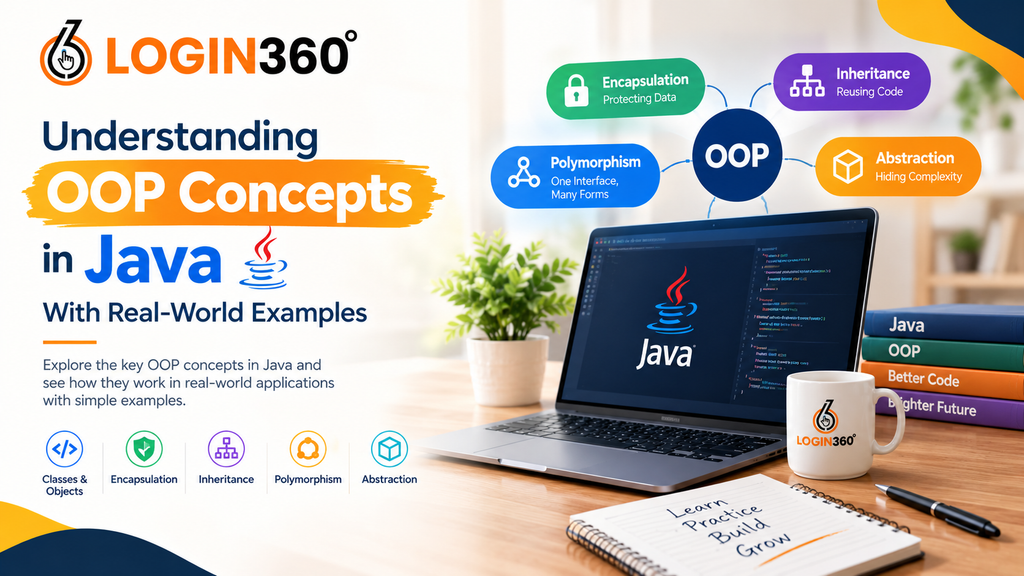
In this blog, we will explore the important OOP concepts in Java, understand the four main pillars, and discover how these ideas are used in real-world applications.
What Is Object-Oriented Programming in Java?
Object-Oriented Programming is a way of designing and developing software around objects. These objects represent entities and combine their information with the actions they can perform.
Think about a school. A school has students, teachers, classrooms, and subjects. Each has its own characteristics and responsibilities. A student has a name, an admission number, and academic records, while a teacher has professional details and teaching responsibilities.
Software developers can use the same idea to organise information and functionality within an application.
Java supports this approach through classes and objects, allowing developers to structure applications into meaningful components.
Some important benefits of OOP include:
- Code reusability: Common functionality can be reused instead of repeatedly created.
- Better organisation: Complex applications can be divided into manageable components.
- Data protection: Access to important information can be controlled.
- Flexibility: Different components can provide different implementations of similar behaviour.
- Maintainability: Well-structured software is often easier to update, test, and improve.
To understand OOP properly, it is helpful to begin with classes and objects before exploring the four main pillars.
Classes and Objects: The Foundation of OOP
A class is like a blueprint, while an object is something created from that blueprint.
Consider a car manufacturing company. Before producing cars, the company follows a design that defines features such as the engine, colour options, seating arrangement, and other specifications. Different cars can be produced using the same design, even though their colours, models, and features may differ.
In Java, a class provides a structure for defining the information and behaviour that its objects can have. Each object represents an individual instance of that class.
This concept is useful in many applications. In an online shopping system, a product can have a name, price, category, and stock quantity. Individual products have their own values, even though they follow the same general structure.
Understanding classes and objects provides the foundation for learning the four main pillars of object-oriented programming.
1. Encapsulation: Keeping Information Protected
Encapsulation is the practice of combining information and the operations associated with it while controlling how that information can be accessed or changed.
In simple terms, encapsulation helps protect an object’s internal information from uncontrolled changes.
Real-world example: A banking application
Imagine using a banking application to check your account balance or transfer money. You can perform these actions through the application’s approved features, but you cannot simply change the bank’s internal records whenever you want.
The application controls how account information is accessed and updated.
Encapsulation follows a similar principle in software development. Instead of allowing every part of an application to modify important information directly, developers can provide controlled ways to interact with it.
For example, a bank account may allow deposits and withdrawals while checking whether a transaction follows the required rules.
This approach helps prevent accidental changes and keeps the application’s information more consistent.
Why is encapsulation important?
Encapsulation is particularly useful when applications handle sensitive or valuable information. Banking systems, employee databases, inventory platforms, and customer management software all benefit from controlled access to data.
It also makes software easier to maintain because the internal implementation can change without requiring every part of the application to change with it.
2. Inheritance: Learning from Existing Structures
Inheritance allows a class to reuse accessible information and behaviour from another class. It helps developers create specialised components without repeatedly defining the same functionality.
A simple way to understand inheritance is to think about the relationship between a general category and its specialised types.
Real-world example: Employees in a company
Imagine a company with developers, managers, accountants, and sales executives. Although their responsibilities differ, they all share some common characteristics. Every employee has a name, an employee ID, and a department.
Instead of designing each employee type completely independently, developers can organise the shared characteristics in a general employee category. Specialised employee types can then build on that shared foundation.
For example, a developer may have additional responsibilities related to software development, while an accountant may handle financial records.
This structure reduces repeated work and makes the relationship between different employee types clearer.
Why is inheritance useful?
Inheritance can make applications easier to expand. When a new specialised type is introduced, developers may be able to reuse existing functionality rather than starting from scratch.
It is useful in systems that manage different types of employees, vehicles, products, or user roles.
However, inheritance should be used when there is a genuine relationship between the types. Good software design is not about reusing code at any cost; it is about choosing a structure that makes sense for the application.
3. Polymorphism: One Action, Different Behaviours
Polymorphism means that the same operation can produce different behaviours depending on the object involved.
Although the term may sound technical, the idea is familiar from everyday life.
Real-world example: Payment methods in online shopping
Imagine purchasing a product from an online store. You might choose to pay using a debit card, a credit card, or a digital wallet.
The purpose of each option is the same: to complete a payment. However, the process behind each payment method is different.
A card payment follows the card provider’s process, while a digital wallet uses its own payment mechanism. The shopping application can provide a common way to initiate payment without requiring every payment method to work identically.
This is an example of how polymorphism can be applied in software design.
Developers can create a common operation and allow different types of objects to provide their own behaviour. As a result, the application becomes more flexible and easier to extend.
Why is polymorphism important?
Imagine that an online store introduces another supported payment method. With a well-designed system, developers can add the new payment option without unnecessarily changing every other part of the application.
Polymorphism is also useful in notification systems, reporting tools, document processing, and applications that support multiple service providers.
It encourages flexible design and helps different components work together through common operations.
4. Abstraction: Simplifying Complex Systems
Abstraction means focusing on the essential features of something while hiding unnecessary implementation details.
We use abstraction every day, even without realising it.
Real-world example: Driving a car
When you drive a car, you use the steering wheel, accelerator, brake, and other controls. You do not need to understand every detail of the engine, transmission, or electronic control system before starting the vehicle.
The controls provide a simpler way to interact with a complex machine.
Software applications use the same principle. A user may click a button to upload a document without needing to understand all the technical processes happening in the background.
In Java, abstraction can be achieved through abstract classes and interfaces. These mechanisms allow developers to define essential behaviour while leaving implementation details to the relevant components.
For example, a vehicle system might define a general requirement for starting a vehicle. A car and a motorcycle can then provide their own specific implementations.
Why is abstraction useful?
Abstraction helps developers manage complexity by separating what a component does from how it performs the task.
It is especially valuable in large applications, where different teams or components need to work together without understanding every internal detail.
Payment gateways, database systems, notification services, and software interfaces all benefit from well-designed abstractions.
How the Four Pillars Work Together
Encapsulation, inheritance, polymorphism, and abstraction are often described as the four pillars of object-oriented programming. Although each concept serves a different purpose, they can work together within the same application.
Consider an online shopping platform.
Encapsulation helps protect customer information, product details, and order records by controlling how they are accessed and modified.
Inheritance can organise shared features among related components, such as different types of employees or products.
Polymorphism allows different payment methods to perform the same general operation according to their own requirements.
Abstraction helps define common operations without exposing every technical detail of their implementation.
Together, these principles help developers organise complex software into smaller, understandable components.
However, using OOP does not automatically make an application efficient or secure. Developers still need to make thoughtful design decisions, validate information, test their systems, and follow appropriate security practices.
Where Are OOP Concepts Used in the Real World?
Object-oriented programming is relevant to many areas of software development.
Banking and financial applications: OOP can help organise account information, transactions, customer records, and payment operations.
E-commerce platforms: Online stores can represent products, customers, orders, shopping carts, and payment services as separate components.
Student management systems: Educational applications can organise student profiles, course information, attendance, assessments, and teacher records.
Enterprise software: Business applications often manage employees, departments, inventory, invoices, and operational workflows.
Mobile and desktop applications: OOP principles can help structure user interfaces, application features, and the components responsible for processing information.
These examples demonstrate why understanding OOP is valuable for anyone planning to build a career in Java development or broader software engineering.
Common Mistakes Beginners Should Avoid
Learning OOP takes practice, and it is normal to feel confused when several new concepts appear together. A few common mistakes can make the learning process more difficult.
One mistake is confusing classes with objects. Remember that a class defines a structure, while an object represents an individual instance of that structure.
Another mistake is using inheritance for every situation. Sometimes two components need similar functionality without having a direct parent-child relationship. In such cases, other design approaches may be more suitable.
Beginners may also treat encapsulation as simply making information private. Its broader purpose is to control access and protect the consistency of an object’s internal state.
Similarly, abstraction and encapsulation are related but different. Encapsulation focuses on organising and controlling access to data and behaviour, while abstraction focuses on exposing essential functionality and hiding unnecessary details.
The best way to understand these differences is to study practical scenarios and gradually apply each concept to small projects.
How to Start Learning OOP in Java
If you are new to Java, avoid trying to memorise every definition at once. Instead, learn the concepts step by step.
Begin by understanding classes and objects. Once you are comfortable with them, explore encapsulation, inheritance, polymorphism, and abstraction individually.
Use familiar examples, such as a library system, a school management application, or an online shopping platform, to understand how the concepts relate to real software.
As you progress, focus on how different components interact, why certain design choices are made, and how a well-organised application can be maintained as it grows.
Most importantly, practise consistently. Understanding the purpose behind a concept is more valuable than simply memorising its definition.
Conclusion
Object-Oriented Programming is one of the key foundations of Java development. It provides a practical way to organise software, manage information, and build applications that can evolve as requirements change.
Classes and objects help represent real-world entities, while encapsulation protects internal information, inheritance supports reuse, polymorphism enables different behaviours, and abstraction reduces unnecessary complexity.
Once you understand these concepts, it becomes easier to see how large software applications are structured and how their different components work together.
Whether you want to become a Java developer, explore software engineering, or strengthen your programming fundamentals, learning OOP is an important step towards building that knowledge.
Start Your Technology Journey with Login 360
Technology becomes easier to understand when learning connects with real-world applications. Every concept you explore today can help you approach tomorrow’s development challenges with greater confidence.
At Login 360, we encourage learners and aspiring professionals to explore technology, strengthen their digital skills, and continue discovering new opportunities in the digital world.
Keep learning, stay curious, and take the next step towards your goals.
Login 360 — Learn, Build, and Grow in the Digital World.