

Introduction
The demand for modern web applications is constantly growing, and businesses are always looking for faster, scalable and cost-effective development solutions. Among technology stacks, the MERN stack has gained immense popularity among developers and companies. MERN is a powerful set of technologies that allows developers to build full-featured web applications using JavaScript from front end to back end. This single approach makes development easier, increases efficiency and lets teams create dynamic apps with fewer complexities. Whether you’re a beginner exploring web development or a business owner evaluating technology options, understanding the MERN stack can help you make informed decisions. In this guide, we will discuss the components, benefits, architecture, use cases, and learning path of MERN stack development.
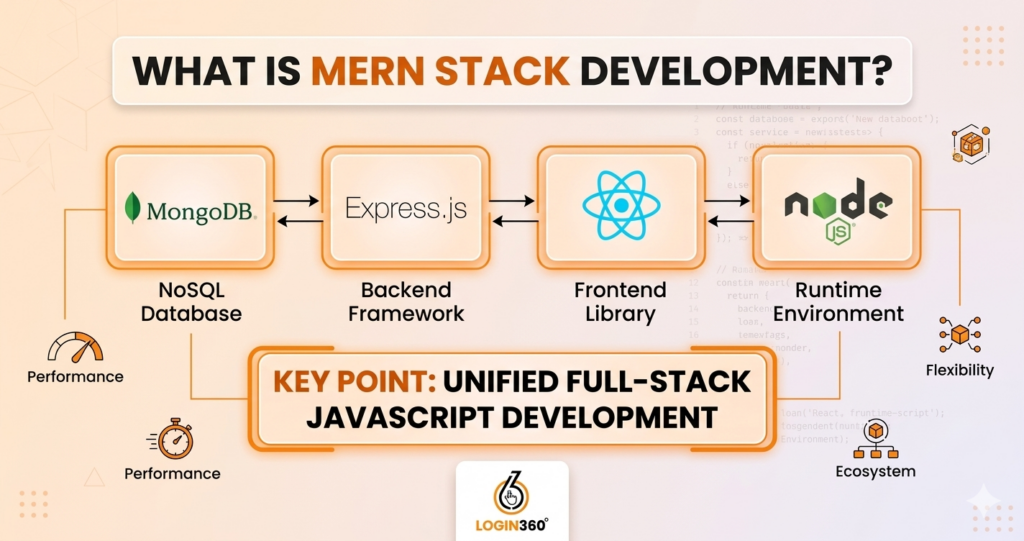
What Is MERN Stack Development?
MERN stack development refers to the process of building web applications using four key technologies:
- MongoDB – Database
- Express.js – Backend framework
- React.js – Frontend library
- Node.js – Runtime environment
Together, these technologies create a complete environment for full-stack development, allowing developers to build both client-side and server-side applications using JavaScript.
The MERN stack is particularly popular because it offers high performance, flexibility, and a large ecosystem of tools and libraries.
Components of the MERN Stack
MongoDB: The Database Layer
MongoDB is a NoSQL database that stores data in flexible JSON-like documents instead of traditional tables.
Key Features of MongoDB
- Document-oriented database structure
- High scalability
- Flexible schema design
- Fast query performance
- Cloud hosting support
Why MongoDB Is Important
Unlike relational databases, MongoDB allows developers to store complex data structures without rigid schemas. This flexibility makes it ideal for modern applications that frequently evolve.
Examples of applications using MongoDB include:
- E-commerce platforms
- Social media applications
- Content management systems
- Real-time applications
Express.js: The Backend Framework
Express.js is a lightweight framework that runs on Node.js and simplifies backend development.
Features of Express.js
- Easy route management
- Middleware support
- Fast API development
- Minimal configuration
- Seamless integration with MongoDB
Benefits for Developers
Express.js reduces development time by providing tools and utilities for handling requests, responses, authentication, and APIs efficiently.
React.js: The Frontend Library
React.js is one of the most popular JavaScript frameworks and libraries used for building interactive user interfaces.
Key Features of React.js
- Component-based architecture
- Virtual DOM for performance
- Reusable UI components
- Strong community support
- Easy integration with APIs
Why React.js Is Popular
React.js enables developers to create highly responsive applications with smooth user experiences. Its component-based structure also improves code maintenance and scalability.
Popular companies using React include Facebook, Netflix, and Airbnb.
Node.js: The Runtime Environment
Node.js allows JavaScript to run outside the browser.
Features of Node.js
- Event-driven architecture
- Non-blocking I/O operations
- High scalability
- Fast execution speed
- Large package ecosystem
Advantages
Node.js helps developers build fast and efficient server-side applications while maintaining a single programming language throughout the entire project.
How MERN Stack Development Works
The MERN stack follows a simple flow:
Step 1: User Interaction
Users interact with the application through the React.js frontend.
Step 2: API Requests
React sends requests to the Express.js backend through REST APIs or GraphQL.
Step 3: Server Processing
Express.js running on Node.js processes requests and business logic.
Step 4: Database Communication
The backend communicates with MongoDB to store or retrieve data.
Step 5: Response Delivery
Processed data is sent back to the frontend and displayed to users.
This seamless communication creates a smooth and responsive web application experience.
Advantages of MERN Stack Development
Single Language Across the Stack
One of the biggest advantages is that developers use JavaScript throughout the application.
Benefits include:
- Faster development
- Easier debugging
- Improved team collaboration
- Reduced learning curve
Cost-Effective Development
Since one language powers the entire stack, companies can hire developers with a unified skill set.
This reduces:
- Training costs
- Development complexity
- Maintenance expenses
High Performance
Node.js and React.js work together to deliver excellent application performance.
Performance benefits include:
- Faster page loading
- Better responsiveness
- Real-time data handling
- Efficient resource usage
Scalability
MERN applications can easily scale as businesses grow.
Examples include:
- Expanding user bases
- Adding new features
- Handling increased traffic
- Managing large datasets
Strong Community Support
The MERN ecosystem has a massive developer community.
Benefits include:
- Extensive documentation
- Open-source libraries
- Community tutorials
- Regular updates
Common Use Cases of MERN Stack Development
E-Commerce Websites
MERN is widely used for online stores because it can handle:
- Product catalogs
- User authentication
- Shopping carts
- Payment integrations
Social Media Platforms
Features such as real-time messaging, feeds, and user profiles make MERN suitable for social networking applications.
Project Management Tools
Applications like task trackers and collaboration platforms benefit from MERN’s scalability and responsiveness.
Content Management Systems
Businesses use MERN to create dynamic content platforms with flexible database structures.
SaaS Applications
Many Software-as-a-Service companies choose MERN for rapid development and easy scaling.
MERN Stack Architecture Explained
Frontend Layer
The frontend is built using React.js and handles:
- User interface
- Navigation
- Data presentation
- User interactions
Application Layer
Node.js and Express.js manage:
- Business logic
- Authentication
- API handling
- Server operations
Database Layer
MongoDB stores:
- User data
- Product information
- Content records
- Application settings
Together, these layers create a complete web application ecosystem.
MERN Stack vs Other JavaScript Frameworks
MERN vs MEAN
MEAN Stack uses Angular instead of React.
MERN Advantages
- Easier learning curve
- Better flexibility
- Faster UI rendering
- Larger component ecosystem
MERN vs Traditional Development
Traditional web development often involves multiple languages for frontend and backend.
MERN Benefits
- Single language ecosystem
- Faster development cycles
- Easier maintenance
- Better code consistency
How to Learn MERN Stack Development
Learn JavaScript Fundamentals
Start with:
- Variables
- Functions
- Arrays
- Objects
- ES6 features
JavaScript forms the foundation of all MERN technologies.
Master React.js
Focus on:
- Components
- Props
- State management
- Hooks
- Routing
Learn Backend Development
Study:
- Node.js basics
- Express.js routing
- Middleware
- API development
Understand MongoDB
Learn:
- CRUD operations
- Database design
- Aggregation
- Indexing
Build Real Projects
Practical projects accelerate learning.
Examples include:
- Blog applications
- Task managers
- E-commerce websites
- Social networking apps
Following a structured MERN stack tutorial can significantly improve learning speed.
Career Opportunities in MERN Stack Development
As businesses continue to adopt modern web technologies, MERN developers remain in high demand.
Popular roles include:
- MERN Stack Developer
- Full Stack Developer
- Frontend Developer
- Backend Developer
- Software Engineer
- Web Application Developer
Skills in full stack development often lead to competitive salaries and strong career growth opportunities.
Best Practices for MERN Stack Development
Write Clean Code
Maintain readability through:
- Consistent naming conventions
- Modular architecture
- Proper documentation
Secure Your Applications
Implement:
- Authentication
- Authorization
- Data validation
- HTTPS security
Optimize Performance
Use:
- Caching strategies
- Database indexing
- Lazy loading
- Code splitting
Test Thoroughly
Perform:
- Unit testing
- Integration testing
- Performance testing
- Security testing
Conclusion
Nowadays, the most frequent way of building modern web applications is through MERN stack development. MongoDB, Express.js, React.js, and Node.js together allow developers to build powerful, scalable, and high-performance applications using only one programming language. The stack has many benefits including faster development, easier maintenance, great scalability and great community support. If you’re brand new to web development or an experienced programmer wanting to learn modern tools, learning the MERN stack can open great doors to opportunities in full-stack development. With the growing demand for web applications and JavaScript-based solutions, it is a great time to start your MERN journey and build real-world projects to showcase your skills.