

Introduction
MERN Stack Development has become a popular career choice for people who want to work in modern web development. It combines MongoDB, Express.js, React, and Node.js to help developers create complete web applications. Since all four technologies are based around JavaScript, learning both frontend and backend development becomes more straightforward. This makes MERN a practical option for beginners who want to build real-world projects and move toward a career as a full-stack developer.
What Is a MERN Stack Developer?
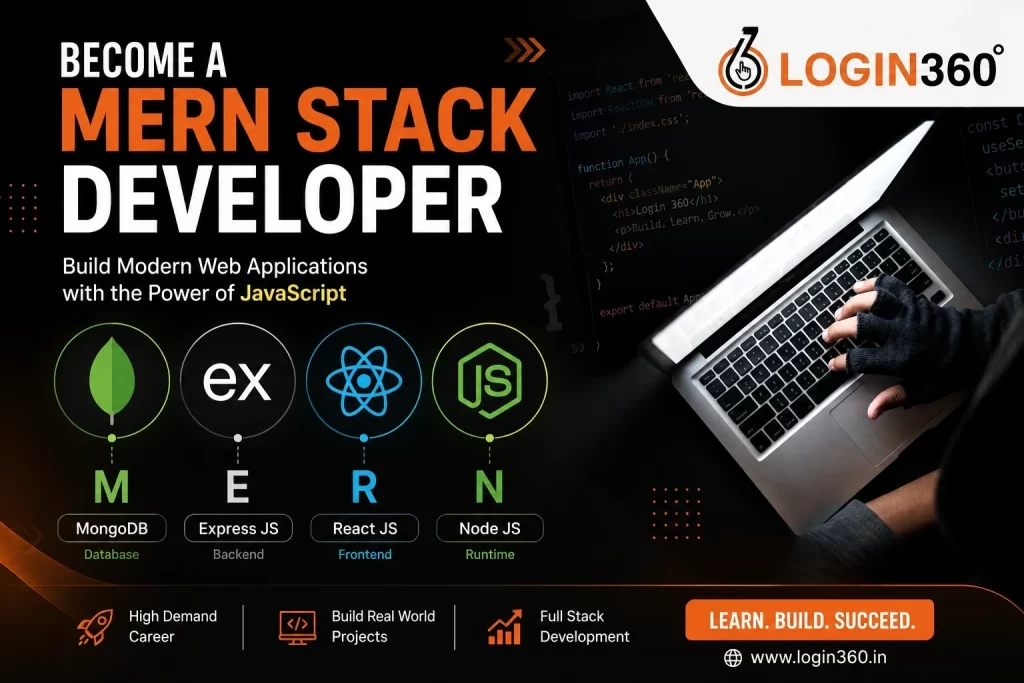
A MERN Stack Developer works with four main technologies: MongoDB for databases, Express.js for backend development, React.js for building user interfaces, and Node.js for running JavaScript on the server.
Together, these technologies help developers build complete web applications. For example, in an e-commerce website, React can manage product pages and shopping carts, Node.js and Express.js can handle backend requests, while MongoDB stores user, product, and order data.
A MERN Stack Developer can work across both frontend and backend development, giving them the ability to build different parts of a web application.
Understanding the MERN Stack
MongoDB
MongoDB is a NoSQL database used to store application data in documents and collections. MERN developers should understand databases, CRUD operations, queries, indexing, relationships, and basic database design. For example, a learning platform can use MongoDB to store student details, courses, assignments, and learning progress.
Express.js
Express.js is a backend framework for Node.js that helps developers build servers, APIs, and routes. It is commonly used to handle requests, application logic, database connections, and responses. Key concepts include routing, middleware, REST APIs, error handling, and authentication.
React.js
React.js is a frontend library used to create interactive web interfaces with reusable components. Developers can use React to build elements such as navigation bars, product cards, forms, and shopping carts. Important topics include components, JSX, props, state, hooks, forms, routing, and API integration.
Node.js
Node.js allows JavaScript to run outside the browser, making it useful for backend development. It can be used to build servers, APIs, backend services, and real-time applications. Important concepts include npm, modules, promises, async/await, HTTP, environment variables, and server development.
Why Learn MERN Stack Development?
There are several reasons why MERN is a popular choice for web development.
Why Learn MERN Stack Development?
MERN is popular because it allows developers to build complete web applications using a single JavaScript-based stack.
JavaScript Across the Stack
MERN uses JavaScript for both frontend and backend development, making it easier to work across different parts of an application.
Large Developer Community
JavaScript has a large developer community with plenty of libraries, tools, documentation, and learning resources available online.
Build Different Types of Applications
MERN can be used to create e-commerce websites, job portals, social media platforms, learning platforms, booking apps, dashboards, SaaS products, and inventory systems.
Good Foundation for Full-Stack Development
MERN provides beginners with a clear path to learn frontend, backend, and database development and connect them into one application.
Skills Required to Become a MERN Stack Developer
Along with MERN technologies, developers need a few supporting skills to build practical and reliable applications.
HTML and CSS
A good understanding of HTML and CSS helps you create structured, responsive, and user-friendly web pages. Learn HTML structure, forms, Flexbox, CSS Grid, responsive design, media queries, and basic styling.
JavaScript
JavaScript is the foundation of MERN development, so build a strong understanding before moving deeply into React. Focus on variables, functions, arrays, objects, DOM, ES6 features, promises, async/await, modules, and error handling.
Git and GitHub
Git helps developers track code changes and work safely on projects. Learn repositories, commits, branches, merging, pushing, pulling, and pull requests, while using GitHub to showcase your projects.
REST APIs
REST APIs allow the frontend and backend to communicate with each other. Understand common methods such as GET for retrieving data, POST for creating data, PUT/PATCH for updating data, and DELETE for removing data.
Authentication and Security
Most applications require secure user accounts and access control. Learn the basics of registration, login, password hashing, authorization, protected routes, JWT, sessions, and user roles while keeping security in mind throughout development.
MERN Stack Developer Roadmap
If you’re starting from zero, learn each technology step by step instead of trying to master everything at once.
Step 1: Learn HTML and CSS
Start with HTML and CSS to understand the basics of web design. Build simple projects such as portfolio pages, landing pages, login forms, and responsive websites.
Step 2: Learn JavaScript
Once you understand HTML and CSS, focus on JavaScript. Practice by building small projects like calculators, to-do lists, quizzes, weather apps, and expense trackers.
Step 3: Learn React
After developing a strong JavaScript foundation, move to React. Learn components, JSX, props, state, hooks, forms, routing, and API integration while building small applications.
Step 4: Learn Node.js and Express
Next, move into backend development with Node.js and Express. Learn about servers, routes, APIs, middleware, requests, responses, and error handling.
Step 5: Learn MongoDB
Learn how MongoDB stores data using databases and collections. Practice CRUD operations, queries, and connecting MongoDB with your backend application.
Step 6: Build Full-Stack Projects
Now connect everything together using React → Node.js/Express → MongoDB. Build projects such as e-commerce websites, job portals, student management systems, or booking applications.
Don’t simply copy tutorials. Rebuild projects yourself and add your own features to improve your problem-solving skills.
Step 7: Learn Deployment
Finally, learn how to make your projects available online. Understand deployment, environment variables, database hosting, production builds, domains, and cloud platforms.
Having live projects in your portfolio can help demonstrate your practical skills to potential employers.
MERN Stack Developer Career Opportunities
MERN skills can open the door to several career paths.
Frontend Developer
Frontend developers build the user interface and focus on how websites work in the browser. React is an important skill for this role.
Backend Developer
Backend developers handle servers, APIs, databases, authentication, and application logic. Node.js and Express are useful technologies for this career path.
Full-Stack Developer
Full-stack developers work on both frontend and backend development. MERN provides a practical stack for building complete web applications.
Software Developer
With experience, developers can move into broader software roles by learning testing, system design, cloud technologies, and software architecture.
Freelance Developer
MERN developers can work as freelancers and build websites, dashboards, e-commerce platforms, booking systems, and custom applications for clients. A strong portfolio can help showcase your skills and attract potential clients.
MERN Stack Developer Salary
A MERN Stack Developer’s salary can vary based on experience, location, company, skills, and job role. Beginners usually start with entry-level salaries, while experienced developers with strong technical and problem-solving skills can earn more. Instead of focusing only on salary, beginners should build practical skills and gain real project experience. Developers who can build complete applications, work with APIs and databases, use Git, solve problems, and deploy projects can have better career opportunities.
How Long Does It Take to Learn MERN?
There is no fixed timeline for learning MERN. Everyone learns at a different speed.
A beginner could follow a roadmap like:
Months 1–2: HTML, CSS, and JavaScript
Months 3–4: Advanced JavaScript and React
Months 5–6: Node.js, Express.js, and MongoDB
Months 7–8: Full-stack projects, authentication, APIs, Git, and deployment
This is only a general guide. Some people may progress faster, while others may need more time.
The important thing is not how quickly you finish. What matters is whether you can understand concepts and build applications independently.
Common Mistakes Beginners Make
Trying to Learn Everything
You don’t need to learn every technology available. Focus on the core MERN skills and build a strong foundation first.
Watching Too Many Tutorials
Tutorials can help you learn, but practice is equally important. After learning something new, try building it yourself instead of only following tutorials.
Ignoring JavaScript
React becomes easier when your JavaScript basics are strong. Spend enough time learning JavaScript before going deeper into React.
Building Only Basic Projects
Start with simple projects, then gradually add real features such as authentication, APIs, databases, search, filtering, and deployment.
Not Using GitHub
Learn Git and GitHub early and upload your projects regularly. This helps you track your progress and build a useful developer portfolio.
What Should You Learn After MERN?
Once you are comfortable with MERN, you can expand your skills based on your career goals. Useful areas include TypeScript, testing, cloud computing, DevOps, CI/CD, system design, cybersecurity, performance optimization, advanced databases, and AI-assisted development. You don’t need to learn everything at once; first build confidence with MERN and then choose skills that support your career path.
The Future of MERN Stack Development
Web development is always evolving, with new frameworks, cloud platforms, AI tools, and technologies being introduced regularly. Still, strong fundamentals such as programming, databases, APIs, security, software architecture, and problem-solving remain important. MERN can be a strong starting point for developers, but continuous learning is essential as technology changes. Instead of trying to learn every new tool, focus on understanding real problems and building practical solutions that can adapt to changing technologies.
IS MERN Still Worth Learning?
If you’re interested in JavaScript-based web development, MERN is still a useful stack to learn because it gives you a practical way to understand frontend, backend, and database development. However, simply learning MERN does not guarantee a job. Employers also value problem-solving, teamwork, clean coding, and the ability to understand and build real-world applications. That’s why practical experience is important. Build projects, make mistakes, debug your code, improve your applications, and keep practicing. Each project helps you gain experience, strengthen your skills, and become a better developer.
Conclusion
Becoming a MERN Stack Developer requires consistent learning, practice, and hands-on experience. Start with HTML, CSS, and JavaScript, then gradually learn React, Node.js, Express.js, and MongoDB. Building real projects, working with APIs, understanding databases, and using Git will help you develop practical skills and become more confident. MERN Stack development can lead to frontend, backend, full-stack, software development, and freelance opportunities. Keep learning, build projects, solve problems, and improve your skills with practice. If you’re ready to start your web development journey, explore the career-focused courses and training programs at Login 360. Learn. Build. Practice. Grow.