

Introduction
The demand for highly qualified full-stack developers has been increasing due to the growing number of companies that require web applications, e-commerce solutions, cloud computing solutions, and various other digital products. Being able to develop both the front and back end of an application, full-stack development is currently one of the most valuable skills to have in the software industry.There are many different technologies that one may want to learn now, but the choice of Java Full Stack vs MERN Stack is popular among students and fresh graduates. Although these two stacks offer great career prospects, there are significant differences between them in terms of programming languages, frameworks, databases, approaches, and so on.
Java Full Stack development mainly relies on Java and on such technologies as Spring Boot, Hibernate, SQL databases, while MERN Stack development implies the usage of JavaScript in all parts of the application (MongoDB, Express.js, React.js, Node.js).By getting to know about the differences between these stacks, you will be able to choose the stack which suits your career goals and interests the most.
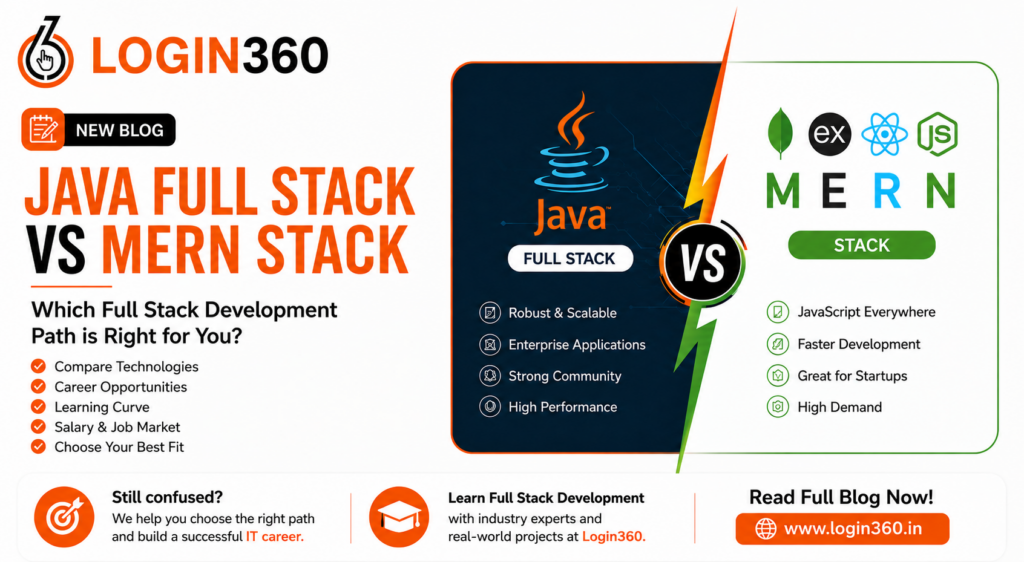
What Is Java Full Stack Development?
Java Full Stack development refers to the development of complete web applications using Java-based technologies on the backend side and modern technologies on the frontend side.
In general, a Java Full Stack developer uses the following technologies:
- HTML/CSS – structure and styling;
- JavaScript – frontend;
- React/Angular – frontend;
- Java – backend programming;
- Spring and Spring Boot – backend frameworks;
- Hibernate/JPA – database communication;
- MySQL/PostgreSQL – relational databases;
- REST APIs – communication between frontend and backend;
- Git/GitHub – version control.
Java is highly popular in enterprise applications because of its stability, security, scalability, and great ecosystem. Many companies from banking, healthcare, e-commerce, insurance and many other sectors use Java for their applications.
What Is MERN Stack Development?
The MERN stack development uses a set of modern technologies based on JavaScript programming language for building web applications. MERN is called after its primary technologies:
M – MongoDB
E – Express.js
R – React.js
N – Node.js
MongoDB is NoSQL database for storing information about an application. Express.js is the framework which works for the Node.js backend. React.js is the technology for building user interface. Node.js enables to run JavaScript on the server-side.
One of the most significant benefits of MERN is that a developer can use JavaScript throughout all parts of an application.
Java Full Stack vs MERN Stack: Main Differences
Despite the fact that both stacks can be applied for building web applications, their technologies and approach differ.
- Features
- Java Full Stack
- MERN Stack
- Main Language
- Java and JavaScript
- JavaScript
- Frontend
- React/Angular
- React
- Backend
- Java, Spring Boot
- Node.js, Express.js
- Database
- MySQL/PostgreSQL
- MongoDB
- Architecture
- Typically enterprise-oriented
- Typically web-oriented
- Learning curve
- Moderate to High
- Moderate
- Suitable For
- Enterprise applications
- Web applications
- Style of Development
- Structured, strongly typed
- Flexible, JavaScript-based
- Job Market
- Good demand in enterprises
- Good demand in web development
Programming Language
One of the most noticeable differences between these stacks is the programming language that is used.
While Java Full Stack development uses Java as the programming language for the backend and JavaScript/TypeScript for frontend development, MERN only requires knowledge of JavaScript for backend and frontend development.
As Java is a strongly typed language with object-oriented programming, MERN is an attractive option for beginners who enjoy working with JavaScript in web development. Those interested in enterprise applications and object-oriented programming should consider Java.
Frontend Development
Both Java Full Stack and MERN development can involve the use of React framework for frontend development.
React is a widely-used JavaScript library to develop interactive web applications by using UI components. When Java Full Stack development is concerned, React framework interacts with the backend programmed in Java through APIs.
As React framework is one of the key parts of MERN stack, the combination is especially popular among web developers.
Thus, frontend skills like HTML, CSS, JavaScript, React, responsive design, and API integration are useful regardless of what stack a developer chooses.
Backend Development
When it comes to backend, the experience is quite different.
Java Full Stack developers use Spring Boot framework to create REST APIs and enterprise-grade backend applications. Spring Boot simplifies Java application development and provides various security, database, dependency, and configuration options for applications.
In MERN stack, Node.js and Express.js frameworks are used to develop backend services and APIs. Node.js, just like React, uses JavaScript as the programming language, so a developer does not have to learn a new language to start backend development.
Java is often preferable when developing enterprise applications, and Node.js for real-time applications, APIs, startups, and web platforms.
Database
The database is another significant distinction.
Applications using Java Full Stack usually employ relational databases such as MySQL and PostgreSQL. These databases store data in tabular form and apply SQL to query and manage data.
In contrast, MERN employs MongoDB as the default database. It is a NoSQL database storing data in flexible JSON-like documents.
There is no universal better way of doing things. While relational databases could prove quite effective in case the application required a structured and complex relationship between data, MongoDB could prove helpful when flexibility and fast development are essential.
Performance and Scalability
Both Java Full Stack and MERN have the capacity to deliver high-performance applications when designed well and optimized properly.
Java and Spring Boot are popular tools for enterprise-level systems because of matured and high-performing technology stack. With multiple threads, multithreading capacity and strong frameworks, Java proves suitable for complex business logic.
Node.js has an event-driven and non-blocking I/O model allowing it to process many requests concurrently, making MERN stack suitable for real-time applications and API-driven platforms.
Performance is dependent on factors such as architecture, database design, server setup, caching, code quality, and more, not only the technology stack.
Learning Curve
While MERN might seem initially simpler for novices since the same language is used on both front-end and back-end.
Professional developers of MERN still need to master JavaScript basics, React, Node.js, Express.js, MongoDB, APIs, authentication, Git, deployment and other development aspects.
Since Java Full Stack students need to learn Java programming, object-oriented approach, Spring Boot, database usage, APIs, frontend technologies and other aspects of software development, the stack might be harder to master.
Therefore, students should choose the stack according to their interests and future plans and not simply because of ease of mastering it.
Career Prospects
Career prospects are promising for both stacks.
A Java full stack developer can opt for job profiles like:
- Java Full Stack Developer
- Java Developer
- Back End Developer
- Spring Boot Developer
- Software Engineer
- Web Application Developer
- Enterprise Application Developer
A MERN developer can opt for job profiles like:
- MERN Stack Developer
- React Developer
- Node.js Developer
- Full Stack Developer
- Front End Developer
- Back End Developer
- JavaScript Developer
The exact designation may vary according to the organization. Knowledge of Git, REST APIs, cloud computing, testing, databases, deployment, and software development process is often required from many developers.
Salary and Career Demand
The salary will depend upon many factors including experience, technical skills, location, company, project experience, and the ability to crack the interview.
Both Java and MERN developers have equal prospects in startups, IT service companies, product companies, and large organizations.
Java is specially dominant in enterprise environments where large-scale software systems are developed by organizations and maintained for years. MERN is especially in demand at organizations developing web-based products, SaaS products, e-commerce websites, or startups.
For freshers, practical project experience may prove more useful than being aware of some technologies.
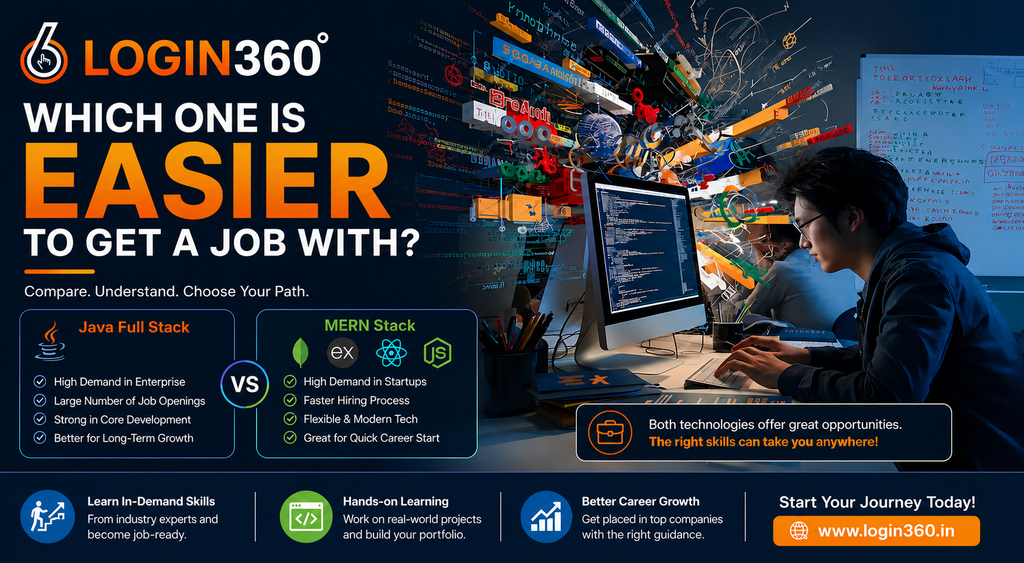
Which One Is Easier to Get a Job With?
It is not possible to give a definitive answer to this question.
If you have good skills in Java, Spring Boot, SQL, API, and frontend development, you will find great chances in Java development. Likewise, if you are skilled in React, Node.js, Express, MongoDB, and JavaScript, you should consider MERN.When comparing Java Full Stack vs MERN Stack for the purpose of employment, the better option is determined by the kind of companies and applications you would like to work with.
Learning technologies superficially and having a broad skill set is not enough. Rather, you should focus on building projects and putting them in your portfolio, which might include an authentication system, dashboards, ecommerce app, APIs, database connections, and deployed projects.
Java Full Stack vs MERN Stack: Which One Should You Choose?
Go for Java Full Stack if:
- You are interested in Java development.
- You like working with enterprise apps.
- You like working with object-oriented and structured languages.
- You are interested in Spring Boot and backend development.
- You would like to work with relational databases.
- You target companies using Java intensively.
Go for MERN Stack if:
- You are interested in JavaScript and frontend development.
- You want to learn React and Node.js.
- You are interested in modern web apps.
- You want to work with only one language through the stack.
- You would like to work on startup and product-based development.
- You are interested in building web interfaces.
Becoming a Full Stack Developer
No matter which stack you select, your education program must include both basics and development aspects.
An example pathway could be:
- Stage 1: Study HTML, CSS, and JavaScript.
- Stage 2: Study Git and GitHub.
- Stage 3: Study frontend development using React or Angular.
- Stage 4: Study backend development using Java and Spring Boot or Node.js and Express.js.
- Stage 5: Learn about databases like MySQL/PostgreSQL or MongoDB.
- Stage 6: Learn about REST APIs and authentication.
- Stage 7: Develop real-world projects.
- Stage 8: Learn about deployment and basic cloud computing.
- Stage 9: Develop a good GitHub portfolio and resume.
- Stage 10: Practice coding and technical interviews.
Practical training will facilitate this because structured learning will help students understand how various technologies work together.
conclusion
And what is better?
Well, it depends on the future career aspirations of the trainee.
Java Full Stack is a great fit for learners who have interest in enterprise-level development, Java, Spring Boot, and structured programming. On the other hand, MERN Stack will be a good fit for those who are interested in JavaScript, React, Node.js, and current web technologies.
The first step here is not just to choose the technology stack with the highest demand. What is needed here is to choose one stack, learn its ins and outs, do some serious projects, and gain an insight into software engineering basics.
In any case, Java Full Stack vs MERN Stack does not come down to identifying a universal winner or a universally bad technology. Both stacks offer a lot and each can lead to a successful career. The interests, learning habits, career aspirations, and real-life projects are the key factors to consider.
Those who want to begin a career in full-stack development might benefit from proper education and projects experience a lot.
Are You Ready to Be a Full Stack Developer? Learn with Login360