

Introduction
How to become a data scientist The rapid advancement of digital technology has led to a huge volume of data, and companies now require skilled people who can turn this data into useful insights. Because of this, data science has become one of the most appealing career options for students, recent graduates, and technology professionals. A data scientist carries out analysis of data in order to detect trends, provide answers to business questions, develop predictive models, and help with better decision-making. Yet simply learning Python or finishing an online course is not enough to get into the field. To be a successful data scientist one must have a mix of programming knowledge, a understanding of statistics, analytical thinking, machine learning skills, practical experience, and good communication skills. In this article we will look at the **10 essential steps to becoming a data scientist**, covering the skills you should acquire, the certifications you might consider, the projects you should build, and the career route you can take.
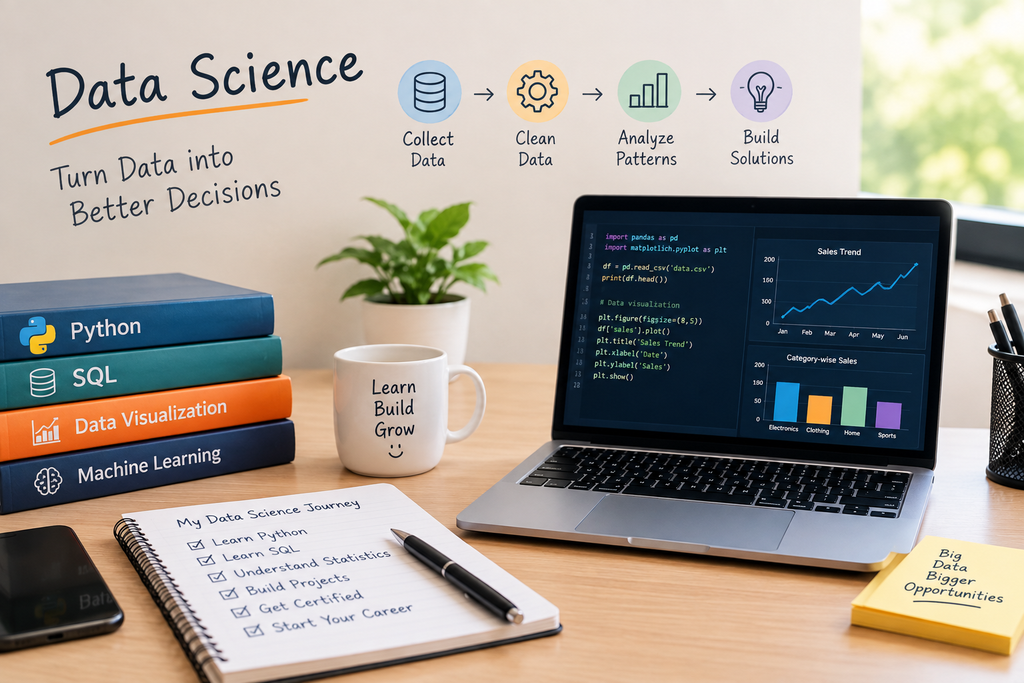
Begin with the basic principles of data science
It is important to understand what data science really consists of before getting on to learning advanced technologies. Data science involves the use of data, statistical methods, programming, and machine learning techniques in order to solve problems and produce valuable insights.
A data scientist might be involved in carrying out tasks such as forecasting customer behaviour, spotting business trends, picking out odd transactions, predicting sales, or developing recommendation systems.
When you understand the role, you will be able to tell which skills are important and will avoid wasting time on learning tools without knowing their purpose.Learning Python for data science
Python ought to be one of the first technical skills that you acquire.
Python is widely used in the field of data science due to the availability of a large number of libraries which cover analysis, visualization, machine learning, and artificial intelligence.
Start with:
* Python syntax
* Variables and data types
* Operators
* Conditional statements
* Loops
* Functions
* Lists and dictionaries
* File handling
* Object-oriented programming
Go on to the essential libraries such as *NumPy, Pandas, Matplotlib, Seaborn, and Scikit-learn*.
What we want is not to memorise Python commands; instead, we should get used to using Python in order to manipulate, analyse, and understand data.
Establish a basis in statistics
Statistics plays a central role in data science.
Understanding statistics well enables you to interpret data correctly and to determine whether the patterns you find are significant.
Important concepts include:
* Mean, median, and mode
* Variance and standard deviation
* Probability
* Data distributions
* Correlation
* Regression
* Sampling
* Hypothesis testing
* Confidence intervals
As you move on, you will have the opportunity to pick up the fundamentals of linear algebra and calculus, particularly if you are studying advanced machine learning and deep learning.
You won’t need to study advanced mathematics right from the start; instead, gradually build up your knowledge by applying it to real datasets.
Get used to SQL
Since data scientists usually work with information that is stored in databases, SQL forms an important element of their toolkit.
You should learn how to:
* Retrieve data
* Filter records
* Sort information
* Group data
* Calculate aggregate values
* Join multiple tables
* Write subqueries
* Use CTEs
* Work with window functions
You ought to also understand the basic concepts of databases such as the way that tables are related to one another, primary keys, foreign keys, and database structures.
Studying SQL together with Python provides a more solid basis for working with business data.
Master Data Preparation
You must ensure that the data is usable before you analyse a dataset or train a machine-learning model.
Real-world datasets can contain:
* Missing values
* Duplicate records
* Incorrect data types
* Outliers
* Inconsistent values
* Irrelevant columns
The process of data preparation consists of cleaning and transforming the dataset so that it becomes suitable for effective analysis.
You ought to carry out exercises involving the treatment of missing values, the elimination of duplicates, the transformation of variables, the detection of outliers, and the merging of datasets.
The stage is usually neglected by people who are just starting out, but it is an important element of practical data science.
Learn how to carry out exploratory data analysis and visualization
After the data has been prepared, the following step is to find out what the data is telling you.
Through exploratory data analysis (EDA) you are able to identify relationships, patterns, trends, and any unusual values in a dataset.
Visualization simplifies this process.
Learn how to create:
* Bar charts
* Line charts
* Histograms
* Scatter plots
* Box plots
* Correlation matrices
* Interactive dashboards
You can present information effectively using tools such as *Matplotlib, Seaborn, Power BI, and Tableau*.
A data scientist who is competent should be capable of analysing the data and presenting the results in a manner that can be understood by people who are not technical.
Learn machine learning step by step
Thanks to machine learning, computers are able to identify patterns in data and then make predictions or classifications.
Start by looking at the difference between supervised and unsupervised learning.
Common algorithms include:
Supervised Learning
* Linear Regression
* Logistic Regression
* Decision Trees
* Random Forest
* Gradient Boosting
Unsupervised Learning
* K-Means Clustering
* Hierarchical Clustering
* Principal Component Analysis
You ought also to study key concepts including feature engineering, train-test splitting, model evaluation, cross-validation, overfitting, underfitting, and hyperparameter tuning.
What matters is grasping the rationale for choosing a model rather than just running the algorithm.
Look into artificial intelligence and advanced technologies
After you have a basic understanding of data science and machine learning, you can go on to study more advanced topics.
These may include:
* Deep learning
* Neural networks
* Natural language processing
* Computer vision
* Generative AI
* Large language models
New opportunities are being created in a variety of industries, including finance, healthcare, e-commerce, manufacturing, and technology.
Advanced AI should be seen as the next stage in the process of learning rather than as a substitute for the basic principles. A solid understanding of Python, statistics, SQL, and machine learning will make it much easier to understand advanced topics.
Create Projects and an Professional Portfolio
Practical projects can make your learning a great deal more valuable.
Rather than just doing tutorials, you should work on projects that are similar to actual business problems.
For example:
* Customer churn prediction
* Sales forecasting
* Fraud detection
* Product recommendation
* Customer segmentation
* Sentiment analysis
* House price prediction
* E-commerce customer analysis
When building a project, document the entire process:
Problem → Data → Cleaning → Analysis → Model → Evaluation → Conclusion
Upload your projects to GitHub in order to build a portfolio which clearly shows off your skills.
A portfolio provides recruiters and employers with proof of what you are actually capable of.
Select your certifications and plan your career
While certifications can be used to show that you know something about particular technologies or platforms, they should be seen as supplementing practical skills rather than taking their place.
Depending on your interests, you can explore credentials related to:
* Data science
* Data analytics
* Machine learning
* Artificial intelligence
* Cloud technologies
* Business intelligence
Before choosing a certification, make sure that the program is still active and relates to your career objectives since certification programs and exam tracks can change over time.
Your career can begin through roles such as:
* Data Science Intern
* Junior Data Scientist
* Data Analyst
* Business Analyst
* Machine Learning Intern
* BI Analyst
After gaining experience, you can move into roles such as:
* Data Scientist
* Senior Data Scientist
* Machine Learning Engineer
* AI Engineer
* Data Science Lead
Essential Skills for a Data Scientist
A data scientist who is well-rounded should have both technical and professional skills.
Technical Skills
Python | SQL | Statistics | Machine Learning | Data Analysis | Data Visualization | Git | AI | Cloud Fundamentals
Professional Skills
Problem-solving | Communication | Critical Thinking | Business Understanding | Presentation | Curiosity | Continuous Learning
Technical skills enable you to work with data, whereas professional skills allow you to turn technical findings into business value.
A Practical Data Science Career Roadmap
A simple learning path for beginners is:
**Python → SQL → Statistics → Data Analysis → Visualization → Machine Learning → Projects → Portfolio → Internship → Job
When you have a good understanding of the basic principles, you can then focus on areas like machine learning, artificial intelligence, natural language processing, computer vision, or business analytics.
The precise route you take will vary according to your educational background, your interests, and your career objectives.

Conclusion
How to Becoming a data scientist is a step-by-step affair that involves gaining technical knowledge together with a great deal of hands-on experience. You should first establish a solid understanding of Python, SQL, statistics, data analysis, and visualization, before moving on to machine learning and more advanced AI technologies. It’s important to create projects that address real-world problems, keep a professional portfolio, and obtain certifications that are relevant to your career objectives. Above all, concentrate on putting your knowledge into practice rather than just finishing courses or watching tutorials. By sticking to consistent practice, accumulating project experience, and having a clear plan for your learning, you will be able to acquire the skills necessary to get into the data science field and go on to build a satisfying long-term career in technology.
Ready to Start Your Data Science Career?
Learn Python, SQL, Statistics, Machine Learning & more with Login360.
Gain practical skills + real project experience.
Join Login360 and start building your future today!