
If you’re still running your business mostly on word-of-mouth, print pamphlets, and hoping your existing customers refer a few friends you’re not broken, but you are leaving a lot on the table. A lot.
Digital marketing isn’t a buzzword anymore. It isn’t something only big corporations with fat budgets worry about. It’s the way people find businesses, compare options, make decisions, and spend money every single day. And if your business isn’t showing up in those moments, someone else’s is.
This Blog isn’t going to lecture you. It’s going to walk you through what digital marketing actually means, what you’re genuinely missing by ignoring it, and why getting started is more approachable than you might think.
First, Let’s Clear Up What “Digital Marketing” Actually Means
People hear “digital marketing” and picture some 25-year-old running Instagram ads in a coffee shop. But the reality is much broader and much more useful.
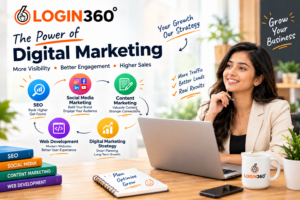
Digital marketing is simply any form of marketing that happens online or through digital channels. That includes:
- Your website and how it shows up in Google search results (SEO)
- Posts and ads on social media platforms like Instagram, Facebook, or LinkedIn
- Emails you send to your customers or subscribers
- Paid ads on Google or YouTube
- Blog articles and video content that answer questions your audience is already asking
- WhatsApp and messaging-based marketing
- Online reviews and reputation management
Some of these cost money. Many of them cost mostly time. All of them, when used well, work together to build something that traditional marketing can’t quite match: a consistent, scalable presence that finds the right people at the right moment.
The Real Cost of Ignoring It
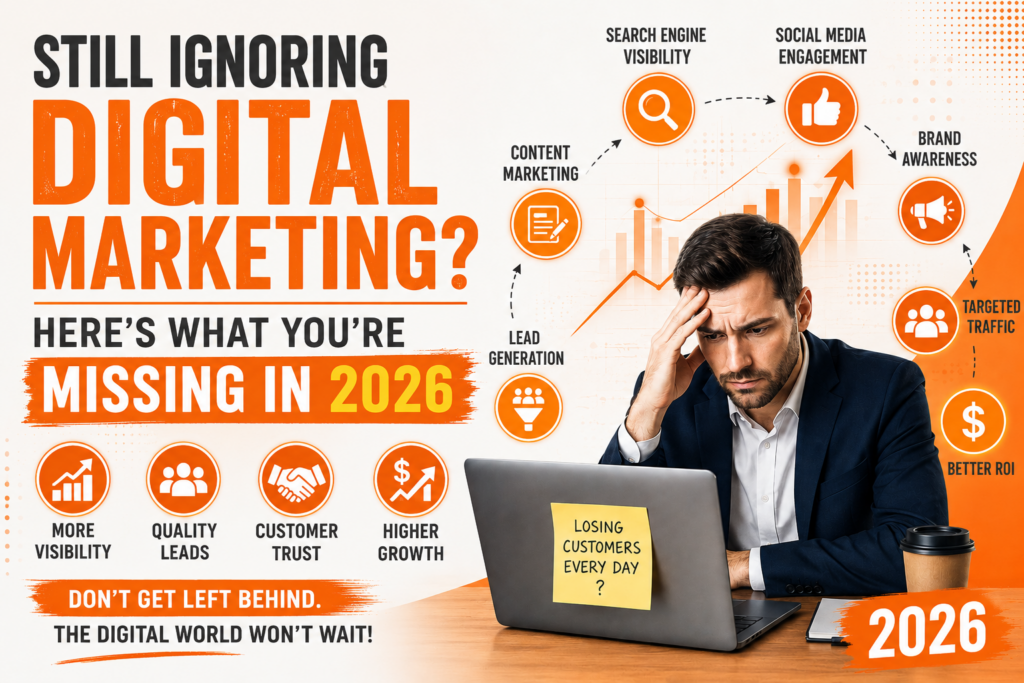
Here’s something a lot of business owners don’t think about: ignoring Digital marketing isn’t a neutral choice. It has a cost it’s just invisible.
Every day someone searches for a product or service you offer and doesn’t find you, that’s a missed sale. Every time a potential customer checks your competitor’s well-designed website and glowing reviews while yours is either nonexistent or last updated in 2019, that’s a lost opportunity. Every time someone shares a recommendation online and your business has no online presence to link to, that conversation ends without benefiting you.
The cost of doing nothing is very real. It just shows up slowly in stagnant revenue, in customers who quietly drift to competitors, in growth that never quite takes off.
Let’s go deeper into exactly what you’re missing.
1. You’re Invisible When People Are Actively Looking for You
Think about the last time you needed something a plumber, a good restaurant, a software course, a tailoring shop. What did you do? You probably picked up your phone and searched for it.
That moment when someone is actively looking for exactly what you offer is the most valuable moment in marketing. It costs nothing to appear there organically (through SEO), or a modest amount through Google Ads. Either way, it’s warm, intent-driven traffic. These aren’t people you’re interrupting with an ad they didn’t ask for. These are people who want to find you.
If you’re not investing in SEO or even basic search visibility, you’re absent in that moment. You’re missing buyers who are literally ready to spend money on what you sell.
What you can do about it: Start with the basics. Make sure your business has a Google Business Profile (it’s free). Make sure your website clearly describes what you do, where you are, and who you serve. Use the words your customers actually type into Google not industry jargon.
2. You Have No Way to Stay in Touch With Past Customers
One of the biggest hidden losses in a business that ignores digital marketing is the inability to re-engage people who’ve already bought from you. Your past customers are your warmest audience. They already trust you. They’ve already paid you. Getting them to come back is far easier and cheaper than acquiring someone brand new.
But if you don’t have their email address, they’re not following you anywhere online, and you have no digital touchpoint with them how do you reach them again?
You hope they remember you. That’s a weak strategy.
Email marketing, even something as simple as a monthly newsletter or a “here’s what’s new” update, keeps your name in front of people who already like you. Social media followers see your posts regularly. Remarketing ads bring back visitors who checked your website but didn’t buy.
None of these need to be complicated. They just need to exist.
What you can do about it: Start collecting email addresses. Offer something small in return a discount, a helpful guide, early access to new products. Then send a simple, honest email once or twice a month. It costs very little and the payoff compounds over time.
3. You’re Letting Your Competitors Win by Default
Here’s an uncomfortable truth: your competitors who are active online aren’t necessarily better at what they do. They might not be. But they’re more visible, more trusted seeming, and easier to reach and in the eyes of a customer who doesn’t yet know you, that matters enormously.
When someone searches your industry and your competitor has a well-optimised website, a strong Google rating, an active Instagram, and a YouTube channel with helpful content and you have none of that the customer’s choice is made before they even consider the quality of your actual work.
Perception is part of the product. A business that looks active, present, and professional online signals that it is trustworthy and capable. That’s not fair, perhaps but it’s real.
Digital marketing is one of the great equalisers for small businesses. You don’t need a massive advertising budget to build an online presence that looks and feels authoritative. You need consistency, a bit of strategy, and the willingness to show up regularly.
What you can do about it: Spend one hour doing a simple competitor audit. Google the top three or four businesses in your space. What do their websites look like? What are their Google ratings? What social platforms are they active on? This will quickly show you where the gaps are and where your energy is best spent.
4. You’re Missing an Incredibly Targeted Way to Reach New People
Traditional advertising a billboard, a newspaper ad, a flyer drop is essentially a numbers game. You spend money to reach a broad audience and hope enough of the right people are in that audience. The targeting is rough. The feedback is minimal. You rarely know what worked.
Digital advertising is the opposite of this.
With platforms like Facebook Ads or Google Ads, you can define your audience with remarkable precision. You can target by location down to a city or a postcode. You can target by age, profession, interests, and income level. You can show ads to people who have already visited your website. You can exclude audiences who have already converted. You can test two different versions of an ad and know within days which one performs better.
And crucially you can start small. You don’t need a large budget to begin learning how digital advertising works. Many businesses start with a few hundred rupees a day, learn what resonates, and scale up from there.
What you can do about it: If you’re new to this, start with Google Ads for search it targets people who are already looking for what you offer. Even a small budget, well-targeted, will teach you more in a month than years of traditional advertising guesswork.
5. You’re Not Building Any Long-Term Brand Assets
There’s a difference between marketing that works once and marketing that compounds.
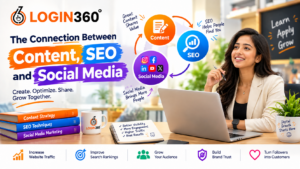
A good blog post, optimised for the right search terms, can bring in organic traffic for years without you spending another rupee on it. A YouTube video that genuinely helps people can keep getting views and subscribers long after you posted it. An email list, grown steadily over time, becomes one of your most valuable business assets a direct line to people who want to hear from you, completely independent of any algorithm.
This is what content marketing and SEO build in digital marketing. They’re slow at the start. But they compound.
Paid ads stop the moment you stop paying. Word-of-mouth is unpredictable. But a well-written article that ranks on page one of Google for a question your customers are asking? That’s an asset. It works while you sleep.
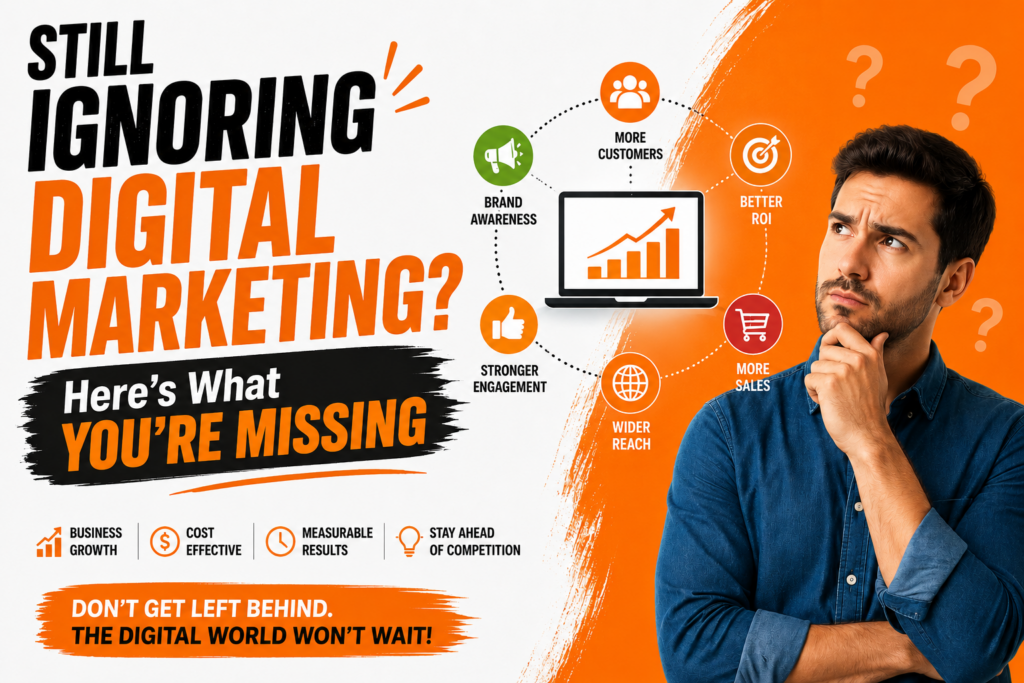
Many businesses that start ignoring digital marketing today will find, five years from now, that they’re playing catch-up with competitors who started building these assets years ago. The best time to start was yesterday. The second best time is now.
What you can do about it: Identify five to ten questions your customers regularly ask you. Write an honest, thorough answer to each one as a blog post or FAQ page on your website. Optimise each one for the search terms people use. These small, consistent efforts build domain authority and organic visibility over time.
6. You Have No Data — So You Can’t Improve
One of the most underrated advantages of digital marketing is the data it gives you.
When you run a print ad, you don’t really know how many people saw it, how many were interested, or what happened next. You spend the money and you hope.
Digital marketing is transparent in a way traditional marketing never was. You can see how many people visited your website, which pages they spent time on, where they dropped off, which ads got clicked, which emails got opened, what search terms brought people to you — all of it.
This data isn’t just interesting. It’s actionable. It tells you what’s working and what isn’t. It tells you what your customers actually care about versus what you assumed they care about. It removes the guesswork from growing your business.
Even free tools like Google Analytics and Google Search Console in Digital marketing give you an extraordinary amount of insight into how people are finding and interacting with your digital presence. Most businesses don’t even use these tools — which means the ones that do have a significant edge.
What you can do about it: Install Google Analytics on your website today if you haven’t already. Set up Google Search Console to see which search queries are bringing traffic to your site. Spend thirty minutes a week looking at these numbers. You’ll start spotting patterns quickly.
7. You’re Missing the Trust-Building Power of Social Proof
People don’t just search for businesses today they check them. Before making a decision, customers look at reviews, scroll through social media profiles, check how a business responds to complaints, and look for signs that other real people have had positive experiences.
This is social proof, and it’s become one of the most powerful forces in consumer decision-making. A business with 200 genuine five-star reviews and an active, responsive Instagram presence feels more trustworthy than one with none of these things regardless of actual quality.
If you’re not actively managing your digital reputation, you’re missing the chance to build this trust at scale. Happy customers don’t automatically leave reviews. You have to ask them. And when you respond to reviews especially negative ones professionally and helpfully, you signal to everyone watching that you’re a business that cares.
What you can do about it: Make it a habit to ask satisfied customers for a Google review. Make it easy send them a direct link. Respond to every review, positive or negative. Build a simple but professional social media presence that shows your work, your values, and your personality.
8. Your Competitors Are Getting Smarter — Fast
The digital marketing landscape is evolving quickly. AI tools are helping businesses create content faster. Automation is making email campaigns and ad management more efficient. Video content is exploding in reach and influence.
Businesses that started taking digital marketing seriously five years ago are now miles ahead in terms of brand authority, search rankings, and audience loyalty. Every year you wait, the gap gets harder to close.
This isn’t meant to scare you it’s meant to give you a realistic sense of urgency. You don’t need to master everything at once. But starting somewhere, and starting now, is genuinely important.
What you can do about it: Pick one or two channels and do them well rather than trying to be everywhere at once. For most businesses, a well-optimised website plus an active Google Business Profile plus one consistent social media platform is a better foundation than a scattered presence across six platforms with no real strategy.
So, Where Do You Actually Start?
If you’ve read this far and you’re thinking “okay, I get it I need to take this seriously,” here’s a simple starting framework:
Step 1 — Get the foundations right. Make sure you have a professional, mobile-friendly website that clearly explains what you do. Set up your Google Business Profile. Make sure your contact details are consistent and easy to find everywhere online.
Step 2 — Pick your primary channel. Are your customers on Instagram? Is LinkedIn more relevant? Are they searching Google? Focus your early energy on one channel where your audience actually is.
Step 3 — Start building your email list. This is the one asset you truly own. Social platforms can change algorithms overnight. Google rankings can shift. But your email list is yours.
Step 4 — Create content that actually helps people. Answer the questions your customers are asking. Share your expertise. Be useful. This builds trust faster than any advertisement.
Step 5 — Measure and adjust. Use free analytics tools to understand what’s working. Don’t assume — look at the data.
Final Thoughts
Digital marketing isn’t magic, and it isn’t instant. But it is one of the most powerful tools available to any business small or large for reaching the right people, building genuine trust, and growing sustainably.
The businesses that thrive in the next decade will be the ones that understood this early and acted on it. Not the ones with the biggest budgets, but the ones that were consistent, authentic, and willing to learn.
You don’t need to do everything at once. You just need to start.
And honestly? The fact that you’re reading this article is already a step in the right direction.
Looking to build real digital marketing skills? A structured course can help you move from confusion to confidence faster than figuring it all out on your own. Explore digital marketing programs at Login360 to see what’s available.