
Introduction:
Digital marketing and ai is now frequently used to analyse data, create content, and communicate with audiences—a practical skillset taught in a modern Digital marketing course in Chennai to help marketers measure and optimise campaign results. Applications of AI are often designed to resolve specific issues, for example supporting consumers to find suitable products, enabling employees to provide faster responses and assisting marketers to assess the effectiveness of marketing content. Although AI can greatly assist, it cannot replace robust marketing strategy and high-quality service. AI does this by extending human capacity, analysing data and providing decision-making support.
Digital marketing and ai in E-commerce:
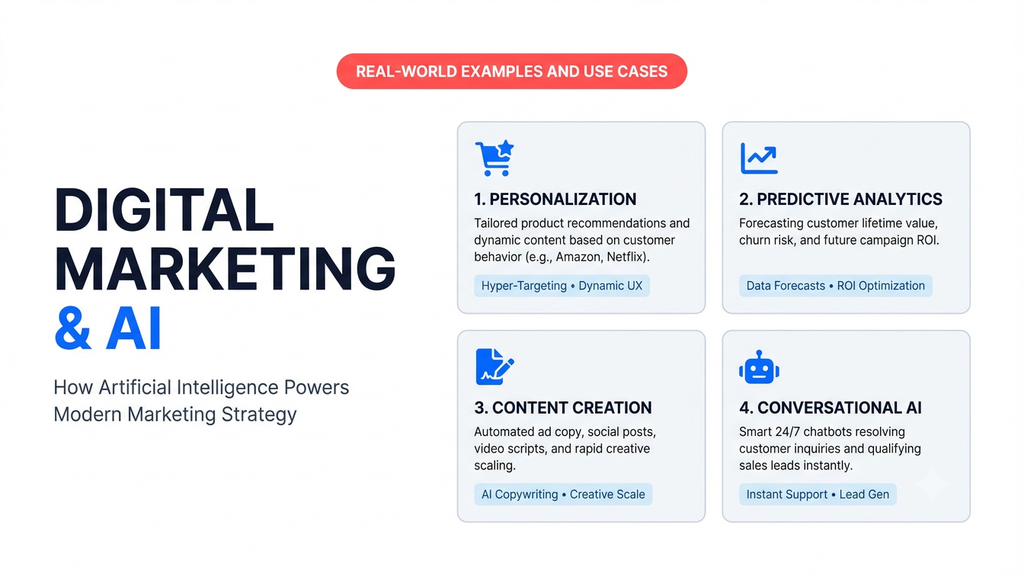
AI can be used to tailor the products that a consumer sees. Alongside a consumer’s viewing, saving and purchasing history, products can be analysed for characteristics including type, colour and stock levels. An existing customer who has viewed rainwear, for example, could be shown waterproofs together with complementary items. Formal attire may similarly be personalised. Consumers’ natural language can also be recognised so that an enquiry such as “lightweight bag for a weekend trip” can be matched with suitable products. Marketing can then analyse consumers’ viewing and buying behaviour to recognise popular product combinations. It can then use these insights to devise product packages and/or information.
Content and Search:
- Analyse data – such as customer reviews, searches and support enquiries – to recognise popular areas of interest.
- Convert a marketing-approved brief into a framework for information such as a guide, comparison chart or FAQs.
- Provide alternative titles, body text, social media content and/or calls to action for further editorial editing.
- Advise on further questions and keywords that would be of value in presenting information on a particular area. Staff then assess the relevance of the suggested elements and ensure that keywords are not inappropriately crammed in.
- Convert lengthy content to a summary for a newsletter, social media and/or brief video script, ensuring key points remain.
- Assess content for spelling, readability, structure and conformity with a defined style guide.
- For example, a home improvement store might use common customer queries regarding paint types to help to develop a relevant article. Specialist knowledge must then be used to validate the information provided on surface types, preparation and product performance. Although AI can speed up data analysis and basic content production, high quality specialist knowledge and well-structured content are still required.
Advertising:
Companies can utilise AI within search and social media marketing to further inform and optimise marketing. For example, an online educational service may promote a range of courses. AI can advise on which market segments respond favourably to different content and also suggest suitable bid costs. It can also analyse the effectiveness of differing advertising creatives. Marketing could trial two contrasting ad messages – one focusing on students’ adaptable study hours and the other emphasising career skills. Rather than merely analysing which ad generated the highest number of clicks, marketing can assess which one stimulated the greatest number of relevant enquiries. Furthermore, Small Businesses can automatically allocate their restricted marketing budget.
Email and Customer Marketing:
- Orientating – New customers can be presented with brand, product and preference information, together with relevant marketing, rather than receiving an untargeted sequence of emails.
- Cart re-engagement – Consumers can be effectively reminded of items in their shopping basket. Customers can also manage how frequently these emails are sent and opt out of marketing emails.
- Educating – Following purchase, a software company can email educational material relating to areas of a customer’s set-up that they have already configured.
- Re-ordering – A domestic goods store can calculate when a regularly purchased item may need reordering. Customers can then alter this suggested date.
- Tailoring – A newsletter can showcase articles corresponding to a consumer’s chosen interests, in contrast to all readers receiving identical content.
- Testing – Marketing can analyse the impact of differing sending times and/or email headings. It can then assess significant effects on factors including sales, responses and opt-outs.
- Security – Reliable consumer information, correct permissions and stringent security procedures are fundamental. As with other areas, AI should be used to ensure that marketing is valuable, rather than just exploit the ease of automated email dispatch to increase communication volumes.
Customer Service and Marketing Dialogue:
A travel firm could deploy a chat function to address standard customer queries, including those around the booking process, luggage allowances, and cancellation rules, reflecting the conversational AI strategies taught in a Digital marketing course in Coimbatore. This could pull information from authorised webpages and ask a consumer a couple of supplementary questions before signposting them to the relevant web page. Should a traveller explain that they have missed a flight or need assistance with an intricate refund procedure, the dialogue should seamlessly transfer to a member of staff without requiring the customer to re-state their issue.
Analysis, Prediction and Marketing Strategy:
- E-commerce marketing can segment customers according to broad buying behaviours and so analyse re-purchasing behaviour. Marketing can then devise relevant customer retention strategies.
- A marketing analyst can detect unexpected changes in conversion levels and then investigate whether this is due to alterations in data monitoring, site functionality and/or market segment quality.
- A subscription-based service can anticipate which subscribers are likely to leave and assess whether a suitable on-boarding or support related message increases customer retention.
- Marketing management can analyse different marketing channel effectiveness. Recognition is also needed that some channels may be used for initial customer engagement whereas others are likely to secure the final click.
- Sales personnel can rank new leads in accordance with pre-agreed indicators. They can then analyse the extent to which this ordering correlates with the suitability of the lead, not just their level of engagement.
- A not-for-profit can investigate donating behaviour to determine the optimal moment to share information regarding an organisation’s impact and/or to remind donors to renew. Donor preferences should also be respected.
- As predictions are not definitive, it is essential to validate source data. Marketing must also contrast AI’s suggested actions with observed outcomes. Further, marketing should not assume that a campaign is solely responsible for an effect simply because of a correlation. Ideally, marketing strategy is informed by both numerical trends and qualitative factors including discussion, consumer responses and business context.
Application in Small and Local Businesses:
Even Small Businesses can utilise AI. For instance, a local restaurant could use an AI writing tool to initially draft a revised weekly menu. A manager could then manually check pricing, ingredients and stock levels. Similarly, a local gym could analyse members’ class feedback to recognise most commonly suggested timetable amendments. A not-for-profit may convert a marketing-approved event brief into web, email and social media content. Each of these variants can then be manually assessed for both factual and stylistic accuracy. Successful implementation of AI arises from initially addressing common, easily-manageable areas for development. Small marketing teams should ensure that they adopt AI solutions that integrate well with current processes.
Implementing AI Effectively:
- Businesses can implement AI in stages, and in a controlled manner. Firstly, an exact marketing aim should be identified, for example to enhance reaction speed, boost quality leads, and/or provide consumers with valuable information, much like the campaign-planning approach covered in a Digital marketing course in Kochi.
- Next, an understanding of the present marketing process should be established. A baseline should then be created in order that progress can be analysed post-intervention.
- One AI solution should be adopted for a specific marketing function. Before implementation, marketing must confirm the tool’s price, data-handling methods, and compatibility and constraints. This should occur in relation to consumer data.
- Authorised source information should be prepared. Unnecessary personal data should also be excluded.
- Parameters must then be established for manual checking, together with an outline of the re-direction process and individual accountability for rectifying errors.
- Piloting should then occur with a select group of people or outputs. Accuracy, customer experience, staff workloads and pertinent business impacts should be analysed.
- Finally, based on the insights gained, marketing must determine whether to progress with, amend or discontinue an AI application. Learning should then be formally recorded.
- Concentrating on a particular area allows marketing to more readily analyse the advantages and challenges of AI, before later applying it across further marketing functions.
Conclusion:
AI can effectively underpin diverse digital marketing applications, for example, product recommendation, research, content creation, advertising trials, email marketing, answering common queries and result analysis. For optimum results, these activities should stem from genuine business or consumer concerns. Suitable data should be analysed and human checking should also occur. Marketing should assess a range of beneficial outcomes including quality lead generation, customer experience, retention and time-efficiency. Although small-scale and well-evaluated pilots are a good means of facilitating learning, marketing must continue to prioritise precision, data security and trust. Effectively utilising technology in line with clear marketing aims can thus successfully enhance digital marketing relevance and value.