

Introduction
In today’s digital landscape, applications must be capable of handling growing numbers of users, increasing amounts of data, and evolving business requirements. Whether it’s a startup launching a new platform or an enterprise expanding its online services, scalability has become a critical factor in modern web development.
This is where the MERN stack stands out. As one of the most popular technology stacks for full-stack JavaScript development, the MERN stack enables developers to build powerful, flexible, and scalable web applications using a unified language across both the frontend and backend.
The popularity of the MERN stack continues to grow because it combines four highly effective technologies—MongoDB, Express.js, React, and Node.js—into a streamlined development ecosystem. Together, these technologies make it easier to create applications that can adapt to increasing workloads while maintaining performance and user experience.
In this guide, we’ll explore how the MERN stack supports scalability, examine each component’s role, discuss best practices for building scalable applications, and look at real-world scenarios where this technology stack excels.
What Is the MERN Stack?
The MERN stack is a collection of JavaScript-based technologies used for building modern web applications. The acronym MERN represents:
- MongoDB – Database
- Express.js – Backend framework
- React – Frontend library
- Node.js – Runtime environment
One of the biggest advantages of the MERN stack is that developers can use JavaScript throughout the entire application. This consistency simplifies development workflows, reduces context switching, and improves collaboration between frontend and backend teams.
The stack is widely used for:
- SaaS applications
- E-commerce platforms
- Social networking websites
- Real-time collaboration tools
- Content management systems
- Enterprise web applications
Because all components are designed to work well together, the MERN stack provides an efficient foundation for scalable application development.
Understanding the Components of the MERN Stack
To understand why the MERN stack is so effective for scalability, it’s important to examine the role of each technology.
MongoDB: Flexible and Scalable Data Storage
MongoDB is a NoSQL database that stores information in JSON-like documents instead of traditional tables and rows.
Key Benefits
- Flexible schema design
- High performance for large datasets
- Horizontal scaling through sharding
- Easy integration with JavaScript applications
Unlike relational databases that require predefined structures, MongoDB allows developers to adapt data models as business requirements change.
For growing applications, this flexibility is particularly valuable because new features can often be introduced without major database restructuring.
Scalability Advantages
MongoDB supports:
- Data replication
- Automatic failover
- Distributed architecture
- Horizontal scaling
These capabilities make it easier to manage increasing volumes of users and data.
Express.js: Simplifying Backend Development
Express.js is a lightweight web application framework built on Node.js.
It provides a streamlined approach to building APIs, handling requests, and managing application logic.
Features of Express.js
- Routing management
- Middleware support
- API development tools
- Error handling capabilities
- Integration with third-party services
Express.js minimizes unnecessary complexity while providing developers with the flexibility needed to build scalable backend systems.
Why It Supports Scalability
A well-designed Express.js backend can:
- Handle large numbers of API requests
- Separate services into modular components
- Integrate with load balancing systems
- Support microservices architectures
This flexibility allows applications to grow without becoming difficult to maintain.
React: Efficient Frontend Performance
React is a JavaScript library developed for building user interfaces.
It focuses on creating reusable components and delivering highly responsive user experiences.
Core React Features
- Component-based architecture
- Virtual DOM
- Reusable UI elements
- Efficient rendering
- State management support
React’s Virtual DOM minimizes unnecessary updates, helping applications remain fast even as they become more complex.
Scalability Benefits
React contributes to scalability by:
- Encouraging reusable code
- Simplifying maintenance
- Supporting large applications
- Improving rendering performance
As applications expand, developers can continue adding components without significantly affecting performance.
Node.js: Fast and Efficient Server Operations
Node.js is the runtime environment that enables JavaScript execution on the server.
It uses an event-driven, non-blocking architecture that makes it highly efficient for handling multiple simultaneous requests.
Advantages of Node.js
- High-speed execution
- Asynchronous processing
- Large ecosystem of packages
- Efficient resource utilization
Scalability Benefits
Node.js supports scalability through:
- Event-driven architecture
- Concurrent request handling
- Lightweight server processes
- Easy integration with cloud infrastructure
These features make Node.js particularly suitable for applications expecting rapid growth.
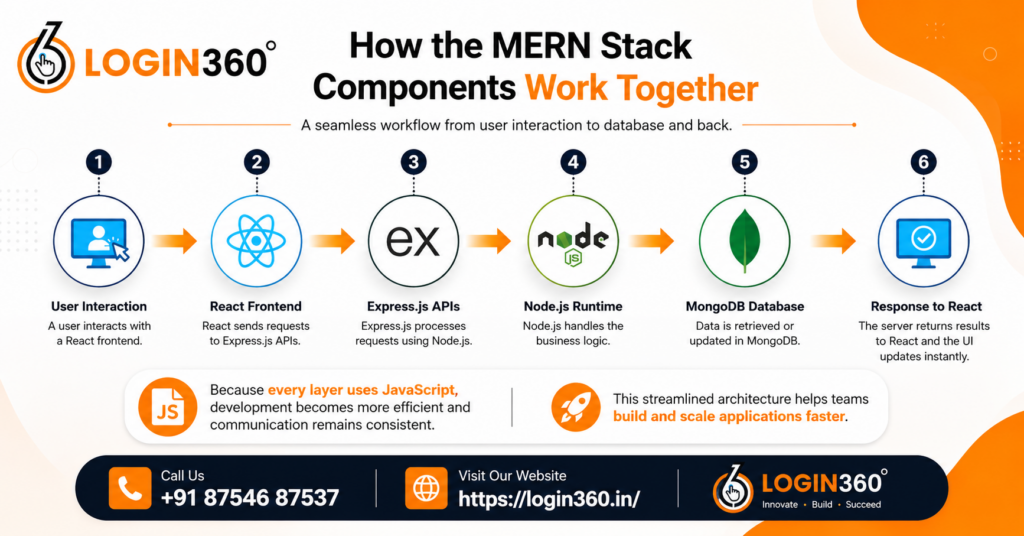
How the MERN Stack Components Work Together
The strength of the MERN stack comes from how seamlessly its components interact.
A typical workflow looks like this:
- A user interacts with a React frontend.
- React sends requests to Express.js APIs.
- Express.js processes requests using Node.js.
- Data is retrieved or updated in MongoDB.
- The server returns results to React.
- React updates the user interface.
Because every layer uses JavaScript, development becomes more efficient and communication between components remains consistent.
This streamlined architecture helps teams build and scale applications faster.
How the MERN Stack Supports Scalability
Scalability involves much more than handling additional users. It requires systems that remain reliable, responsive, and maintainable as demand increases.
The MERN stack provides several advantages in this area.
Client-Side Scalability
React enables scalable frontend development through its component-based architecture.
Benefits Include
- Reusable components
- Easier maintenance
- Faster UI updates
- Better application organization
As applications grow, developers can add features without rebuilding the entire frontend.
Large-scale applications often contain hundreds of components that work independently while sharing data efficiently.
Server-Side Scalability
Node.js and Express.js work together to support scalable backend infrastructure.
Advantages
- Efficient handling of concurrent users
- Reduced server overhead
- Fast API response times
- Easy horizontal scaling
Instead of creating separate threads for every request, Node.js uses an event-driven approach that can manage thousands of connections efficiently.
This makes it ideal for high-traffic web applications.
Database Scalability
MongoDB offers significant scalability benefits compared to many traditional database systems.
Features That Support Growth
- Distributed architecture
- Sharding
- Replication
- Flexible document structure
As data volumes increase, organizations can distribute data across multiple servers without major architectural changes.
This enables applications to continue performing well even with millions of records.
Performance Optimization
Performance directly affects scalability.
The MERN stack supports high-performance applications through:
- Efficient frontend rendering with React
- Fast backend processing with Node.js
- Optimized API handling with Express.js
- Flexible data retrieval with MongoDB
When these technologies are combined effectively, applications can maintain responsiveness under increasing workloads.
Best Practices for Building Scalable Applications with the MERN Stack
Building scalable applications requires more than simply choosing the right technologies.
Developers should follow proven architectural and development practices.
Organize Code Effectively
A structured codebase becomes increasingly important as applications grow.
Recommended Practices
- Separate frontend and backend concerns
- Use modular architecture
- Create reusable components
- Maintain consistent naming conventions
- Follow coding standards
Well-organized code improves maintainability and makes scaling easier over time.
Design Scalable APIs
APIs often become the backbone of growing applications.
Best Practices
- Use RESTful API principles
- Implement versioning
- Validate incoming requests
- Handle errors consistently
- Document endpoints clearly
A scalable API design reduces future development challenges.
Implement Microservices When Necessary
As applications become more complex, a monolithic architecture may become difficult to manage.
Microservices allow teams to separate functionality into independent services.
Examples include:
- Authentication service
- Payment service
- Notification service
- Analytics service
Benefits include:
- Independent deployment
- Better fault isolation
- Improved scalability
- Faster development cycles
While microservices aren’t necessary for every project, they can significantly improve scalability for large applications.
Optimize Database Performance
Database efficiency has a direct impact on scalability.
Useful Optimization Techniques
- Create proper indexes
- Avoid unnecessary queries
- Use pagination
- Optimize aggregation pipelines
- Monitor database performance
Regular optimization helps maintain fast response times as data grows.
Implement Caching
Caching reduces the workload on servers and databases.
Popular caching strategies include:
- API response caching
- Database query caching
- Content caching
- Session caching
Benefits include:
- Faster page loads
- Reduced server load
- Improved user experience
Caching is often one of the most effective scalability improvements available.
Use Cloud Infrastructure
Modern cloud platforms simplify application scaling.
Common options include:
- AWS
- Microsoft Azure
- Google Cloud
Cloud deployment enables:
- Auto-scaling
- Load balancing
- High availability
- Global content delivery
These services help applications handle traffic spikes without manual intervention.
Monitor and Maintain Performance
Scalability is an ongoing process.
Developers should regularly monitor:
- Server response times
- API performance
- Database health
- User activity
- Error rates
Continuous monitoring helps identify bottlenecks before they affect users.
Real-World Use Cases Where the MERN Stack Excels
The MERN stack is used across many industries because of its flexibility and scalability.
E-Commerce Platforms
Online stores often experience traffic fluctuations during promotions and seasonal sales.
The MERN stack supports:
- Product catalogs
- User accounts
- Shopping carts
- Payment integrations
- Order management
Its scalability allows businesses to handle growth without major architectural changes.
Social Media Applications
Social platforms generate enormous amounts of user-generated content.
The MERN stack is well suited for:
- User profiles
- Real-time interactions
- Messaging systems
- Content feeds
- Notifications
Node.js and MongoDB help manage high volumes of concurrent activity efficiently.
SaaS Platforms
Software-as-a-Service products frequently need to support thousands of users across multiple organizations.
The MERN stack enables:
- Multi-tenant architectures
- Subscription management
- User authentication
- Analytics dashboards
Its modular structure makes it easier to expand functionality over time.
Collaboration Tools
Project management and collaboration applications require responsive interfaces and real-time updates.
Examples include:
- Team communication platforms
- Task management systems
- Document collaboration tools
- Workflow automation software
React and Node.js provide the performance needed for seamless user experiences.
Tips for Getting Started with Scalable MERN Stack Development
If you’re new to the MERN ecosystem, focus on building a strong foundation before tackling large-scale projects.
Start with Small Projects
Build applications such as:
- To-do lists
- Blogging platforms
- Expense trackers
- Portfolio websites
These projects help you understand how the components interact.
Learn API Development
A strong understanding of APIs is essential for scalable applications.
Practice:
- CRUD operations
- Authentication
- Authorization
- Error handling
Master React Fundamentals
Focus on:
- Components
- Hooks
- State management
- Routing
- Performance optimization
A scalable frontend begins with solid React knowledge.
Understand Database Design
Learn:
- Data modeling
- Indexing
- Relationships
- Query optimization
Efficient database design supports future growth.
Explore Deployment Tools
Become familiar with:
- Docker
- CI/CD pipelines
- Cloud platforms
- Monitoring solutions
Deployment knowledge is crucial for production-ready scalability.
Learning Resources for the MERN Stack
To continue improving your skills, consider exploring:
- Official MongoDB documentation
- Official React documentation
- Express.js documentation
- Node.js documentation
- Full-stack development courses
- Open-source MERN projects
- GitHub repositories
- Technical blogs and tutorials
Consistent practice and real-world project experience remain the most effective ways to master the MERN stack.
Conclusion
The demand for scalable web applications continues to rise, and the MERN stack has become one of the most trusted solutions for modern development. By combining MongoDB, Express.js, React, and Node.js, developers gain access to a powerful ecosystem capable of supporting applications from startup MVPs to enterprise-scale platforms.
The MERN stack offers significant advantages through its unified JavaScript environment, flexible database architecture, efficient frontend rendering, and high-performance server capabilities. When paired with best practices such as modular code organization, optimized APIs, database tuning, caching, cloud deployment, and performance monitoring, it provides a strong foundation for long-term growth.
Whether you’re a beginner exploring full-stack development or an experienced developer designing high-traffic applications, the MERN stack delivers the tools and flexibility needed to build scalable, maintainable, and future-ready web applications.