
Table of Contents
Introduction
Are you planning to become a data scientist and build a successful career in the technology industry? The rapid advancement of digital technology has created a huge volume of data, and companies now need skilled professionals who can turn this data into meaningful insights. As a result, data science has become one of the most promising career options for students, recent graduates, and technology professionals. A data scientist analyses large amounts of data to identify trends, answer business questions, develop predictive models, and support better decision-making. However, simply learning Python or completing an online course is not enough to enter this field. To become a data scientist, you need a combination of programming knowledge, statistical understanding, analytical thinking, machine learning skills, practical experience, and communication abilities. In this article, we will explore 10 essential steps to become a data scientist, including the technical skills you should learn, certifications you can consider, projects you should build, and career opportunities available in this growing field.
Understand the Basics of Data Science
Before learning advanced technologies, it is important to understand what data science actually involves. Data science combines data analysis, statistics, programming, and machine learning techniques to solve real-world problems and generate valuable insights. A data scientist performs different tasks, such as forecasting customer behaviour, identifying business trends, detecting unusual transactions, predicting sales, and developing recommendation systems. Understanding the fundamentals of data science helps beginners identify the skills they need and choose the right learning path. If you want to become a data scientist, start by understanding how data is collected, processed, analysed, and used to make decisions.
Learn Python for Data Science
Python is one of the first programming languages you should learn when planning to become a data scientist. Python is widely used in data science because it offers many libraries and frameworks for data analysis, visualization, machine learning, and artificial intelligence. Start by learning the following Python concepts:
- Python syntax
- Variables and data types
- Operators
- Conditional statements
- Loops
- Functions
- Lists and dictionaries
- File handling
- Object-oriented programming
After understanding the basics, move on to important Python libraries such as NumPy, Pandas, Matplotlib, Seaborn, and Scikit-learn. The objective is not simply to memorize Python commands but to understand how to use Python to manipulate, analyse, and interpret datasets.
Build a Strong Foundation in Statistics
- Mean, median, and mode
- Variance and standard deviation
- Probability
- Data distributions
- Correlation
- Regression
- Sampling
- Hypothesis testing
- Confidence intervals
As you progress, you can also learn the fundamentals of linear algebra and calculus, especially when exploring advanced machine learning and deep learning techniques. You do not need to master advanced mathematics immediately. Start with basic statistical concepts and gradually improve your knowledge by practising with real-world datasets.
Learn SQL and Database Management
- Retrieve data from databases
- Filter records
- Sort information
- Group data
- Calculate aggregate values
- Join multiple tables
- Write subqueries
- Use Common Table Expressions (CTEs)
- Work with window functions
You should also understand database fundamentals, including tables, relationships, primary keys, foreign keys, and database structures. Learning SQL alongside Python provides a strong foundation for working with business data and solving practical data science problems.
Master Data Preparation
Before analysing a dataset or developing a machine learning model, you must ensure that the data is accurate, clean, and properly organized. Real-world datasets often contain:
- Missing values
- Duplicate records
- Incorrect data types
- Outliers
- Inconsistent values
- Irrelevant columns
Data preparation involves cleaning and transforming raw data into a suitable format for analysis. Practise handling missing values, removing duplicates, transforming variables, identifying outliers, and combining multiple datasets. Data preparation is sometimes overlooked by beginners, but it is one of the most important steps in practical data science.
Learn Exploratory Data Analysis and Data Visualization
Once the data is cleaned and prepared, the next step is to understand what the dataset reveals. Exploratory Data Analysis (EDA) helps identify relationships, patterns, trends, and unusual values within a dataset. Data visualization makes this process easier by presenting information through charts and graphs. Learn how to create:
- Bar charts
- Line charts
- Histograms
- Scatter plots
- Box plots
- Correlation matrices
- Interactive dashboards
You can use tools such as Matplotlib, Seaborn, Power BI, and Tableau to analyse and present data effectively. A skilled data scientist should not only analyse information but also communicate findings in a simple and understandable way, including to people without a technical background.
Understand Machine Learning Step by Step
Machine learning is an important part of data science. It enables computers to identify patterns in datasets and make predictions or classifications based on available information. Start by understanding the difference between supervised and unsupervised learning.
Supervised Learning
- Linear Regression
- Logistic Regression
- Decision Trees
- Random Forest
- Gradient Boosting
Unsupervised Learning - Important algorithms include:
- K-Means Clustering
- Hierarchical Clustering
- Principal Component Analysis (PCA)
You should also learn important machine learning concepts such as feature engineering, train-test splitting, model evaluation, cross-validation, overfitting, underfitting, and hyperparameter tuning. Understanding why and when to choose a particular algorithm is more important than simply running machine learning models.
Explore Artificial Intelligence and Advanced Technologies
After developing a strong foundation in data science and machine learning, you can move towards advanced technologies. Some important areas to explore include:
- Deep Learning
- Neural Networks
- Natural Language Processing (NLP)
- Computer Vision
- Generative AI
- Large Language Models (LLMs)
These technologies are creating opportunities across different industries, including finance, healthcare, e-commerce, manufacturing, and information technology. If you want to become a data scientist with advanced technical expertise, developing knowledge of artificial intelligence can help you explore more specialized career opportunities. However, remember that advanced AI technologies should be learned after building a strong foundation in Python, statistics, SQL, and machine learning.
Build Practical Projects and a Professional Portfolio
Practical experience is essential when preparing for a career in data science. Instead of only watching tutorials or completing online courses, work on projects that solve real-world business problems. Some beginner-friendly data science project ideas include:
- Customer Churn Prediction
- Sales Forecasting
- Fraud Detection
- Product Recommendation Systems
- Customer Segmentation
- Sentiment Analysis
- House Price Prediction
- E-commerce Customer Analysis
While developing a project, document every stage of the process:
Problem → Data Collection → Data Cleaning → Analysis → Model Development → Evaluation → Conclusion
Upload your completed projects to GitHub to create a professional portfolio.A well-organized portfolio allows recruiters and employers to understand your practical knowledge, problem-solving abilities, and technical skills.
Choose Relevant Certifications and Plan Your Career
Certifications can help demonstrate your knowledge of specific technologies and platforms. However, they should complement your practical skills rather than replace hands-on experience. Depending on your interests and career goals, you can explore certifications related to:
- Data Science
- Data Analytics
- Machine Learning
- Artificial Intelligence
- Cloud Technologies
- Business Intelligence
Career Opportunities in Data Science - Data Science Intern
- Junior Data Scientist
- Data Analyst
- Business Analyst
- Machine Learning Intern
- Business Intelligence Analyst
With experience and advanced technical knowledge, you can progress into roles such as: - Data Scientist
- Senior Data Scientist
- Machine Learning Engineer
- AI Engineer
- Data Science Lead
Essential Skills for a Data Scientist
Technical Skills
- Python
- SQL
- Statistics
- Machine Learning
- Data Analysis
- Data Visualization
- Git
- Artificial Intelligence
- Cloud Fundamentals
Professional Skills - Problem-solving
- Communication
- Critical Thinking
- Business Understanding
- Presentation Skills
- Curiosity
- Continuous Learning
A Practical Data Science Career Roadmap
For beginners, following a structured learning roadmap makes it easier to develop the required knowledge and practical skills.
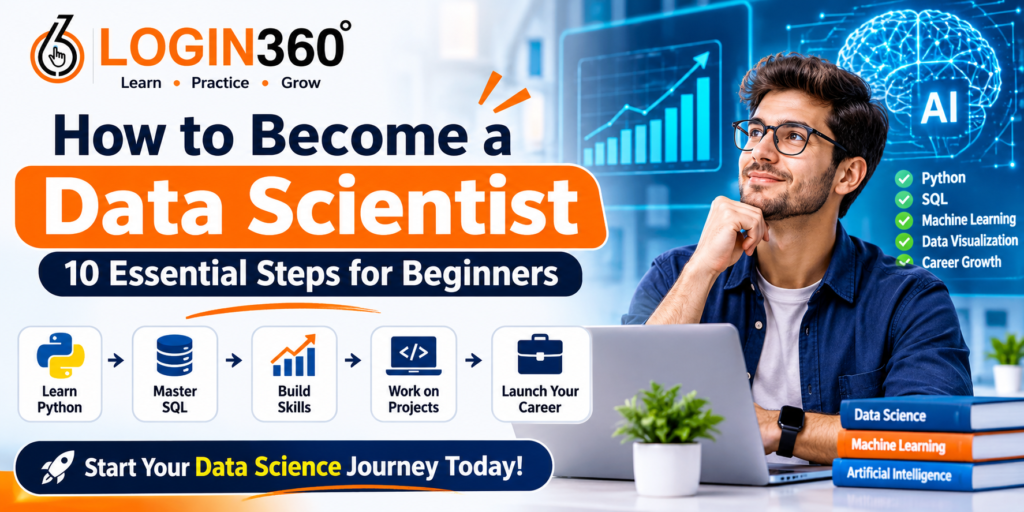
Python → SQL → Statistics → Data Analysis → Data Visualization → Machine Learning → Projects → Portfolio → Internship → Job
Once you understand these fundamentals, you can explore specialized areas such as deep learning, artificial intelligence, natural language processing, computer vision, and business analytics. Your learning journey may vary depending on your educational background, interests, and career objectives. Consistent practice and real-world project experience will help you move towards your goal.
Conclusion
Learning how to become a data scientist requires a combination of technical knowledge, analytical thinking, and hands-on experience. Start by developing a strong foundation in Python, SQL, statistics, data analysis, and data visualization. Once you understand these essential concepts, gradually move towards machine learning and advanced AI technologies. Building real-world projects, maintaining a professional portfolio, and choosing relevant certifications can further strengthen your career opportunities. Most importantly, focus on applying your knowledge rather than simply completing courses or watching tutorials. With consistent practice, practical project experience, and a clear learning roadmap, you can develop the skills needed to become a data scientist and build a rewarding career in the technology industry. Start your data science journey with Login360!