

Introduction
This specialized role, once considered exclusive to advanced degree holders, has become significantly more accessible due to the rapid expansion of cloud adoption and skill-based hiring trends. In India alone, demand for cloud professionals is projected to reach nearly 2 million roles by 2025, creating opportunities far beyond traditional degree pathways . Machine Learning Engineer At the same time, companies are increasingly prioritizing practical skills in platforms like AWS, Azure, and DevOps tools over formal education, opening doors for self-taught learners and certification holders . The rise of free and low-cost online training programs, including initiatives by major tech companies, has further democratized access to these careers, enabling beginners to gain industry-ready skills without expensive degrees . With over 90% of organizations reporting cloud skill shortages and cloud computing jobs growing at over 25% annually, the industry is actively encouraging newcomers, making it one of the most accessible high-paying tech careers today .
Decoding the Machine Learning Engineer Role
A machine learning engineer is much more than just a model builder. This pivotal role bridges the gap between theoretical data science and practical software engineering, focusing on designing, building, deploying, and maintaining scalable machine learning systems in production environments.
For example, imagine an e-commerce platform where a recommendation model is already trained and performing well in testing. A machine learning engineer’s daily work goes beyond simply improving the model’s accuracy they ensure the system can handle thousands of users in real time, integrate the model into backend services, monitor its performance after deployment, and quickly fix issues like slow response times or unexpected data changes. Machine Learning Engineer They might spend their day optimizing APIs, setting up automated pipelines, or debugging why a perfectly trained model is suddenly giving poor recommendations due to shifts in live user data clearly showing how their role connects data science insights with real-world software reliability.
The Foundational Pillars: Math, Statistics, and Programming
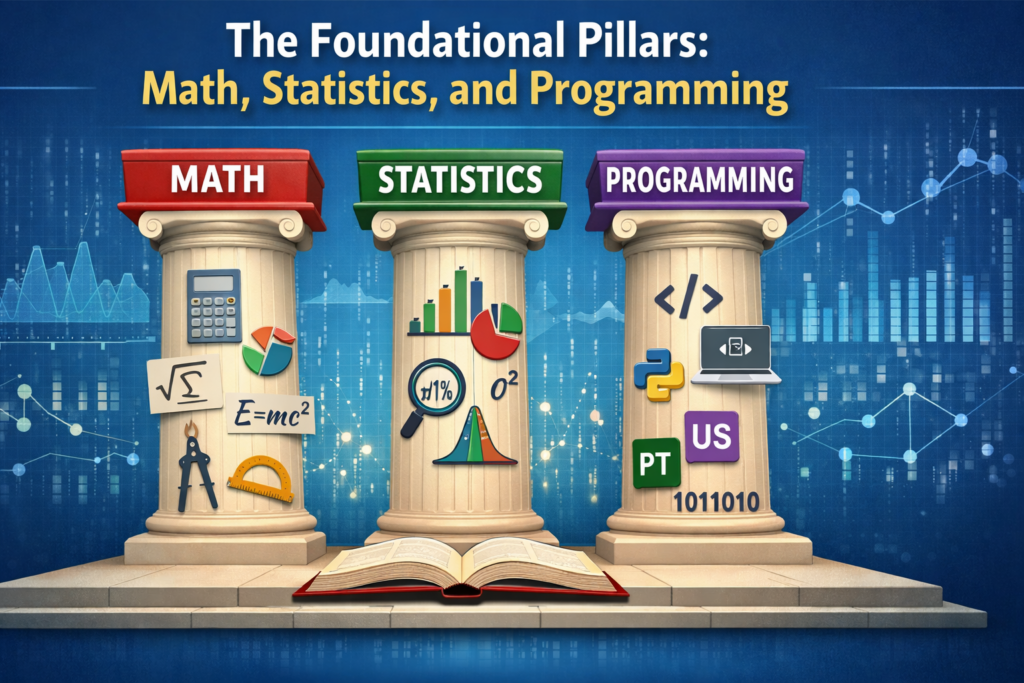
Embarking on this journey requires a solid grounding in several fundamental areas:Mathematics for Machine Learning While you don’t need to be a theoretical mathematician, a functional understanding of key concepts is vital. Linear algebra, with its vectors, matrices, and transformations, forms the backbone of many algorithms, from neural networks to principal component analysis. Calculus, particularly derivatives and gradients, is essential for grasping how models learn through optimization algorithms like gradient descent. A grasp of these mathematical principles allows you to understand why algorithms work, rather than just how to use them.
Statistics and Probability
These are the languages of data. Understanding probability distributions, hypothesis testing, regression analysis, and various statistical measures is critical for data exploration, preprocessing, and interpreting model results. Concepts like variance, bias, p-values, and confidence intervals are not just academic; they directly inform data quality assessment and model evaluation, helping you make informed decisions about this Machine Learning Engineer
Programming Fundamentals (Python is King)
Python has become the default language of machine learning not just by popularity, but because it offers a powerful combination of simplicity and capability. Its clean, readable syntax allows developers to prototype ideas quickly, while its massive ecosystem of specialized libraries like NumPy, Pandas, TensorFlow, and PyTorch makes complex data processing and model building far more efficient. On top of that, strong community support ensures constant updates, learning resources, and problem-solving discussions. However, experienced ML engineers don’t just rely on Python blindly, they also understand its limitations. A common pitfall they actively avoid is writing inefficient loops instead of leveraging optimized, vectorized operations provided by libraries like NumPy, which can drastically improve performance. This balance of ease, power, and best practices is what truly makes Python the backbone of modern machine learning.
Diving Deep into Machine Learning Concepts
The sections on supervised and unsupervised learning go beyond simple definitions and algorithm lists by emphasizing how machine learning engineers actually apply these approaches in real-world scenarios. In supervised learning, engineers must carefully evaluate factors such as the availability and quality of labeled data, the nature of the problem (classification vs. regression), and performance requirements before selecting algorithms like decision trees, support vector machines, or neural networks. They often face challenges such as overfitting, data imbalance, and feature selection, requiring iterative experimentation, model validation, and hyperparameter tuning. In contrast, unsupervised learning focuses on extracting hidden patterns from unlabeled data, where engineers must decide between clustering, dimensionality reduction, or anomaly detection techniques based on the business objective. Choosing algorithms like K means, hierarchical clustering, or principal component analysis depends on data distribution, scalability needs, and interpretability. Across both paradigms, deployment considerations such as model scalability, inference speed, monitoring, and continuous retraining play a critical role. Ultimately, the focus shifts from merely understanding what these methods are to how engineers make informed, practical decisions to solve complex, real-world problems effectively.
Reinforcement Learning (Introduction)
While often more advanced, a basic understanding of reinforcement learning, where agents learn through trial and error by interacting with an environment, is beneficial for a well-rounded machine learning engineer.
Model Evaluation and Validation
Understanding how to effectively evaluate your models is paramount. This involves metrics like accuracy, precision, recall, F1-score, AUC-ROC for classification, and Mean Squared Error (MSE), Root Mean Squared Error (RMSE) for regression. Techniques like cross-validation are crucial for assessing a model’s generalization performance and detecting issues like overfitting or underfitting.Machine Learning Engineer
Essential Tools and Technologies
Beyond core concepts, practical machine learning engineers utilize a suite of powerful tools:
- Python Libraries:Machine Learning Engineer
- NumPy: For numerical operations and array manipulation.
- Pandas: For data manipulation and analysis, handling tabular data efficiently.
- Matplotlib & Seaborn: For data visualization, creating insightful plots and graphs.
- Scikit-learn: A comprehensive library for classic machine learning algorithms, preprocessing, and model selection.
- Deep Learning Frameworks: For more complex tasks involving neural networks, familiarity with TensorFlow or PyTorch is crucial.
- Cloud Platforms: Understanding how to deploy and scale ML models on platforms like AWS, Google Cloud Platform (GCP), or Microsoft Azure is increasingly important for production-ready systems.
- Version Control: Git is essential for collaborating on code and managing project history.
Building a Portfolio: Hands-on Experience is Key
Theoretical knowledge alone isn’t enough to become a machine learning engineer you need hands-on experience that proves your skills in real scenarios. Start with small but meaningful projects, such as predicting traffic patterns in Chennai, analyzing local retail sales trends, or building a simple model for weather-based crop predictions relevant to nearby agricultural regions. These kinds of projects show practical thinking and local relevance, which many candidates overlook.
To stand out on platforms like Kaggle, don’t just submit models—focus on storytelling. Write clear notebooks, explain your approach, visualize insights, and learn from top-ranking solutions. Consistency matters more than winning; even a few well-documented competitions can make a strong impression.
login 360: Your Affordable Gateway to ML Engineering in Chennai
Our curriculum is carefully designed to go beyond theory, combining real-time project-based learning with proven industry practices such as Agile development, CI/CD pipelines, version control using Git, and cloud deployment workflows. Students gain hands-on experience with in-demand tools like AWS, Docker, Kubernetes, Jenkins, Figma, and advanced analytics platforms, ensuring they are job-ready from day one. Machine Learning Engineer What makes our approach different is our structured learning path from fundamentals to live client projects along with weekly assessments, mock interviews, and portfolio building. We are committed to making quality education accessible, offering programs starting from ₹14,999 along with flexible EMI options and merit-based scholarships up to 50%. Our instructors are seasoned professionals with 8+ years of industry experience, having worked with leading tech companies, and they provide one-on-one mentorship, career guidance, and personalized feedback. Many of our students have successfully transitioned into high-paying roles, with some securing placements within 3 to 6 months of completion, making this program a practical and result-driven choice for aspiring professionals.
Conclusion
The journey to becoming a machine learning engineer from scratch is challenging but incredibly rewarding. It demands dedication, continuous learning, and a passion for problem-solving. By building a strong foundation in mathematics, statistics, and programming, mastering core ML concepts, and gaining practical experience, you can carve out a successful career. With login 360 in Chennai, this ambitious path is not just a dream but an achievable reality, supported by affordable, high-quality training tailored for your success in the world of machine learning.