
INTRODUCTION
Businesses in today’s society gather huge volumes of data. This is taken from a range of sources including online shopping, social media and customer and financial data. People must then be able to analyse and analyse this information to make well-informed business decisions. Data analytics with AI is becoming a key area of analysis.With the help of Artificial Intelligence, data analysts can now effectively complete tasks which previously took much longer.Students wishing to pursue a career in data analytics should also consider which type of training will be most beneficial. Investigating the Best Data Analytics courses in Chennai can enable students to access relevant training that includes both theoretical and hands-on elements.
What Is Data Analytics with AI?
Using artificial intelligence, data analytics enables data to be gathered, analysed and interpreted. Typically, people will utilise data software such as spreadsheets, databases and data visualisation tools in order to assess data. Artificial intelligence can automate processes and further enable data analysts to detect previously unobvious trends.An online retailer can analyse data to determine what customers may be interested in purchasing. An AI can assess customer order, search and preference data to determine this.As well as supporting trend assessment, Artificial Intelligence can also facilitate predictive analysis. It can furthermore be used for report production and to recognise data anomalies.
Why Are Projects Involving AI Data Analytics Important?
Whilst theoretical knowledge is valuable, it can also be highly valuable to students to practically apply this in relation to data. Students can thus learn how to analyse data and solve issues. A range of skills can therefore be developed.
Benefits of data analytics projects include:
- Hands-on experience – Students can practically apply their knowledge to data.
- Problem solving – Students can assess and resolve issues in relation to data.
- Technical skills – Students can develop expertise in areas including Excel, Python and Power BI.
- Knowledge of artificial intelligence – Students can recognise how AI can be applied within data analytics to analyse and predict data.
- Portfolio construction – Students can showcase their skills via their project work.
- Career readiness – Students can effectively convey their knowledge in job interviews.
Beginner Level Data Analytics Projects
Whilst students are not expected to initially engage with highly sophisticated data and machine learning, there are many beginner-friendly data analytics projects which can effectively support students learning.
1. Student Analysis
Analysis of student data can be a highly beneficial first project. Students can assess what affects student academic achievement.Students can gather data concerning aspects such as student attendance, exam results and the amount of time spent studying and completing assignments. Excel, Python and/or Power BI can then be used to analyse this data to recognise trends.It may, for example, be found that students generally attain greater results if they have a good attendance rate. Additionally, AI can be used to recognise and analyse inter-relationships within data.Developed skills: Data analysis; Excel; Python; data visualisation; basic statistics.
2. Sales Analysis
Sales analysis is highly applicable as the sales function is fundamental to most businesses.Students can analyse sales data, which usually comprises of data concerning goods sold, along with associated quantities, prices and customer details. They can then assess which goods are most successfully sold and establish monthly turnover. Trends can also be recognised.Interactive data dashboards can be produced using software such as Power BI or Excel. Similarly, AI can identify data anomalies and analyse sales data to provide a summary of business performance.A retail business may recognise that particular goods are more commonly purchased at times of festival. Businesses can use this knowledge to inform stock and marketing strategy.Developed skills: Excel; SQL; Power BI; data visualisation; business analysis.
3. Customer Segmentation
Many businesses will have a diverse customer base in terms of interests, purchasing behaviour and expenditure.Customers can be segmented in relation to, for example, age range, purchasing frequency and total expenditure. Software such as Python libraries can be used to analyse and analyse data.Artificial intelligence and machine learning can also recognise similar customer behaviour, thereby enabling businesses to tailor marketing and enhance customer experience.Developed skills: Python; data analysis; customer analysis; basic machine learning.
4. Social Media Analysis
Social media provides insightful data regarding both audience and content engagement. Hence, this is a highly relevant data analytics project for those with an interest in marketing and business analytics.Students can assess data including audience reach, engagement (such as likes, comments and shares) and the frequency with which content is engaged with. Comparison of varying content can then be undertaken to recognise which content leads to greater audience engagement.AI can be used to analyse and summarise data relating to social media engagement. It can also recognise trends in engagement and advise where improvements could be implemented.Developed skills: Data gathering; Excel; dashboard creation; and engagement and reporting analysis.
5. Online Shopping Customer Analysis
Online retailers use data to analyse customer behaviour and so continually improve their provision. Within this project, students will analyse online shopping data to recognise customer behaviour.Students can analyse data such as types of goods, order value, geographical location and payment method. They can then recognise popular good sectors and average order value as well as which goods are most commonly purchased.AI analytical tools can analyse data to recognise behavioural trends. For example, an online retailer may recognise that particular goods are often purchased together.Developed skills: Python; SQL; Excel; customer analysis; and AI-assisted reporting.Intermediate Level and Advanced Level Data Analytics ProjectsFollowing the acquisition of fundamental data analytics skills, students can engage with more advanced projects.
6. Sales prediction using machine learning
Businesses can utilise historical data to make sales predictions. This is especially relevant to those operating within the retail, manufacturing and e-commerce sectors.Students can analyse historical sales data and recognise seasonal, product and consumer behaviour trends. They can then use Python and machine learning to develop a sales prediction model.Artificial intelligence can furthermore recognise key determinants of sales. Results can then be collated into interactive dashboards (for example using Power BI) so that business personnel can easily analyse sales predictions.Developed skills: Python; machine learning; predictive analysis; time series analysis; Power BI.
7. Customer Churn Analysis
Customer churn occurs when individuals cease to use a business’s goods/ services. It is key for businesses to recognise why customers churn so that they can continue to effectively maintain relationships.Students can analyse data relating to a customer’s subscription status, service utilisation, payments and complaints.Machine learning can be used to analyse data and recognise individuals who may be inclined to end their service utilisation. Artificial intelligence can also recognise typical determinants of customer dissatisfaction.For example, a telecommunications business may recognise that customers are more likely to end their subscriptions if they frequently encounter service disruption.Developed skills: Python; machine learning; classification; data preparation; predictive modelling.
8. Financial Fraud Analysis
Within the banking and financial sector, artificial intelligence is effectively utilised for financial fraud analysis. As a high volume of financial transactions occur daily, it can be challenging to manually analyse these in order to detect any fraudulent behaviour.Students can analyse financial transaction data which typically includes data regarding transaction value, date and location, alongside details of the associated customer.Machine learning can analyse data to recognise atypical transaction behaviour that may suggest fraudulent behaviour. Furthermore, students can investigate ‘anomaly detection’ – a technique that enables atypical behaviour to be recognised and distinguished from typical behaviour.Developed skills: Python; SQL; anomaly detection; machine learning; statistical analysis.
9. Healthcare Analysis
Healthcare related bodies gather extensive data in relation to patients, appointments and hospital functioning. Analysis of this data can therefore be effectively used to enhance planning and service delivery.Students can analyse anonymised health related data to assess aspects including patient attendance, appointment behaviour and hospital admission trends. Data can also be analysed to recognise statistical information relating to patient treatment.Artificial intelligence can analyse health related data to recognise trends and then summarise these. Hospitals for instance can analyse appointment data to recognise peak appointment times and hence optimise resources. It should also not be used in place of medical diagnosis.Developed skills: Python; data analysis; statistical analysis; AI-assisted analysis; data visualisation.
10. Staff Analysis
Businesses frequently assess staff performance in order to evaluate staff productivity and ascertain staffing needs.Students can analyse employee data including staff attendance, department, experience and performance.Interactive dashboards can be produced using Power BI to display staff performance by department and staff related trends. Again, AI can be used to summarise data and to recognise areas of concern.Such data can then be analysed by businesses to recognise staff related trends and to optimise planning.Developed skills: Excel; SQL; Power BI; data visualisation; business analysis.
Essential Artificial Intelligence Tools For Data Analytics Projects
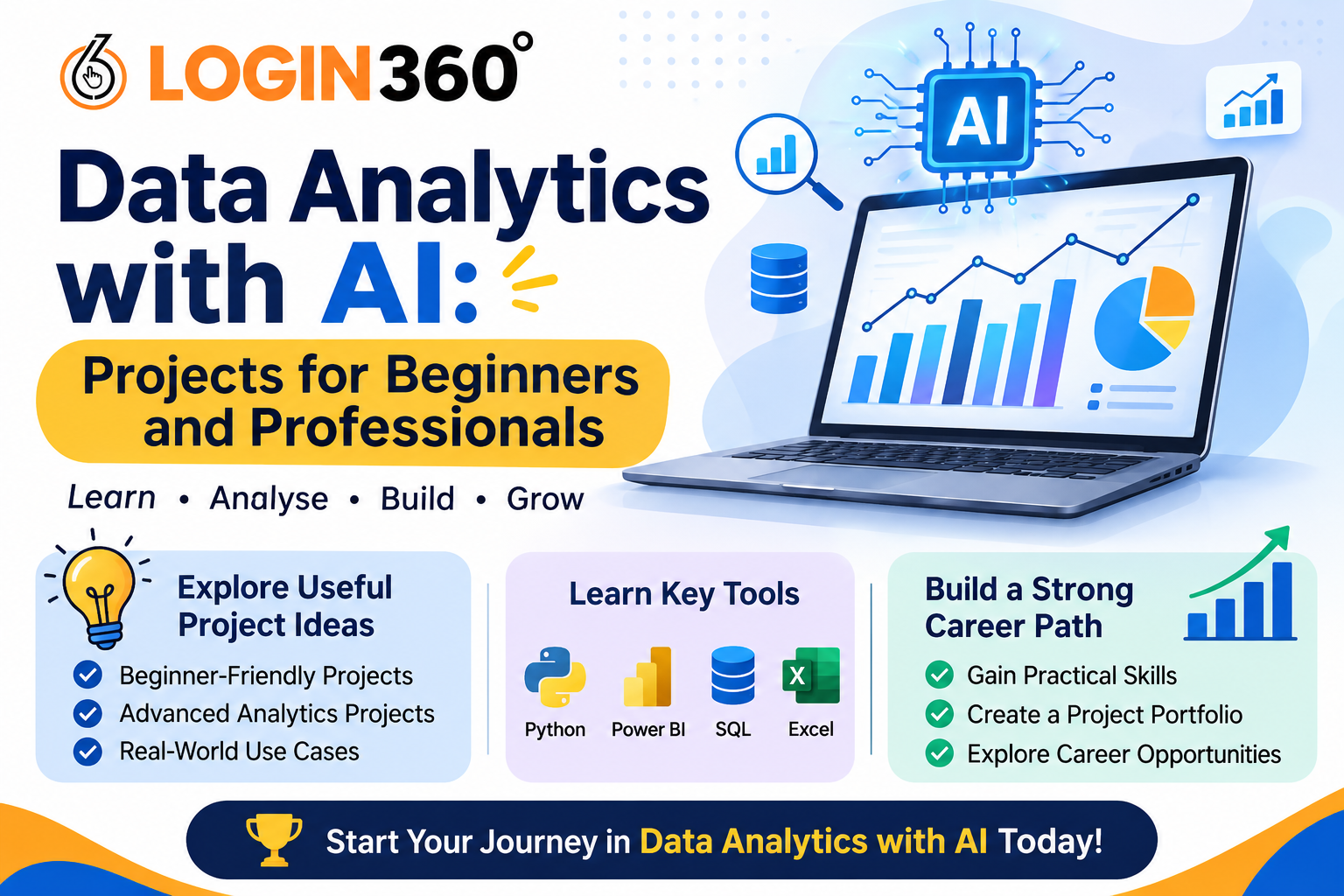
Selecting appropriate tools is key to undertaking successful data analytics projects. Students can initially utilise fundamental tools and then progress to engage with more advanced ones.
Below are some widely used data analytics and artificial intelligence tools:
| Tool | Function |
| Python | Data analysis, data analysis and machine learning. |
| Microsoft | Excel Data organisation and mathematical analysis. |
| SQL | Database data retrieval and management. |
| Power BI | Interactive dashboard and reporting production. |
| ChatGPT | Information explanation, coding and reporting summarisation. |
| Colab Online Python notebook use. | |
| Tableau | Interactive data visualisation. |
| Scikit | learn Machine learning modelling production. |
Different tools can be employed for varied stages of the data analytics process. Rather than seeking to expertly utilise all of these tools at once, students would typically wish to initially engage with Excel, SQL and Python and then move on to more advanced areas such as machine learning.
How To Develop A Good Data Analytics Project Portfolio
Students should endeavour to not only undertake data analytics projects for Freshers, but also to effectively convey the outcomes of these. Students should therefore seek to practically apply their knowledge and to then analyse and explain this.
To do this, students can:
- Identify a relevant issue – Ideally this will relate to a field including sales, education, healthcare, finance or customer behaviour.
- Access data – Students can obtain data from reliable open data sources, for example Kaggle.
- Clean data – Students can remove redundant data and address data gaps and formatting issues.
- Analyse data – Students can utilise Excel, SQL and/or Python to recognise significant data trends.
- Implement artificial intelligence – Students can use artificial intelligence and/or machine learning where appropriate.
- Visualise data – Students can produce data visualisations using Power BI, Tableau and/or Python.
- Explain data – Students can analyse and explain data and further discuss how this may be utilised within a business context.
Students can also investigate Data Analytics Training in Coimbatore. Where possible, students should seek out training that not only provides hands-on experience, but also has expert tuition and business relevant projects, as well as career related support.
Career Prospects Following Data Analytics with AI Study
Across a variety of sectors, there is an increasing requirement for skilled personnel who are able to analyse data and to utilise artificial intelligence. Students can use data analytics projects to effectively showcase their skills and so prepare for both entry level and more senior positions.
Potential careers include:
- Data Analyst – Analyses data so that business decisions can be supported.
- Business Analyst – Investigates business needs and recognises areas for enhancement.
- Data Analytics Consultant – Advises businesses on data understanding and optimal strategy production.
- Business Intelligence Analyst – Produces dashboards and reports to convey business performance.
- Machine Learning Analyst – Engages with predictive modelling and machine learning.
- Data Visualisation Specialist – Transforms data into comprehensible graphical and dashboard representations.
Initially, students can seek to develop skills in Excel, SQL, Python and Power BI. As students’ knowledge and experience develops, they can then investigate how to apply artificial intelligence and implement predictive modelling and further data analytics skills.
Conclusion
Data Analytics with AI is providing novel career prospects for students, new graduates and professionals. Undertaking data analytics projects is an excellent means by which students can recognise how data can be effectively used to address real life issues.Students should initially concentrate on gaining proficiency in Excel, SQL, Python and Power BI. Professionals can further enhance their knowledge by investigating machine learning and predictive analytics and by engaging in business related data analytics projects.Students should also investigate suitable Data Analytics Training. When searching for the best data analytics course in Kochi, they should endeavour to access training that can provide hands-on experience, expert tuition and relevant business projects, as well as career support.