
Table of Contents
Introduction
The technology industry is constantly evolving, creating new career opportunities for students, fresh graduates, and working professionals. Software development has become an essential part of almost every business, from startups to large organizations. Among the popular technology careers, Full Stack Development and Product Engineering are gaining significant attention.
Although both roles involve building software applications, their responsibilities, skills, and approaches to development are different. Understanding full stack developer vs product engineer can help aspiring developers choose the right career path based on their interests, technical knowledge, and professional goals.
In this blog, we will explore the major differences between these two roles, including their responsibilities, technical skills, career opportunities, and future scope.
What Is a Full Stack Developer?
A Full Stack Developer is a software professional who works on both the front-end and back-end components of an application. They have knowledge of different programming languages, frameworks, databases, and development tools required to build functional websites and web applications.The front end is the part of an application that users interact with, while the back end handles server-side operations, application logic, and database management.
Key Responsibilities of a Full Stack Developer:
- Designing and developing user-friendly website interfaces.
- Building server-side applications and APIs.
- Managing databases and handling data efficiently.
- Integrating front-end and back-end components.
- Testing and debugging applications.
- Maintaining application performance and security.
- Collaborating with designers, developers, and project teams.
Technical Skills Required:
- HTML, CSS, and JavaScript.
- React, Angular, or Vue.js.
- Python, Java, Node.js, or PHP.
- MySQL, MongoDB, or PostgreSQL.
- Git and GitHub.
- REST APIs and cloud fundamentals.
What Is a Product Engineer?
A Product Engineer is a technology professional who focuses on designing, developing, testing, and improving software products based on customer requirements and business needs.Unlike developers who may concentrate mainly on implementing specific technical requirements, Product Engineers consider the complete product experience. They work closely with product managers, designers, developers, and stakeholders to create solutions that provide real value to users.
Key Responsibilities of a Product Engineer:
- Understanding customer needs and product requirements.
- Designing and developing product features.
- Building scalable and reliable software solutions.
- Collaborating with cross-functional teams.
- Testing and improving product functionality.
- Identifying technical problems and implementing solutions.
- Monitoring product performance and user feedback.
- Continuously improving the product experience.
Technical Skills Required:
- Programming languages such as Python, Java, or JavaScript.
- Front-end and back-end development.
- Database management.
- Software architecture and system design.
- API development and integration.
- Testing and debugging.
- Cloud computing and deployment.
- Problem-solving and analytical thinking.
Full Stack Developer vs Product Engineer: Key Differences
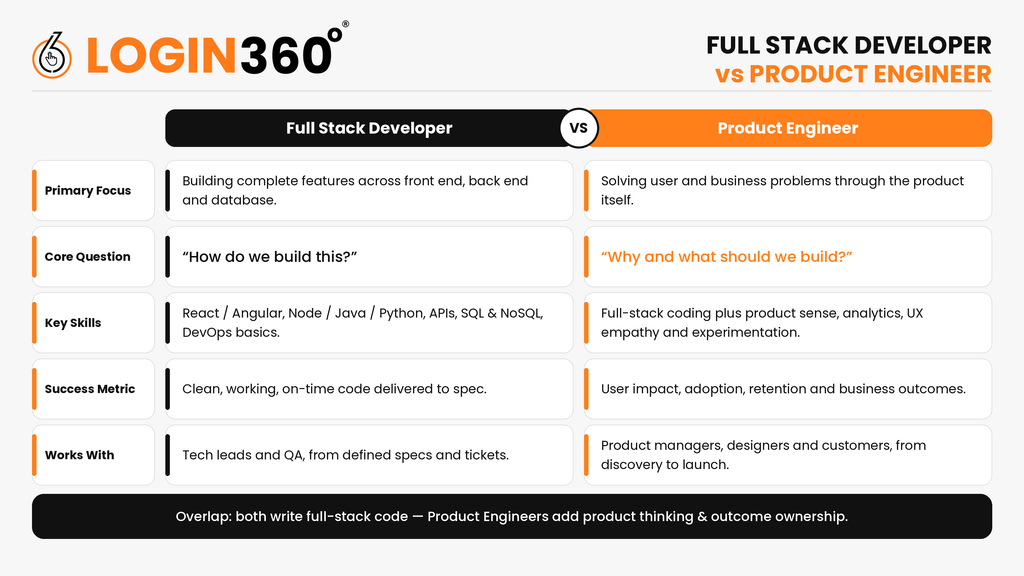
Understanding full stack developer vs product engineer becomes easier when we compare their responsibilities, skills, and development approaches.
| Comparison | Full Stack Developer | Product Engineer |
|---|---|---|
| Primary focus | Front-end and back-end development | Complete product development |
| Main responsibility | Building web applications | Building and improving software products |
| Technical knowledge | Front-end, back-end, databases | Software development, architecture, product systems |
| User involvement | Implements user interface requirements | Considers user needs and product experience |
| Business understanding | May be limited to project requirements | Strong focus on business and user objectives |
| Collaboration | Developers, designers, testers | Product managers, designers, developers, stakeholders |
| Goal | Develop functional applications | Deliver valuable and scalable products |
Skills Required: Full Stack Developer vs Product Engineer
Full Stack Developer Skills: A Full Stack Developer should understand different layers of application development. Knowledge of front-end frameworks, server-side programming, databases, and API integration is essential.Important skills include:
- Programming and coding.
- Responsive web design.
- Database management.
- Front-end and back-end development.
- Version control.
- Application testing and debugging.
Product Engineer Skills: A Product Engineer needs technical expertise along with an understanding of product requirements and customer expectations.Important skills include:
- Full stack programming knowledge.
- Product development and system design.
- Analytical and critical thinking.
- User-focused problem-solving.
- Software testing and optimization.
- Team collaboration and communication.
Therefore, the main difference in full stack developer vs product engineer is not simply programming knowledge. It is also how professionals use their technical skills to solve problems and create value.
Career Opportunities and Future Scope
Both careers offer promising opportunities in the technology industry. As businesses continue investing in digital transformation, the demand for skilled software professionals is growing.
Career Opportunities for Full Stack Developers
- Full Stack Developer.
- Front-End Developer.
- Back-End Developer.
- Web Application Developer.
- Software Developer.
- Technical Lead.
Career Opportunities for Product Engineers
- Product Engineer.
- Software Engineer.
- Product Development Engineer.
- Software Development Engineer.
- Technical Product Specialist.
- Senior Product Engineer.
Salary Expectations: Full Stack Developer vs Product Engineer
Salary is another important factor when choosing between these careers. Compensation depends on experience, technical expertise, company size, location, and project complexity.In India, entry-level Full Stack Developers may earn approximately ₹3–6 LPA, while experienced professionals can earn considerably more.Product Engineers may also receive competitive salaries depending on their technical expertise, product experience, and organizational responsibilities.These figures are indicative estimates rather than fixed salary ranges. Candidates with strong programming skills, practical project experience, and problem-solving abilities may have better career opportunities.Instead of choosing a career based only on salary, aspiring professionals should consider their interests, learning opportunities, and long-term career goals.
Which Career Should You Choose?
Choose Full Stack Development if:
- You enjoy building websites and web applications.
- You want to learn front-end and back-end technologies.
- You are interested in programming and database management.
- You enjoy developing complete applications.
- You want to build a strong foundation in software development.
Choose Product Engineering if:
- You enjoy solving real-world problems through technology.
- You are interested in developing complete software products.
- You want to understand customer needs and business requirements.
- You enjoy working with different teams.
- You are interested in product innovation and continuous improvement.
Why Learn Full Stack Product Engineering?
Modern companies are looking for professionals who can understand software development beyond basic coding. They need developers who can build applications, solve technical challenges, and contribute to product development.Learning Full Stack Product Engineering helps students develop practical knowledge of front-end development, back-end programming, databases, APIs, software architecture, and real-world application development.It also encourages problem-solving, teamwork, and project-based learning.For fresh graduates, gaining hands-on experience through practical projects can help build confidence and prepare them for different opportunities in the technology industry.
Conclusion
Understanding full stack developer vs product engineer is important for anyone planning a career in software development. While Full Stack Developers focus on building both front-end and back-end components, Product Engineers take a broader approach by combining software development with product thinking, customer requirements, and business objectives.Both careers offer excellent opportunities in the growing technology industry. The right choice depends on your interests, technical strengths, and long-term professional goals.
If you want to develop strong programming skills and gain practical industry knowledge, learning Full Stack Product Engineering can be a valuable step towards building a successful technology career.Start your technology journey with Login360!
Explore Login360’s Full Stack Product Engineering course to develop practical skills, work on real-world projects, and gain the technical knowledge needed to prepare for software development opportunities.
Frequently Asked Questions (FAQs)
1. What is the main difference between a Full Stack Developer and a Product Engineer?
A Full Stack Developer focuses on developing both front-end and back-end applications, whereas a Product Engineer focuses on building and improving complete software products based on user needs and business requirements.
2. Is Product Engineering better than Full Stack Development?
Neither career is universally better. Full Stack Development is suitable for people interested in application development, while Product Engineering is ideal for professionals who enjoy combining technical development with product-focused problem-solving.
3. Can a Full Stack Developer become a Product Engineer?
Yes. A Full Stack Developer can transition into Product Engineering by developing skills in product thinking, system design, customer requirements, software architecture, and problem-solving.
4. Which programming languages are required for Full Stack Development?
Popular programming languages and technologies include HTML, CSS, JavaScript, Python, Java, and frameworks such as React, Angular, and Node.js.
5. Is Product Engineering suitable for freshers?
Yes. Fresh graduates with programming knowledge, problem-solving abilities, and an interest in software development can start a career in Product Engineering. Practical projects and industry-oriented training can help them prepare.
6. What is the future scope of Full Stack Development and Product Engineering?
Both fields have promising career opportunities because businesses increasingly depend on web applications, software platforms, and digital products. Professionals with strong technical and practical skills can explore opportunities across different industries.