
Introduction:
Improve SEO and Search Engine Rankings Efficient SEO strategies have evolved a great deal in recent years—a shift explored in depth during any practical Digital marketing course in Chennai. Search engines now offer contextual, user-centered, and in-depth topic understanding via machine learning and natural language processing. . As such, websites which rely on basic tactics risk falling behind. By utilising intelligent SEO tools, sites can gain an advantage in Identify Under-Competed Long Tail Keywords rankings within this new landscape.
Improve SEO and Search Engine Rankings-Making and Rankings:
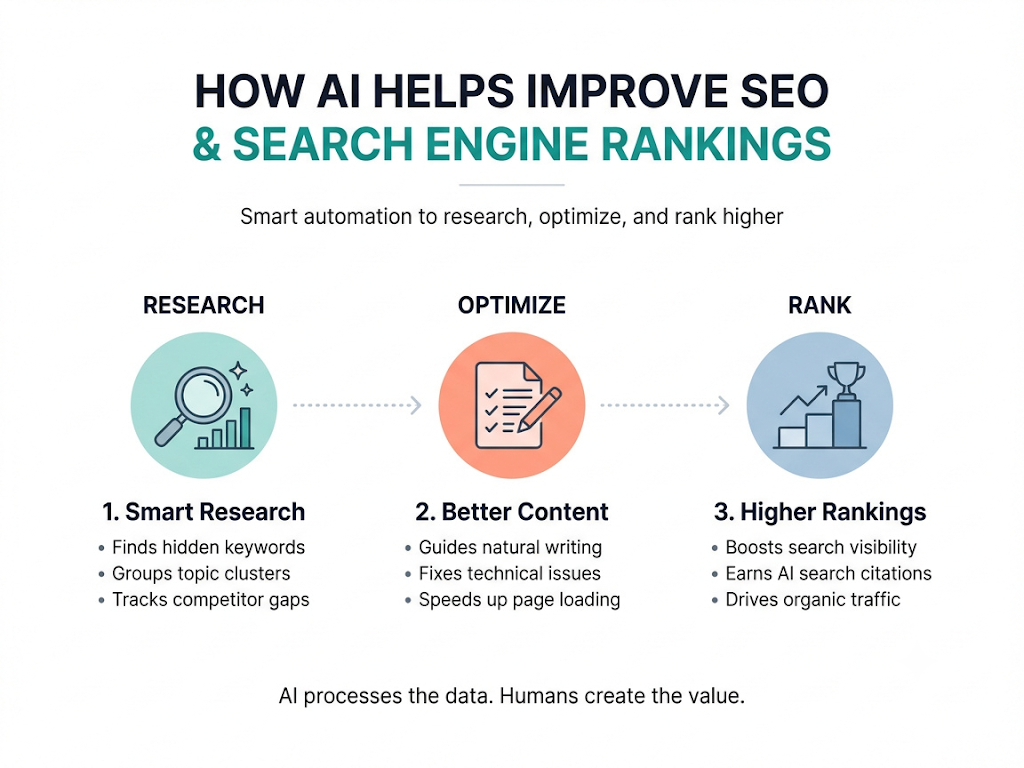
AI tools enable greater accuracy in SEO by analysing millions of data points from search results, user interaction and competitor content in order to make improvements to strategy. Whether improving content on blogs, resolving crawl issues, or analysing brand mention within AI summaries,Ai digital marketing with AI tools help marketers make informed decisions. Using AI allows sites to publish reliable content, increase domain authority, and consistently improve rankings.
Semantically Grouped Keywords:
Group keywords semantically. By grouping thousands of search terms together based on intent, relevant keywords for topics can be identified. Rather than simply focusing on popularity, intent and relevance can be identified.
Identify Searcher Intent:
Machine learning models allow for searcher intent within ranking pages for keywords to be identified. This helps ensure content is relevant to what users are searching for.
Natural language processing tools can be used to identify long Tail Keywords from forum discussions, suggestions and Q&As. Often these have high conversion potential, but may be overlooked by traditional keyword tools.
Predict Trends:
Predictive tools can be used to highlight keywords that are increasing in popularity. By using search and social platforms, SEO teams can publish content on rising trends weeks ahead of competitors.
Language Specific Keyword Optimisation
Modern AI tools are able to provide language specific keyword optimisations. This includes ensuring search volumes, difficulty levels and regional intent are all correct. Global SEO can be made more effective and efficient.
Avoid Keyword Cannibalisation:
Intelligent tools can compare current page content within the domain with targeted keywords, and alert users if multiple pages are competing with the same search intent. This prevents negative impacts to rankings.
On Page Content Improvements:
On-page content is now assessed in much greater detail—a core ranking factor taught in any practical Digital marketing course in Coimbatore. In addition to keywords, content relevance, the relationship of related terms, and readability are all carefully considered. . From this, AI tools analyse ranked pages for a keyword to decide the best way to improve content. This allows for suggestions to be made on headings, word count, sub topic content and entities to be included. This ensures key aspects of the topic are covered without overstuffingkeywords.In addition to improving keyword content, AI editing tools help to improve content readability on both desktop and mobile. Suggestions for ideal sentence length, paragraph length and format can be made.
Automating Technical SEO Audits and Site Health Optimization:
- Crawl Issues and Broken Links Identified-AI tools crawl the site continuously to identify issues. Redirect loops, broken links, orphan pages and server errors can be detected to prevent ranking issues.
- Meta Tags and Alt Text Added Automatically-Audit tools can be used to automatically add optimised meta tags and alternative text to content with missing elements. This means they can be applied without long development processes.
- Core Web Vitals & Page Speed Optimisation-AI tools can detect issues within pages. These could include excessive scripting, large images or layout shifts. The most impactful improvements for user experience are prioritised.
- Schema Markup-AI tools can analyse content to produce high quality schema markup in JSON-LD format. This includes content from articles, FAQs, product information and local business information. This improves the visibility of pages in search results.
- Crawl Budget Optimisation-By automating the analysis of millions of bot requests, it can be determined what areas of a site are wasting crawl budget. Technical teams can prioritise crawling of important pages to drive revenue.
- Faster Indexing-AI tools can be directly integrated with search engine APIs. New URLs can be submitted immediately, improving speeds of rankings.
Increasing Quality Content Briefs & Topic Authority:
Within search, topic authority is important to increase search rankings. To do this efficiently, AI can be used. Artificial intelligence and digital marketing Topic mapping tools can analyse content of current articles and compare to an industry. Subtopics required to increase topic authority can be identified. role of ai in digital marketing This provides strategic insight to move away from general blogging and produce structured content hubs. Pillar pages and supporting content work together to improve trust and visibility.Once topic gaps have been identified, quick content briefs can be created. This includes common questions, headings from competitors, required entities and structures. Authors and experts can quickly add insights, case studies and brand tone without wasting time on research.
Improving Visibility in AI Search:
Now, alongside appearing in search results, brands should also aim to be displayed in AI powered search results. Tools can be used to measure brand mentions in AI Overviews. The frequency of mentions of your site in Google AI Overviews, ChatGPT, Perplexity and other AI search tools can be measured.
Optimizing Content for AI Search Engines and Answer Visibility:
- Content Structured for Extraction-AI tools support content structuring to make extraction by AI models easier. Definitions, lists and comparisons can be organised to increase chances of extraction.
- Monitor Conversational Search-Modern analytics tools can be used to measure questions asked by users within AI assistants. Marketers can use this to create content with conversational styles.
- Check Accessibility for AI Crawler-Technical tools can be used to ensure that AI crawlers are not blocked from content. Checks can be made to CDN setup, robots.txt and firewalls within a domain to ensure AI crawlers can access all pages.
- Measure Share of Voice in AI-Dashboards can be used to compare brand mentions in AI searches with competitors. This can highlight what topics require improvement.
- Improve EE-A-T Signals-AI tools can be used to check author bios, referenced sources and original data. This increases credibility factors for AI systems to choose content from.
Predictive Analysis and Competitor Gaps:
A traditional SEO report can only inform teams of past performance—a reporting limitation covered in any modern Digital marketing course in Kochi. However, predictive analysis provides insight into future performance. Machine learning models can predict traffic, algorithm changes and click through trends. If a high value page begins to decrease in relevance, SEO teams will receive alerts. This means the team can quickly make changes to content, update data, or add links to stabilise rankings and prevent large drops in rankings.Current AI tools can give real time competitor intelligence. By comparing competitor domains, it can be determined what pages generate traffic, what new trends are becoming popular, and where content is lacking.
Link Building & Digital PR:
- Identify High Value Targets-AI tools can be used to scan thousands of websites and prioritise those with high relevance, traffic and authority. This allows for a list of high quality backlink targets to be created quickly.
- Identify Backlink Gaps-Backlink profiles of competitors can be compared quickly. This shows which high quality websites are linking to competitors, but not to your site. This can allow targeted outreach.
- Unlinked Mentions Identified-Mentions of your brand in content can be monitored in real time. If there is an unlinked mention within news articles, blogs or industry round-ups, this can be flagged. A backlink can be requested easily.
- Customised Bulk Outreach-AI writing tools can be used to write customised outreach emails by reading content from journalists/editors. To improve response rates, generic templates are avoided.
- Backlink Profile Monitored-Tools can continuously be used to monitor backlinks. If high value backlinks are lost, or spammy backlinks detected, the user is alerted. This ensures a clean, powerful backlink profile.
- Create Data Driven PR Assets-Surveys, trends and data sets can be converted into stats and infographics by AI tools. This can attract editors. This increases chances of citation.
conclusion:
To improve search rankings efficiently, AI tools are increasingly being used. By identifying semantically grouped keywords, improving semantic on page content, automating technical optimisations, and measuring visibility within AI searches, strong topic authority can be developed. In addition, changes in algorithms can be responded to quicker. Whilst AI tools can be extremely valuable in SEO, the best sites combine AI with human knowledge. By combining the efficiency and accuracy of AI with human creativity and high quality editorial standards, the best results can be achieved.