
INTRODUCTION
Data Analytics with AI we become more reliant on technology, data is increasing. Data can be captured from customers in online shops, social media, websites and online transactions. This data helps businesses understand customers and improve services.Intelligent systems allow companies to understand and predict within their businesses. AI is being applied in Data Analytics, meaning it can support predictions of customer behaviours and the creation of reports.Understanding these types of technologies can be very valuable for students, graduates and workers to get into Data Analytics.
What is AI in Data Analytics?
AI in Data Analytics refers to intelligent systems that collate, process, analyse and understand data. Within Data Analytics, AI can detect patterns, identify anomalies, make summaries, and provide predictions.Traditionally, in Data Analytics data is collated, prepared in spreadsheets, and interpreted. However, with multiple data sources, this process can be very time-consuming.If a drop in sales has occurred within an online shop business, an analyst may use AI assisted tools to investigate sales data, customer data, product demand, and information from the website. This analysis may find that customers are dropping off at certain points, or there has been a change in demand for a certain product.So overall, AI allows businesses to understand current information and consider possible future scenarios.
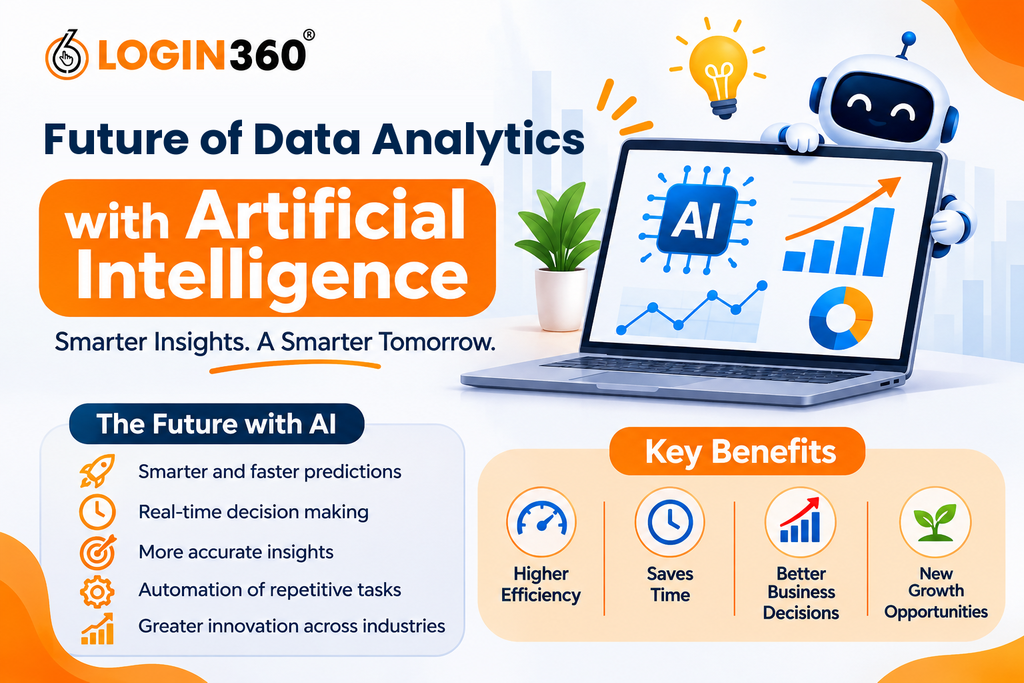
1.Faster Data Processing-When collating data from multiple sources, there may be duplicate data, missing values, inconsistent formatting, or incorrect data. This processing can be very time consuming.AI systems allow large amounts of data to be processed quickly. Patterns can be identified which may otherwise be difficult to spot. Marketing departments may use AI to understand which marketing campaigns are performing well. By analysing web traffic, customer engagement, and marketing, the best campaigns can be identified.
2.Better Business Predictions-Many businesses will often try to predict future sales, customer demand and changes in the market. By analysing past data, AI can be used to identify patterns and allow businesses to make predictions. For example, if a retail company is looking to know how much stock to order for next seasonal period, they may use AI to analyse how much was sold in previous festive periods.
3.Better decision making-Using AI with Data Analytics can provide managers with clearer information. However, results may need to be considered in context. As an unusual amount/prediction may have multiple explanations, it is extremely important that human knowledge is also applied in decision making.
4.Trends in Data Analytics-As technology develops, trends in Data Analytics are changing in the way information is captured and understood by businesses.AI in Business Intelligence-Business intelligence systems are developing. Rather than just providing graphs, modern systems allow users to consider trends, understand changes, and understand performance. Systems such as Power BI and Tableau allow complex data to be made easily understandable using interactive visualisations.
5.Predictive Analytics-This type of analytics uses historical data, statistical information, and machine learning to make predictions. Banking businesses may use predictive analytics to identify unusual transactions that may need further checking. Online retail businesses may use predictive analytics to understand the demand for products based on previous purchases.
6.Automated Reports-Many businesses produce daily/weekly/monthly reports. Using AI, it can be easy to collate data, identify changes, create visualisations, and highlight anomalies.Live Data Analytics-Some businesses want to understand data as it is collected. Within an online business, user visits, interaction and purchases can be monitored during the day.
7.Generative AI-Generative AI allows professionals to engage with data differently. With generative AI assistants, SQL queries can be created, code explained, reports summarised, and basic Python scripts suggested. As a result, generative AI can be very useful for learners. However, errors may occur within the answers.
Role of Machine Learning in Data Analytics
Machine Learning plays a key role in Data Analytics. Machine Learning is a type of AI, meaning computer systems can learn patterns from past data, and make predictions and classifications.
Typical uses of Machine Learning in Data Analytics:
- Customer Segmentation – Customers are divided by their interests, preferences and purchasing habits to allow relevant communication.
- Sales Forecasting – Past sales data can be used to predict future demand, allowing better stock planning.
- Fraud Detection – Allows financial businesses to identify unusual patterns in transactions, meaning they may want to investigate further.
By using machine learning in Data Analytics, businesses can go beyond analysing past performance. If data and models are appropriate to the situation, predictions of future events can be made.
Popular AI tools in Data Analytics
- Microsoft Excel-Excel can be used to manage data sets, perform calculations, create pivot tables, and create reports. It is a good tool to get started with Data Analytics.
- Power BI-Power BI allows professionals to bring together data sources and create interactive reports and dashboards. This provides clear visual representations of business performance.
- Python-Python can be used to clean data, automate processes, perform statistical analysis, and machine learning. Using libraries such as Pandas, NumPy and Scikit-learn common Data Analytics processes can be performed.
- ChatGPT-ChatGPT can be used to understand data, create SQL queries, clarify Python coding, and summarise results. It can be very useful when learning data analysis. However, care must be taken and outputs should be double checked. Confidential business and customer data should not be given to ChatGPT.
- Tableau-Tableau can be used to create charts, dashboards, and visual reports from complex data. It allows for interactive analysis and makes it easier for teams to communicate findings to people that do not regularly work with data.Learning these tools along with data analytic concepts will allow learners to gain practical data analytic knowledge.
Skills needed in Data Analytics for the future
With AI becoming more common, professionals should have a range of skills.
- Microsoft Excel – Be able to use formulae, functions, pivot tables, sorting, filtering, and data cleaning.
- SQL – Understand how to retrieve, filter, combine, and manage information from databases.
- Python – Understand basic coding and different libraries for data analysis.
- Power BI – Be able to manipulate data and create clear, interactive dashboards.
- Statistics – Understand means, percentages, probability, correlations, and basic statistical techniques.
Career Opportunities in Data Analytics with AI
With companies becoming more data driven, professionals are now needed to manage, create reports, identify patterns, and make decisions.
Roles available include:
- Data Analyst – Capture, clean and analyse data to find insights in business.
- Business Intelligence Analyst – Create dashboards and reports to allow teams to understand their performance.
- Data Scientist – Use coding, statistics, and machine learning to investigate complex questions.
- Machine Learning Engineer – Create and manage systems which can learn from data in order to make predictions.
Those just starting out can start with learning Microsoft Excel, SQL, Python and Power BI. Completing practical projects and a portfolio can help show employers what skills can be provided.
Challenges with AI in Data Analytics
- Confidentiality – Confidential information relating to customers and employees should be protected and proper data protection measures put in place.
- Inaccurate Predictions – AI can produce inaccurate results. Results should be tested and any conclusions drawn should be supported by evidence.
- Poor Data Quality – Incomplete, old or inconsistent data can affect analysis.
To effectively use AI in Data Analytics, balance should be made between automated processes, careful consideration, appropriate data handling and human knowledge.
How to get ready for future Data Analytics
Those beginning in Data Analytics do not need to learn all tools straight away.
- Start with Microsoft Excel.
- Learn SQL.
- Practice creating simple interactive dashboards in Power BI.
- Learn Python to manipulate and automate data.
- Learn basic AI and machine learning concepts.
Following a structured course with practical projects can help learners understand how Data Analytics tools are used in business. If you are looking at the Best Data Analytics courses in chennai, ensure that you are gaining practical skills in Microsoft Excel, SQL, Python, Power BI and AI tools.
Conclusion
The Future of Data Analytics is closely connected to artificial intelligence, automation, and machine learning. These technologies are changing how businesses understand information, prepare reports, and make decisions.However, technology does not remove the need for human thinking. Data quality, privacy, communication, problem-solving, and business understanding remain important.For students, freshers, and working professionals, learning Artificial Intelligence in Data Analytics alongside SQL, Python, Excel, Power BI, statistics, and machine learning can create a strong foundation. Start with the basics, practise with real datasets, build projects, and keep learning as technology develops.Learners seeking the best data analytics course in kochi should compare practical training, project work, syllabus coverage, and career guidance before selecting a programme that matches their goals.