
Introduction:
You have probably used data science with AI in your daily life. Some examples include recommendations on Netflix, fraud alerts in your bank, and product recommendations on Amazon. Data science involves extracting insights from data. However, when AI is combined with data science, it allows computers to learn from data and make predictions—enabling businesses to make more informed decisions quickly. This guide has been written for students, graduates, or people wishing to change careers, whether you are exploring self-study or preparing for a structured data science course in Chennai. It explains how AI is used within data science, what it can be used for, which tools are useful, simple projects to complete as an introduction, and how to get started.
How Revolutionizing Data Science With AI:
Previously, data analysis was largely done manually. With AI, data science has evolved in several key ways:
- Predictive Analysis: Machine learning models can make accurate forecasts, such as predicting which customers might leave, which products will succeed next month, or identifying suspicious transactions.
- Automating Repetitive Tasks: AI tools allow data to be cleaned, errors to be flagged, and charts to be suggested automatically—giving analysts more time to focus on solving core business problems.
- Unstructured Data: In the past, it was difficult to extract insights from text, images, audio, and video. AI can now analyse customer reviews, medical imagery, and recorded calls at scale.
- Quick Analysis of Large Datasets: Using trained models, thousands of loan applications or financial transactions can be scored in seconds.
Although data scientists are not made redundant, AI provides powerful tools that make individuals with knowledge of both data science and AI highly valuable.
Applications in Industries:
Below are 5 industries where data science with AI is making a major impact:
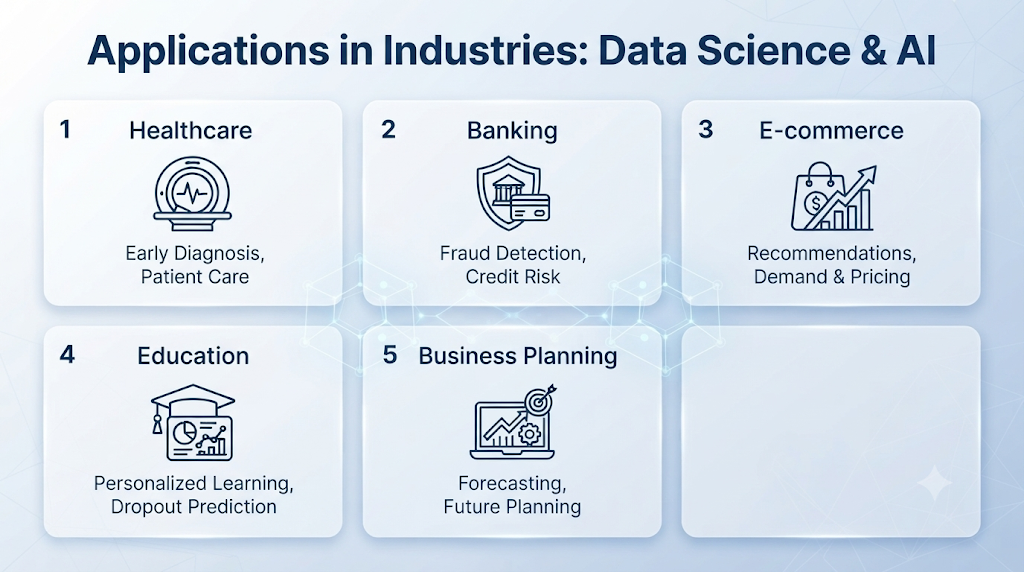
- Healthcare-Hospitals hold vast amounts of patient data. AI models help doctors identify early signs of conditions such as Diabetic Eye Disease and lung issues from X-rays and MRIs. Predictive models are also used to identify patients who require further care, serving as a valuable decision-support tool for medical professionals.
- Banking-Banks use machine learning to detect unusual transactions in real time. If you make an unexpected purchase with your card in another country, a model can flag it based on your typical spending patterns. Banks also use AI to calculate credit risk and perform customer segmentation to match clients with suitable loan or savings products.
- E-commerce-Websites record browsing, searching, and purchasing habits. Based on this data, recommendation systems suggest relevant products—improving customer experience and increasing sales. Retailers also use AI to predict demand, optimise pricing, and manage stock levels.
- Education–Learning platforms track student progress. When learners struggle with specific topics, the platform can recommend extra practice or simpler explanations. Predictive models also help institutions identify students at risk of dropping out, enabling teachers to offer early support.A practical use case often explored in a data science course in Coimbatore.
Business Planning and Customer Data:
Companies use AI to forecast sales, schedule staff appropriately, and understand customer behaviour. For example, a restaurant chain may predict busy days using historical sales, weather, and local events, while a telecom provider may identify customers likely to leave and offer tailored retention packages.
Popular AI Tools:
| Tool | Category | Beginner Use Case |
| Python | Programming Language | Easy syntax with essential data libraries (Pandas, NumPy) for cleaning and analysing data. |
| Scikit-learn | Machine Learning Library | Contains pre-built models for classification, regression, and clustering; best place to learn model training and testing. |
| TensorFlow | Deep Learning | LibraryOpen-source library by Google for image recognition and text analysis; beginners can start with Keras for an easier interface. |
| Power BI | Data Visualisation | Creates clear, interactive dashboards so non-technical decision-makers can easily understand model results. |
| ChatGPT | AI Learning Assistant | Helps write and debug code, explain concepts, and brainstorm ideas (always verify and understand generated code). |
Beginner Data Science with AI Projects:
Completing hands-on projects strengthens your understanding and builds a strong portfolio when applying for jobs. Try these 5 beginner projects:
Customer Churn:
- Problem: Predict which customers are likely to stop using a service.
- Example: Using a telecom dataset with variables like Contract Type, Monthly Charge, and Number of Support Calls, train a classification model using Scikit-learn to identify at-risk customers.
- Skills Learnt: Data cleaning, feature selection, model evaluation.
Sales Prediction:
- Problem: Forecast future sales based on historical data.
- Example: Using 2 years of retail sales data, predict sales for the next 6 months by comparing a basic regression model with a time-series model.
- Skills Learnt: Identifying trends and seasonality, time-series basics, prediction accuracy.
Sentiment Analysis:
- Problem: Determine whether customer feedback is positive, negative, or neutral.
- Example: Analyse product reviews or social media posts using Natural Language Processing (NLP) and display the insights in a simple dashboard.
- Skills Learnt: Text cleaning, NLP basics, data visualisation.
Detect Fraud:
- Problem: Identify suspicious financial transactions.
- Example: Use a public credit card transaction dataset where fraud cases are rare to gain experience working with imbalanced datasets and metrics like precision and recall.
- Skills Learnt: Handling imbalanced data, classification, model evaluation.
Recommendations:
- Problem: Suggest relevant items to users.
- Example: Build a movie or book recommendation system using ratings data—starting with basic popularity-based recommendations before exploring collaborative filtering.
- Skills Learnt: Similarity measures, user-item matrices, recommendation logic.
Portfolio Tip: Upload your completed projects to GitHub and clearly document the problem statement, your process, and the final outcome.
Skills Required for Data Science with AI Projects:
Technical Skills:
- Python coding
- Basic statistics and probability
- Data cleaning and analysis (Pandas & NumPy)
- Working with databases using SQL
- Core machine learning concepts
- Data visualisation (Power BI, Tableau, or Matplotlib)
Professional Skills:
- Structured problem-solving
- Understanding business requirements
- Communicating and storytelling with data
- Curiosity and continuous learning
You do not need to be a mathematics expert—a solid grasp of basic statistics and consistent practice will take you a long way.
Benefits of Learning Data Science with AI:
- Cross-Industry Demand: Applicable across healthcare, finance, retail, education, logistics, and marketing.
- Practical Portfolio: Enables you to build tangible projects that demonstrate real capability to employers.
- Diverse Career Paths: Opens doors to roles in analytics, machine learning, business intelligence, and research.
- Better Decision-Making: Develops critical, data-driven thinking useful even outside purely technical roles.
- Future-Proof Skillset: Equips you to adapt as AI becomes standard across modern workplaces.
Careers in Data Science and AI:
- Data Analyst: Clean and analyse data, and build reports and dashboards.
- Junior Data Scientist: Build, test, and refine foundational predictive models.
- Machine Learning Engineer: Develop, optimise, and deploy AI models into production.
- Business Intelligence Analyst: Translate raw data into actionable insights for management.
- AI / NLP Specialist: Work with text data, chatbots, and language models.
- Data Engineer: Design and maintain pipelines to collect, store, and manage data.
Most newcomers start in a Data Analyst or Junior Data Scientist role. While no course can guarantee a specific job or salary, combining a strong project portfolio with practical skills and clear communication significantly improves your prospects.
Getting Started with Data Science and AI
Follow this step-by-step roadmap to begin your journey:
- Learn basic Python: Focus on variables, loops, functions, and core data structures.
- Learn basic statistics: Understand mean, median, probability, and correlation.
- Analyse data: Practice cleaning and exploring datasets with Pandas.
- Learn SQL: Master querying databases, where most business data resides.
- Learn basic machine learning: Build regression and classification models using Scikit-learn.
- Learn data visualisation: Create clear dashboards using Power BI.
- Complete projects: Build and upload the 5 beginner projects above to GitHub. Once your foundations are solid, explore deep learning with TensorFlow.
- Prepare for jobs: Build a strong CV, GitHub repository, and LinkedIn profile, and practice technical interview questions.
conclusion:
Data Science with AI is transforming how illnesses are diagnosed, fraud is detected, products are recommended, learning is personalised, and businesses plan for the future. By learning Python, building a foundation in statistics and machine learning, and completing practical projects, beginners can steadily break into this field. Whether you are learning independently or enrolling in data science training in Kochi for guided mentorship, solving real problems with data is what sets you apart—pick one of the projects in this guide and start building this week!