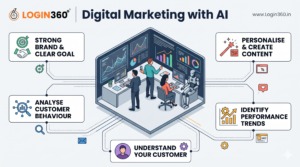

Introduction:
Using ai in digital marketing ,There are many decisions to make when running a digital marketing campaign. Digital marketing course in chennai From deciding who you’re targeting, what message to deliver, how much money to spend, and how to measure success. Using an artificial intelligence (AI) can help marketers to make decisions by analysing the data, spot patterns, create variations of content, and automate processes. Even with AI, your campaign performance will rely on having clear goals, good data, relevant creative, and ensuring great customer experience. AI can give suggestions and automate, however your marketers will need to review the content. In this article we’ll discuss how you can get the most out of an AI by using it throughout your campaign. Improving outcomes like generating qualified leads, sales, and improving retention and return on marketing investment.
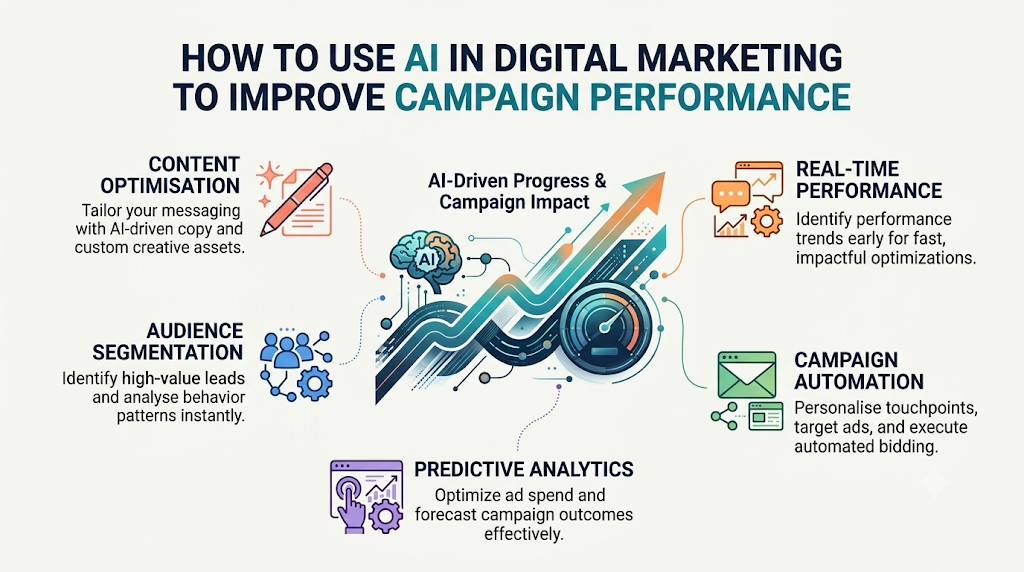
Using ai in digital marketing for campaign performance?
Campaign performance marketers means how well your campaign performs according to your business goals. Some businesses might have the goal of generating sales at an acceptable cost whilst others might have the goal of generating qualified leads, increasing registrations, or getting current customers back.Before using an AI, you should decide what you want to improve and how you’ll measure it. Consider metrics like conversion rate, cost per qualified lead, customer acquisition cost, revenue and return on ad spend. Tracking impressions and clicks can help you understand what’s going on, however they don’t always reflect if you’re achieving business value.The AI will be most useful if you know what you want to achieve. If you ask it for help with a specific question like “Which audience is producing the most qualified enquiries?” rather than asking it to improve your campaign.
Know your goal and Baseline:
Start by writing down what you want to achieve, who you’re targeting, how much money you have to spend, how long your campaign will run for, and which metric will show you if you’ve been successful. It’s important to have a baseline.seo marketing digital This can be recent results from previous campaigns or something else relevant. Without this it’ll be hard to know if your AI assisted work has been beneficial.A local online course provider might want to increase paid registrations with a certain cost per enrolment. They can also track lead quality and how many enquiries convert to paying students.AI can be used to help you create some initial goals based on your wider business goals, suggest metrics, and give you a summary of previous performance. However you should ensure that your goals are achievable.
Ensure you have good data:
The AI will only be as good as the information it has. Before asking it for any recommendations, ensure you’re tracking your campaign correctly. You should also make sure you’re tracking key actions such as form submissions, purchases, and qualified leads. Check that your campaign names, tracking links, duplication, and missing data are all in order.If your data is inconsistent between your advertising platforms, analytics, and CRM, your AI summary can be misleading. If one platform is tracking clicks but your business is interested in purchases, your summary won’t be helpful. Define what the important terms are and what time frame you want to look at.Ensure that you’re protecting customer data. Only use the data you need, and ensure you’re following your organisations privacy procedures. Understand how the tool will be using the data before uploading any customer data or linking your business systems.
Know your audience:
An AI can help you to analyse customer feedback, surveys, website searches, customer service questions, and sales notes..Digital marketing course in coimbatore It can help identify common issues, what products customers need, and differences between different customer segments. This can help your team to improve their targeting.If a travel company finds out from enquiries that one segment are most interested in flexible bookings, and another are looking to compare family activities. They can create different messages to target these needs and test them.Try to view the results as hypothesis. Sometimes the summary might highlight a few comments that aren’t representative of the whole. Correlation doesn’t equal causation. Review the source data, think about how the data was gathered and speak to those who know your customers before making any changes.
Create content:
Using generative AI can help you create headlines, social media posts, email subject lines, landing page content, and ad variations. This can help you create different ways of communicating your offer. Highlighting different selling points such as ease of use vs product quality.Give it a clear brief to create the right content for your audience. Let it know who you’re targeting, what the goal of the campaign is, what channel you’re using, what tone of voice you want, what the offer is, any evidence to back up your offer, and what you want to avoid saying. Ask for multiple unique suggestions and edit the best ones. Ensure you’re keeping your message consistent throughout your advert, landing page, and follow up.Always review the content. Ensure the facts are correct, links are correct, tone of voice is correct, it’s accessible, and accurately reflects the product. Whilst using AI to create content for your website can be useful, Google highlights that it’s important to ensure the content is accurate, high quality, relevant, and fact checked by humans. They also advise not to create lots of pages with no value to the reader. See Google’s guidance on AI generated content.
Optimise and deliver your campaign:
Some advertising platforms use AI to help you target your ads, optimise delivery, and suggest changes to your campaign. This can help you with managing complex campaigns and adapting to changes in performance. Google has an AI assistant called Ask Advisor that can help you link together information from your Google marketing products and give insights into your campaigns. This is currently in beta for English language accounts with features being rolled out over time. See Google’s announcement on Ask Advisor.When using the suggestions from the AI, ensure there are clear limits. Set your budget, know what audiences you want to target, check exclusion and brand suitability, and review any suggested changes. Google also advises to review the suggestions from their Ads and Analytics advisors, and use your own judgement before making any major changes to your account. See Google’s best practice for using advisors.Automated delivery can save you time. However, you should still review your results. Are you seeing valuable conversions? Is your spend moving as expected?
Personalise the customer journey:
An AI can help you personalise your message. Based on what interests them, what they’ve interacted with before, or where they are in their journey. A first time visitor might get an introductory offer, whereas an existing customer might get a product guide or relevant follow up. Customers can be triggered based on actions they take through email platforms and CRM.Personalisation should help make the interaction more useful. Use relevant information, don’t assume based on weak signals, and give customers reasonable control over what they receive. Regularly review your automated messages to ensure they’re accurate and relevant as products, offers, and policies change.
Experiment:
Using an AI can help you come up with ideas to test. When creating your tests ensure you can learn something from the results. Try to only change one key element at a time, for example your headline, image, offer, or audience. Decide what metric you’ll use to decide if you’ve been successful.Don’t declare a winner based on a few clicks or short period of time. Campaigns can be impacted by many factors including seasonality, competitors, budget changes, and tracking issues. Ensure you’re running your test for long enough to get useful data. Note down what you changed so you can learn from the results.Using an AI can help you summarise the data, create a plan, and find out what questions to ask next. Ensure calculations are correct and review the source data.
Take action based on insights:
Decide how often you’d like to review your campaign. If your campaign is active you might want to review weekly. Ask the AI to give you a summary of what changed, what audience/channel performed best, where customers dropped off, and what you should investigate next.Google states that using the AI features in Ads and Analytics can help you explore your campaign performance and gain insights. Whilst this can help you get started with analysing your data, you should review the reports to ensure you’re making the right changes. If you had a spike in traffic but they didn’t complete the action you wanted then it won’t be valuable.After reviewing your campaign, note down what decision you’ve made, why, and what outcome you expect. This creates a learning loop. Plan, launch, measure, adapt, and document. Over time you’ll see how your expectations match up to the actual results and can improve your decisions in future campaigns.
Example:
A local fitness studio wants to increase trial class bookings. Digital marketing course in kochi They decide on what cost per booking they want, and ensure they’re tracking bookings correctly. They review customer enquiries and find out they have 2 main reasons for booking. Building strength and finding a convenient class nearby.They use an AI to create 2 different ad concepts and landing page headlines. A member of staff review the claims and ensure the class details are correct. They run the variations with a small budget and compare how many bookings they got and how many attended. After reviewing the data they decide to keep the best message, look into areas where they had low conversions, and plan their next test.The AI helps in many areas, but the decisions were based on their knowledge of their customers and the results.
Conclusion:
Using an AI can help improve the performance of your digital marketing campaigns. By helping you Understand Your Audience, create variations of creative, analyse your results, personalise the customer journey, and automate routine optimisations. The value comes from using it to make specific decisions and seeing if it helps improve business outcomes.Start with clear goals and good data. Use an AI to come up with ideas, spot patterns, and test them thoroughly. Review any changes made to your campaign, ensure your content is correct, and protect customer data. Focus on meaningful outcomes like generating qualified leads, sales, and retention. Using your judgement, an AI can help you learn quicker.