
A beginner-friendly guide to skills, tools, projects and career opportunities
Introduction:
Data science career with AI These are examples of how data science and artificial intelligence (AI) can be used to solve real-world problems. Data science training Chennai Companies collect large amounts of data every day. They need people who can organize that data, identify patterns and turn findings into useful business decisions. A career in data science with ai can be worth exploring if you are a student, recent graduate, working professional or career changer. You do not need to master programming before you begin. Start with the fundamentals, practice regularly and build experience through projects. If you enjoy technology, problem-solving and learning new skills, this guide explains how to begin your data science journey.
Data Science with AI: A Beginner’s Guide:
How to start a career in Data Scienc is the process of collecting, organizing, analysing and interpreting data to discover useful insights. It helps organisations understand what is happening, why it may be happening and what action they could take.For example, an online retailer may want to understand why customers leave without completing a purchase. A data professional can examine customer behaviour, purchase history, pricing and website activity to identify possible reasons.AI helps computers perform tasks that usually require human-like capabilities, such as recognising patterns, understanding language and generating predictions.
How Are Data Science, Machine Learning and AI Connected?
These fields are closely related, but they have different roles:
Data Science: uses data analysis and statistical methods to find insights. Machine Learning: enables systems to learn patterns from data and make predictions or classifications. Artificial Intelligence: a broader field focused on systems that perform tasks associated with intelligent behaviour. Data Visualization: presents findings through charts, graphs and dashboards so people can understand them. For example, healthcare researchers may analyze patient records to identify patterns associated with health risks.
Why Is Demand Growing for Data Science with AI Skills?
Businesses increasingly use AI and analytics for tasks such as customer support, forecasting, fraud detection and operational planning. These applications depend on reliable data, careful analysis and ongoing monitoring.
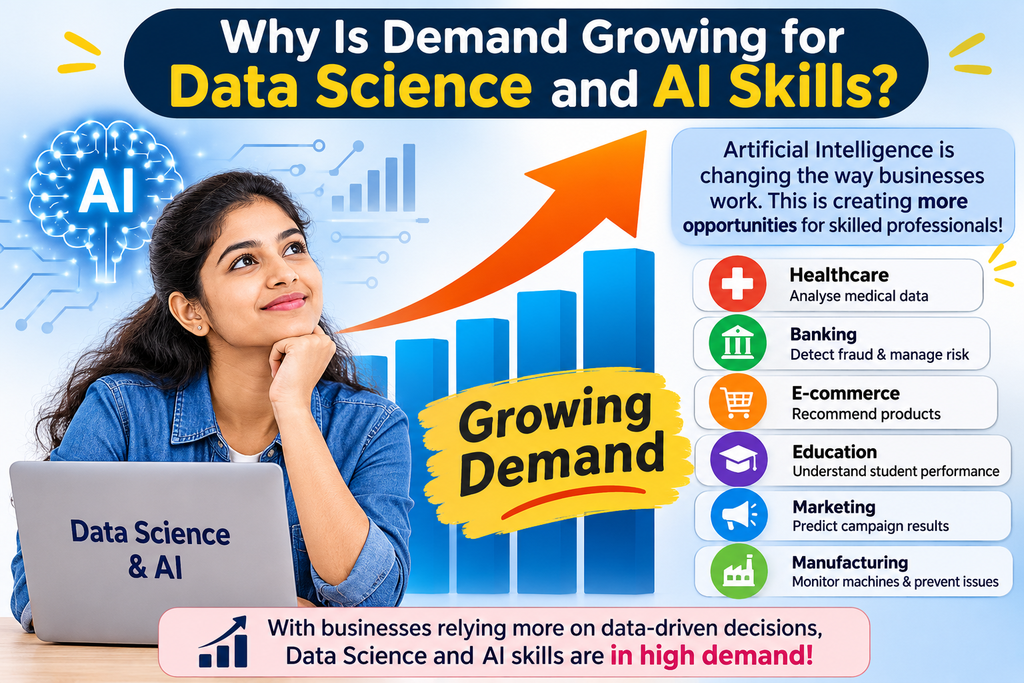
- Healthcare – analysing medical data to support research and identify trends.
- Banking – detecting unusual transactions and potential fraud.
- E-commerce – recommending products based on customer interests and behaviour.
- Education – examining learning patterns and student performance.
- Marketing – measuring customer behaviour and evaluating campaign performance.
- Manufacturing – monitoring equipment and identifying possible maintenance issues.
For example, a marketing team can analyse previous campaign results to understand which audiences are more likely to become customers. Predictive models may help estimate future outcomes, although actual performance can vary.
Skills Required to Become a Data Scientist
- Mathematics and Statistics
Math and statistics help you summarize data, measure relationships and understand uncertainty. Begin with mean, median, mode, percentages, probability, correlation, basic algebra and standard deviation. Data science course in Coimbatore For example, a business can calculate average monthly sales to compare performance over time.
- Python
Python is widely used in data science because it has a readable syntax and a large ecosystem of libraries. Start with variables, data types, conditions, loops, functions, lists and dictionaries. NumPy supports numerical operations; Pandas helps organize and analyze datasets; Matplotlib and Seaborn create visualizations; and Scikit-learn provides tools for machine learning.
- SQL
Structured Query Language (SQL) is used to retrieve and manage information in relational databases. Practise SELECT, WHERE, GROUP BY, ORDER BY, JOIN and aggregate functions.For example, SQL can retrieve customer records or summarise monthly sales from a large database.
- Excel and Power BI
Excel is useful for organising data, applying formulas, filtering records and creating charts. Power BI helps build interactive dashboards that communicate business performance. A sales dashboard might show monthly revenue, best-selling products and sales by region.
- Machine Learning and AI
Machine learning is a branch of AI that learns patterns from data. Beginners should understand supervised and unsupervised learning, classification, regression, clustering, and the purpose of training and testing datasets. Start with small examples, such as estimating house prices or grouping customers with similar behaviours.
Step-by-Step Guide to Start a Data Science Career with AI
1. Understand the Fundamentals
Learn what data science is and how organisations collect, store and use data. Understand the differences between data analytics, data science, machine learning and AI so you can choose a suitable learning path.
2. Learn Excel and SQL
Use Excel to practise rows, columns, formulas, filters and charts. Then learn SQL to retrieve and summarise data. Practise with a small sales, retail or student-performance dataset.
3. Learn Python
Build a foundation in variables, data types, conditional statements, loops, functions, lists and dictionaries. Then move on to Pandas and NumPy, and practise cleaning and analysing small datasets.
4. Practise Data Visualisation
Learn to present findings through charts, graphs and dashboards using Power BI, Matplotlib or Seaborn. For example, create a dashboard showing monthly sales, customer growth and product performance.
5. Understand Machine Learning
After learning Python and data analysis, explore linear regression, logistic regression, decision trees and K-means clustering. Practise splitting data into training and testing sets, making predictions and evaluating model performance.
6. Use Generative AI Tools Responsibly
Generative AI tools can help explain Python code, suggest example SQL queries, clarify statistical concepts, create sample datasets and help investigate coding errors. Always review AI-generated answers. They can contain incorrect code, unsupported assumptions or explanations that do not fit your dataset. Do not upload confidential or personal data to tools unless you are authorized to do so.
7. Build Projects and Apply for Suitable Roles
Projects help demonstrate how you approach a problem and use technical tools. Complete a few projects, publish appropriate code and documentation on GitHub, prepare a clear CV and practise explaining your decisions and findings.
How to Build Practical Data Science Projects
Use projects to apply your learning to realistic questions. Five beginner-friendly ideas are listed below.
1. Student Performance Analysis
Explore marks, attendance and study time to identify patterns in student performance. Tools: Excel, Python, Pandas and Power BI.
2. Customer Churn Analysis
Analyse customer records to understand patterns associated with customers leaving a service. Tools: Python, Pandas and Scikit-learn.
3. Sales Forecasting
Explore historical sales and build a basic model to estimate future trends. Tools: Python, machine learning and Excel.
4. E-commerce Customer Analysis
Study buying behaviour, popular products and sales trends. Tools: SQL, Python and Power BI.
5. Movie Recommendation Project
Build a simple recommendation system that suggests films based on user preferences or similarities between movies. Tools: Python, Pandas and machine learning.
How to Create a Strong Data Science Portfolio as a Beginner
A portfolio gives employers an overview of your skills and problem-solving approach. You can build one even if you have not yet worked in the industry.Include a short introduction, your technical skills, two to four completed projects, each project’s objective, screenshots of dashboards or visualisations, links to code on GitHub and a clear explanation of your findings. Use LinkedIn to share project updates and connect with professionals.
Popular Career Opportunities in Data Science and AI
- Data Analyst – analyses data and prepares reports.
- Junior Data Scientist – explores datasets and supports the development of analytical or predictive models.
- Machine Learning Engineer – develops, tests and deploys machine learning systems.
- Business Intelligence Analyst – creates dashboards and business reports.
- Data Engineer – builds and maintains data pipelines and data infrastructure.
- AI Engineer – develops applications that use AI models and services.
Each role has different requirements. Data Science career with AI Beginners may choose to build experience through data analyst, business intelligence or other entry-level analytics roles before progressing towards more specialized machine learning work.
Common Challenges for Beginners and How to Overcome Them
Challenge 1: Fear of Coding
Solution: Begin with basic Python concepts and practise short exercises regularly. Focus on understanding the logic rather than memorising code.
Challenge 2: No Technical Background
Solution: Build foundations in maths, statistics, Excel, SQL and Python. Progress step by step and use beginner-friendly datasets.
Challenge 3: Too Many AI Tools
Solution: Focus on core data concepts first. Treat AI tools as learning support, and verify their suggestions instead of relying on them blindly.
Challenge 4: Limited Practical Experience
Solution: Work with public datasets, complete projects, document your process and create a portfolio that shows your contribution.
Challenge 5: Interview Preparation
Solution: Practise basic Python and SQL questions, revise statistics and prepare to explain the problem, process, tools and findings for each project.
Career Guidance for Freshers, Experienced Professionals and Career Changers
For Fresh Graduates
Learn Excel, SQL, Python and basic statistics; complete beginner projects; understand machine learning fundamentals; create LinkedIn and GitHub profiles; and explore internships or suitable entry-level roles.
For Experienced Professionals
Connect data science concepts to your existing industry knowledge. Strengthen Python and analytical skills, learn relevant AI and machine learning applications, and build projects related to your field.
For Career Changers
Start with the fundamentals, follow a structured learning plan, complete practical projects and prepare a portfolio. Your previous education or work experience can provide useful context, but you will still need to demonstrate relevant skills.
Conclusion
Starting a career in data science with AI does not mean you need to learn everything at once. Build a strong foundation, practice consistently and use projects to apply what you learn. Begin with Excel and SQL, then learn Python and data visualization. Data science course in Kochi Move on to machine learning and AI after you understand the basics. Create a portfolio, prepare for interviews and keep improving your skills. Progress takes time. Each concept you understand and each project you complete can help you move towards a data-focused career. To explore training options, visit Login360 at https://login360.in/.
Frequently Asked Questions
1. Can I start a career in Data Science without a programming background?
Yes. Start with basic maths, statistics and Excel, then learn SQL and Python. Build your programming skills gradually through practice.
2. Do I need Python for a Data Science career?
Python is widely used for data cleaning, analysis, visualisation and machine learning. It is a valuable skill for many data science roles.
3. How long does it take to learn Data Science?
The time varies according to your starting point, study schedule and career goals. Focus on steady progress and completing projects rather than expecting a fixed timeline.
4. Which projects should beginners include in a Data Science portfolio?
Student performance analysis, sales forecasting, customer churn analysis, e-commerce analysis and a basic movie recommendation project are useful starting points.
5. Can freshers get jobs in Data Science?
Freshers can explore internships and entry-level roles, particularly in data analytics and business intelligence. Strong fundamentals, practical projects, SQL and Python skills, and interview preparation can improve readiness.