

Table of Contents
Introduction
“How to become a successful full stack developer?” is one of those questions that people who have just entered the field of development often ask. Full stack development includes different aspects of application development, such as frontend, backend, databases, APIs, and deployment. As businesses increasingly need web applications, more career opportunities are becoming available for developers who can work with various aspects of development.
Nevertheless, becoming a successful full stack developer requires more than just learning several programming languages. Developers need to gain technical knowledge, practical experience, problem-solving abilities, and a willingness to continuously improve their skills. There is a way to make this journey easier by following a structured learning plan.
A successful full stack developer should understand how different technologies work together to build responsive, secure, and user-friendly applications. Consistent learning and hands-on practice are essential for building a strong career in this field.
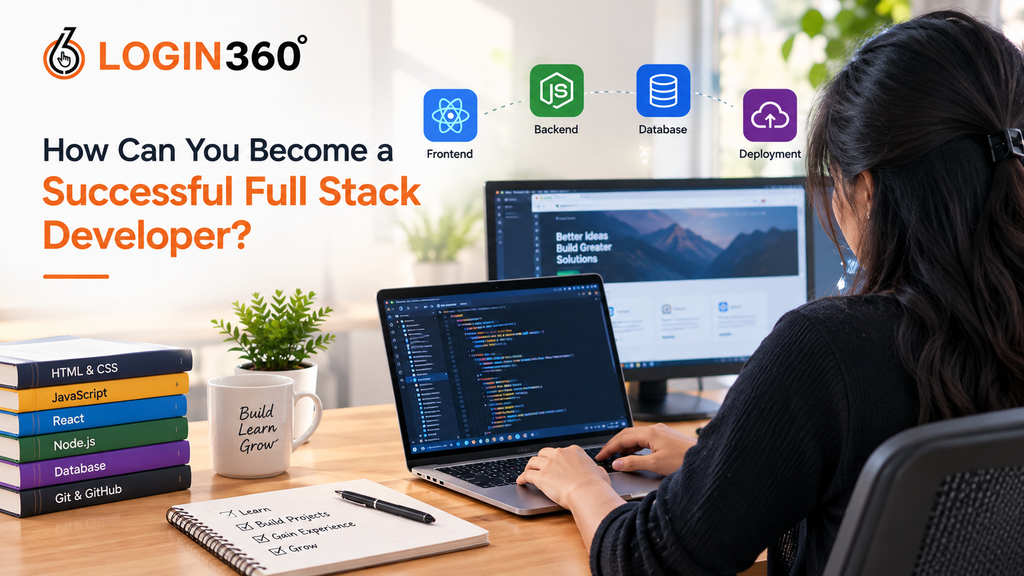
How to Become a Successful Full Stack Developer
Knowing how to become a successful full stack developer becomes much clearer when the learning process is divided into several stages. Beginners should not try to learn everything about frameworks and programming languages right from the beginning. Instead, they should develop each skill separately and gradually connect the knowledge they acquire.
An effective learning approach may include the following steps:
- Learning HTML, CSS, and JavaScript
- Frontend development
- Backend programming
- Databases
- APIs
- Git and version control
- Practical projects
- Testing and debugging
- Professional portfolio development
- Technical interview preparation
- Continuous learning
Following these steps helps beginners develop their skills gradually and gain practical experience throughout the learning process. A structured approach can make the journey towards becoming a successful full stack developer easier and more effective. - Build Strong Web Development Fundamentals: The first thing you need to do when learning full stack development is establish a solid foundation in web technologies. HTML helps you structure webpages, while CSS helps you create attractive designs and responsive layouts. Beginners must understand essential concepts such as HTML elements, CSS layouts, responsive design, JavaScript variables, functions, events, DOM manipulation, and browser behaviour.
Why are these fundamentals so important? Advanced technologies such as React, Angular, and Vue are built on many of these basic concepts. Having a strong foundation makes learning these technologies much easier.
Strong web development fundamentals are the starting point for anyone who wants to become a successful full stack developer. Understanding HTML, CSS, and JavaScript helps developers create responsive websites and provides the foundation for learning advanced frontend and backend technologies. - Choose a Frontend Technology: Once you understand the basics, the next step is to develop frontend skills through a framework or library. React, Angular, and Vue are popular technologies used to create interactive web applications. Beginners are advised to select one framework and learn it properly rather than trying to learn several frameworks at once.
For instance, if you choose React, you can learn about components, props, state, events, routing, forms, and APIs. After understanding these concepts, try building small applications to apply your knowledge. It is not enough to simply mention a framework on your CV. You must understand how to use it and create responsive user interfaces.
A successful full stack developer should know how to build user-friendly interfaces that work smoothly across different devices. Learning a frontend framework and practising component-based development can help beginners improve their web development skills. - Learn Backend Development: Full stack development consists of many aspects, including frontend development. The backend deals with all the processes and logic that happen behind the scenes. Various technologies, such as Node.js, Python, and Java, can be used for backend development and building server-side applications.
You can choose a backend development technology according to your professional interests and learn it thoroughly. Some important backend concepts include routing, server-side programming, APIs, authentication, authorization, validation, error handling, and business logic.
Backend knowledge gives you the ability to build applications that process information, interact with databases, and respond to client requests. To become a successful full stack developer, it is important to understand server-side programming, application logic, authentication, and data processing. These skills help developers create functional applications that provide a smooth experience for users. - Develop Database Skills: Most modern applications use databases for information storage and management. User accounts, products, orders, messages, and other types of information can be stored in databases.
A full stack developer must understand both relational and non-relational databases. Relational databases include MySQL and PostgreSQL, while MongoDB is one of the popular NoSQL databases.It is necessary to understand how to create, retrieve, update, and delete data. Knowledge of database relationships and queries will be helpful when developing complex applications. You do not need to become a database expert immediately, but understanding how the backend interacts with databases is essential.Database management is another important skill for a successful full stack developer. Understanding database operations and how information is stored, retrieved, and updated helps developers build reliable web applications. - Understand APIs: APIs help facilitate communication between different components of an application. For instance, after submitting a login form, the data can be sent from the frontend to the backend using an API. The backend processes the request, interacts with the database, and sends a response.
It is essential to understand how to work with REST APIs, HTTP requests, JSON, status codes, authentication, and API testing. Knowing about APIs enables you to integrate frontend applications with backend systems and other services.
A successful full stack developer must understand how APIs connect frontend interfaces with backend services. Practical knowledge of API integration makes it easier to develop applications that communicate with different systems. - Build Real-World Projects: Another crucial element of becoming a successful full stack developer is gaining practical experience through projects. Tutorials help you understand theoretical concepts, but projects allow you to apply that knowledge to solve real-world challenges.To start with, you can choose small projects such as a calculator, to-do list, portfolio website, or blog. As you develop more skills, move on to larger projects such as e-commerce websites, job portals, booking services, food delivery applications, and HR management systems.
Projects help you understand how the frontend, backend, database, and APIs work together. They also expose you to practical challenges such as authentication, responsiveness, data management, debugging, and error handling. These projects can eventually become valuable additions to your professional portfolio.
Practical projects play an important role in becoming a successful full stack developer. They allow beginners to demonstrate their technical knowledge, improve coding confidence, and gain experience in solving real-world development challenges. - Learn Git and GitHub: Version control is an important part of modern software development. Git allows developers to track changes, create branches, collaborate with other developers, and manage different versions of a project.Beginners should become familiar with fundamental Git commands and understand how repositories work. Uploading your projects to GitHub can also help you showcase your coding skills.
In professional environments, several developers may work on the same project. Git makes collaboration more efficient by helping team members manage code changes and maintain project versions.
A successful full stack developer should also understand version control and collaborative development. Git and GitHub help developers manage code changes and work efficiently with other team members. - Improve Your Problem-Solving Skills: Programming involves more than simply writing code. Developers regularly need to identify and solve problems. Applications may produce errors, API calls may fail, or database connections may not work correctly. Learning how to analyse these situations is important for professional development.
Carefully read error messages, use debugging tools, divide problems into smaller parts, and try different solutions. Regular coding practice improv
Problem-solving skills help a successful full stack developer identify coding errors, understand technical challenges, and develop effective solutions. Regular coding practice can improve logical thinking and programming confidence. - Write Clean and Readable Code: As a competent programmer, you should focus not only on making an application work but also on making the code readable. Use meaningful names for variables and functions, organise files logically, avoid unnecessary repetition, and follow clean coding practices.These practices become even more important when working in a team. Other programmers should be able to understand your code and modify it easily without unnecessary effort. Developing these habits early makes it easier to build and maintain larger applications in the future.Writing maintainable code is an essential habit for a successful full stack developer. Clean coding practices make applications easier to understand, update, test, and maintain.
- Learn Testing and Debugging: Testing helps identify errors in applications before they affect users. You should learn how to test frontend elements, backend functions, APIs, and user interactions.
It is also important to understand debugging techniques. Browser developer tools, server logs, API testing platforms, and other debugging tools can help identify and resolve problems.Do not become discouraged when errors occur. Instead, use every error as an opportunity to understand your code better and improve your programming skills.
A successful full stack developer should know how to test applications and identify errors before deployment. Testing and debugging improve application quality, performance, and reliability. - Keep Learning New Technologies: The IT industry is constantly changing. New frameworks, libraries, tools, and development practices continue to emerge. You do not need to learn every new technology immediately after it becomes popular. Instead, understand new technologies and evaluate whether they are useful for your professional goals.
AI-powered development tools can also help developers write code, debug applications, perform testing, create documentation, and handle repetitive tasks. However, you should always understand the code generated by these tools.
Continuous learning is one of the important ways to become a successful full stack developer because web development continues to evolve. Keeping up with industry changes creates better opportunities for professional growth. - Communication and Collaboration Skills Development: Technical expertise is only one component of becoming an effective developer. Usually, you work not only with code but also with designers, testers, project managers, clients, and other programmers.
Effective communication helps you understand project requirements, discuss technical issues, ask questions, receive feedback, and collaborate with colleagues. Collaboration is especially important when multiple developers work on different aspects of the same application.
Developing professional communication and teamwork skills alongside technical expertise can help you adjust to real-world development environments. - Develop Your Professional Portfolio: A portfolio helps employers and clients understand what you can create. Your portfolio should feature your best projects, along with descriptions of their functionality, technologies used, and problems solved.If possible, include links to your projects and GitHub repositories. A good portfolio demonstrates your practical abilities and can be a valuable addition to your resume. Keep improving your portfolio by adding new projects as you gain experience.
A strong portfolio helps an aspiring successful full stack developer demonstrate practical abilities to potential employers. Including real-world projects, GitHub repositories, and live application links can make a portfolio more valuable. - Interview Preparation for Full Stack Developers: After gaining the necessary skills and creating some projects, you should start preparing for technical interviews. Interview questions may cover HTML, CSS, JavaScript, frontend frameworks, backend development, databases, APIs, authentication, Git, and general programming concepts.
You may also face coding tasks or questions about how you would approach developing a particular application. Do not simply memorise answers. It is much more important to understand the concepts and explain your thoughts clearly.
Prepare to discuss your own projects and the challenges you experienced while developing them. This helps you demonstrate your practical knowledge and problem-solving abilities during interviews. - Learning Process Approach: Full stack development can seem confusing because of the large number of technologies you need to learn. A well-planned learning process will help you manage this challenge more effectively.Start with HTML, CSS, and JavaScript. Next, move on to frontend development, backend programming, databases, APIs, Git, and deployment. Remember to create projects to put your knowledge into practice.
You do not need to learn everything immediately. Gradual progress works much better than trying to learn several technologies at once. Consistent practice and a clear learning plan can help you develop the skills required for a successful full stack developer career.
Conclusion
The journey to becoming a successful full stack developer is not limited to learning programming languages. You should understand how different technologies interact and gain experience by creating complete applications.
First, master the basics and develop skills related to both frontend and backend development. Gain knowledge of databases, APIs, version control, testing, and debugging. At the same time, improve your communication, teamwork, and problem-solving abilities.
Most importantly, continue practising. Every project you create is another opportunity to learn something new and grow as a developer. With consistent effort, practical experience, and continuous learning, you can build a rewarding career in full stack development.
Take the First Step in Your Journey to Full Stack Development with Login360.