

Table of Contents
Introduction
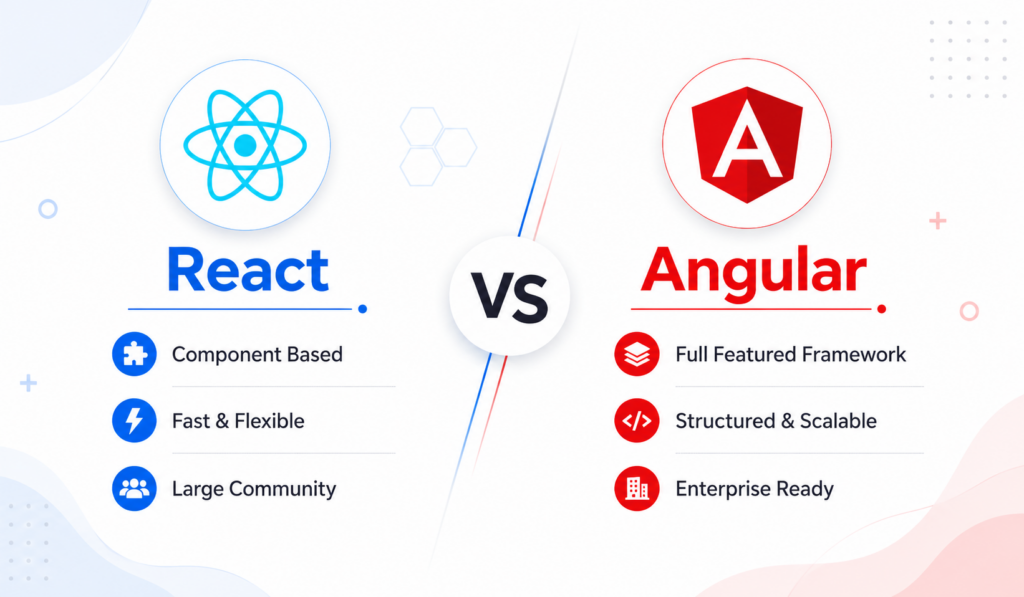
In today’s fast changing Full stack developers web development landscape, selecting the right frontend framework is one of the most important decisions for developers and businesses. A frontend framework determines how users interact with a website or web application, influencing its speed, responsiveness, maintainability, and overall user experience. Among the many frontend technologies available, React and Angular have consistently remained the two most popular choices for building modern web applications. Both frameworks have powered thousands of successful projects across industries, making them trusted solutions for startups, enterprises, and individual developers alike. Although React and Angular serve a similar purpose of creating interactive user interfaces, they differ significantly in architecture, functionality, learning approach, and development style. React focuses on building reusable UI components with flexibility, while Angular provides a complete development framework with built in tools for routing, state management, dependency injection, and form handling.
What Is React?
React is a widely used JavaScript library for building fast, interactive, and responsive user interfaces, particularly for single-page applications. Developed by Meta (formerly Facebook), React has become a preferred choice for developers because of its component based architecture, which allows reusable UI components and simplifies application maintenance. One of its standout features is the Virtual DOM, which improves performance by updating only the parts of a webpage that change instead of reloading the entire page. React is also highly flexible, enabling developers to integrate libraries such as React Router, Redux, and Axios based on project requirements. This adaptability makes it suitable for projects ranging from small websites to large enterprise applications. Another major advantage is its vast developer community, which provides extensive documentation, open-source libraries, tutorials, and regular updates to keep the technology modern and reliable. Features like React Hooks have further streamlined development by making state management and lifecycle handling simpler and more efficient.
What Is Angular?
Angular is a powerful frontend framework developed and maintained by Google for building dynamic, scalable, and enterprise level web applications. Unlike React, which focuses mainly on the user interface, Angular provides a complete development framework with built in features such as routing, form validation, HTTP services, dependency injection, testing tools, and state management. It uses TypeScript as its primary programming language, helping developers write cleaner, more maintainable, and error-resistant code. Angular follows a component based architecture and offers a structured development approach, making it an excellent choice for large projects with multiple developers. Tools like Angular CLI simplify project creation, configuration, testing, and deployment, significantly improving developer productivity. The framework also includes performance optimization techniques such as Ahead of Time (AOT) compilation, lazy loading, tree shaking, and efficient change detection, ensuring fast and responsive applications.
React vs Angular
- Although React and Angular are widely used for Frontend development, they differ in several important ways. The first major distinction is that React is a JavaScript library, whereas Angular is a complete frontend framework.
- Another significant difference lies in their programming languages. React primarily uses JavaScript along with JSX, a syntax extension that allows developers to write HTML like code within JavaScript. JSX makes component creation more intuitive and simplifies UI development.
- Angular uses TypeScript by default, providing strong typing, interfaces, and advanced programming features that improve code reliability and maintainability. While TypeScript offers many advantages, it also introduces additional concepts that beginners need to learn.
- Dependency management is also handled differently. React developers often install third-party libraries based on project requirements, giving them greater flexibility to customize their development environment.
- Testing approaches also vary. Angular includes built in testing utilities, making it easier to perform unit testing and integration testing without additional setup. React supports testing as well, but developers typically rely on external libraries such as Jest and React Testing Library to create comprehensive testing environments.
Performance, Speed, and Scalability Comparison
Performance Comparison
React is widely recognized for its excellent rendering performance due to its Virtual DOM implementation. Instead of updating every element on a webpage whenever data changes, React compares the current Virtual DOM with its previous version and updates only the necessary components. This selective rendering significantly reduces unnecessary operations, resulting in faster user interactions and smoother application performance. Applications with frequently changing user interfaces, such as dashboards, social media platforms, and e-commerce websites, benefit greatly from this optimization. Angular uses a Real DOM but compensates with advanced optimization mechanisms such as Ahead of Time (AOT) compilation, tree shaking, lazy loading, and improved change detection strategies. AOT compilation converts application code into efficient JavaScript before it reaches the browser, reducing startup time and improving overall performance.
Scalability Comparison
Angular excels in enterprise scalability because its structured architecture enforces consistent coding practices across large development teams. Built in dependency injection, modular organization, and standardized project structure simplify long term maintenance and collaboration. Large organizations developing banking systems, healthcare applications, customer relationship management platforms, and government portals often choose Angular because it supports complex business logic while maintaining code consistency. Application size also influences performance. React applications generally have smaller bundle sizes because Developers trends include only the libraries they actually need. Angular applications tend to have larger initial bundles due to their comprehensive framework features.
Speed Comparison
In terms of speed, React often provides faster initial UI rendering and smoother updates for highly interactive applications. Angular may require more resources during initial loading but performs exceptionally well in structured enterprise applications where stability, maintainability, and built in functionality outweigh minimal startup differences. Overall, both React and Angular are capable of delivering excellent performance when implemented correctly. Proper coding practices, optimization strategies, and efficient application architecture contribute more to real-world performance than the choice of framework alone.
Learning Curve, Development Experience, and Community Support
The learning experience is an important consideration for beginners and experienced developers alike. React is generally regarded as easier to learn because developers primarily need a solid understanding of JavaScript, ES6 concepts, and JSX. Beginners can quickly start building functional applications without learning numerous framework specific concepts. React’s straightforward component structure enables developers to see results early in their learning journey, making it a popular choice for aspiring frontend engineers. The overall development experience also differs between the two technologies. React offers greater flexibility by allowing developers to choose their preferred libraries and project structure of Full stack developers. This freedom makes React highly adaptable but also requires careful decision making when selecting third party tools. Angular provides a more opinionated development environment with standardized workflows, reducing architectural decisions and encouraging consistent coding practices across development teams. Community support remains one of the biggest advantages of both technologies.
Use Cases: When to Choose React or Angular
React is an excellent choice for projects that require highly interactive user interfaces, fast rendering, and maximum flexibility. It is commonly used for single page applications (SPAs), social media platforms, e-commerce websites, content management systems, dashboards, and Software as a Service (SaaS) applications. Since React follows a component based architecture, developers can easily create reusable UI components, making development faster and simplifying long term maintenance. Startups and small development teams often prefer React because it allows them to build and launch products quickly while adapting to changing business requirements. React is also ideal when developers want complete control over their technology stack. They can choose libraries for routing, state management, API integration, and testing according to the project’s specific needs. This flexibility makes React suitable for projects where customization and rapid innovation are priorities. Companies building customer facing applications with frequent UI updates often benefit from React’s efficient rendering and extensive ecosystem. Angular, on the other hand, is better suited for large-scale enterprise applications that require a structured development approach.
Career Opportunities and Job Market for React and Angular Developers
- React has become one of the most widely adopted frontend technologies due to its flexibility, ease of learning, and strong community support. Thousands of startups, technology companies, and multinational organizations use React to build modern web applications.
- As a result, companies regularly hire React Developers, Frontend Developers, JavaScript Developers, UI Engineers, and Full Stack Developers with React expertise. Learning React also opens opportunities to work with related technologies such as React Native for mobile application development, expanding career possibilities even further.
- The React ecosystem continues to evolve with new Ai tools, libraries, and best practices, making it an attractive skill for developers seeking long-term career growth. Freelancers and remote developers also benefit from React’s popularity, as many businesses look for professionals who can build responsive and interactive web applications.
- Angular remains a highly valuable skill, particularly in enterprise software development. Large corporations, financial institutions, healthcare organizations, government agencies, and multinational companies frequently rely on Angular for developing secure, scalable, and maintainable business applications.
- Because Angular projects are commonly associated with large scale systems, developers often gain experience working in structured development environments using Agile methodologies, DevOps practices, and collaborative software engineering processes. This exposure enhances professional growth and prepares developers for senior technical roles.
Factors to Consider Before Choosing a Frontend Framework
The first consideration is project complexity. Small and medium sized applications often benefit from React’s lightweight architecture and development flexibility. Large enterprise systems with multiple interconnected modules may be better served by Angular’s structured framework and built in capabilities. Development team experience is another important factor. Teams already familiar with JavaScript may find React easier to adopt because it requires fewer framework-specific concepts. Organizations with developers experienced in Type Script and enterprise software architecture may achieve greater productivity using Angular. Project timeline also influences framework selection. React enables rapid development by allowing teams to build applications incrementally using reusable components. Angular may require more initial setup and learning, but its comprehensive feature set can accelerate development for large projects over the long term. Long-term maintenance should also be considered. React offers flexibility but requires developers to manage multiple third-party libraries.
Conclusion
React and Angular are both powerful frontend technologies that have transformed modern web development by enabling developers to build fast, responsive, and feature rich applications. While they share the common goal of creating exceptional user experiences, they approach frontend development in different ways. React emphasizes flexibility, reusable components, and rapid UI development, making it an excellent choice for startups, dynamic web applications, and developers seeking greater customization. Angular, in contrast, offers a complete framework with built-in tools, standardized architecture, and enterprise grade capabilities that simplify the development of large, scalable applications. There is no universal winner in the React versus Angular debate because the right choice depends entirely on your project requirements, development team’s expertise, scalability needs, and long-term maintenance goals. Full stack developers looking for flexibility and a gentle learning curve may find React more appealing, while organizations requiring consistency, structure, and comprehensive development tools often prefer Angular.