

Introduction
In today’s digital world, data has become one of the most valuable assets for businesses across every industry. Organizations rely on data to understand customer behavior, improve products, optimize operations, and make informed decisions. This growing dependence on data has created a huge demand for skilled data scientists who can transform raw information into meaningful insights. If you are wondering How to Become a Data Scientist, the good news is that there is a clear learning path that anyone with dedication and consistent practice can follow. A successful data scientist combines analytical thinking, programming skills, statistical knowledge, and business understanding to solve complex problems. Whether you are a student, a working professional, or someone planning a career change, becoming a data scientist is achievable through structured learning and hands-on experience. This complete roadmap explains every important step, from learning the fundamentals to building projects and preparing for job interviews.
What Does a Data Scientist Do?
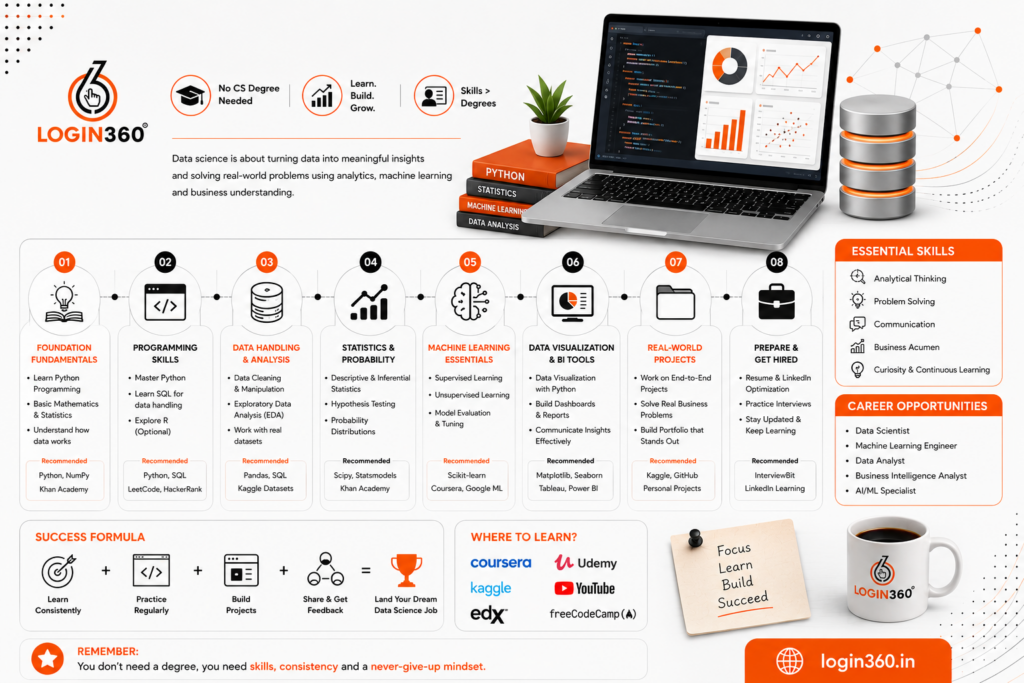
A data scientist transforms raw data into meaningful insights that help organizations make smarter decisions and solve complex business challenges. Their work begins with collecting, cleaning, and analyzing large volumes of structured and unstructured data to identify valuable patterns, trends, and opportunities. They also build predictive models using machine learning algorithms to forecast future outcomes, improve customer experiences, reduce risks, and automate business processes. Beyond technical analysis, data scientists communicate their findings through reports, dashboards, and data visualizations, making complex information easy for managers and stakeholders to understand. They apply these skills to solve real-world problems such as fraud detection, customer segmentation, recommendation systems, sales forecasting, and healthcare analytics, ultimately helping businesses improve efficiency, productivity, and long-term growth.
Understand the Essential Skills Required
- Develop Analytical Thinking: Analytical thinking helps data scientists identify patterns, interpret information, and solve complicated problems logically. Strong problem-solving abilities enable professionals to choose the best approach when working with different datasets.
- Learn Statistical Concepts: Statistics forms the backbone of data science. Understanding probability, distributions, hypothesis testing, correlation, and regression helps professionals analyze data accurately and draw reliable conclusions from business information.
- Improve Communication Skills: Technical expertise alone is not enough. Data scientists should communicate insights effectively to both technical and non-technical audiences. Clear communication ensures stakeholders understand recommendations and confidently implement data-driven decisions.
- Gain Business Knowledge: Understanding industry requirements helps data scientists create practical solutions. Knowledge of business objectives allows professionals to focus on solving problems that deliver measurable value rather than simply building technical models.
Build a Strong Foundation in Mathematics and Statistics
- Master Basic Mathematics: Topics like algebra, calculus, matrices, and linear algebra are essential for understanding machine learning algorithms. These mathematical concepts improve your ability to build accurate predictive models and optimize their performance.
- Understand Probability: Probability helps estimate uncertainty and predict possible outcomes. Learning concepts such as conditional probability, Bayesian theorem, and probability distributions improves your understanding of real-world data science applications.
- Learn Statistical Analysis: Statistical analysis enables professionals to summarize data, identify relationships, and validate assumptions. Techniques like hypothesis testing, confidence intervals, and sampling methods are widely used in data science projects.
- Practice Mathematical Applications: Learning theory alone is insufficient. Apply mathematical concepts while solving datasets and implementing machine learning algorithms. Practical implementation strengthens understanding and prepares you for real industry challenges.
Learn Programming Languages for Data Science
Programming is a fundamental skill for every data scientist, as it enables efficient data analysis, automation, and model development. Begin by learning Python, the most widely used language in data science because of its simple syntax and powerful libraries such as NumPy, Pandas, Matplotlib, and Scikit-learn, which simplify data manipulation, visualization, and machine learning tasks. Alongside Python, develop proficiency in SQL since most business data is stored in databases, and SQL helps retrieve, filter, update, and organize information for analysis. It is also beneficial to explore R programming, especially if you are interested in statistical computing, research, or advanced data visualization. Most importantly, strengthen your programming abilities through regular practice by solving coding challenges, working on real-world projects, automating repetitive tasks, and building small applications that improve both your confidence and problem-solving skills.
Master Data Analysis and Visualization Tools
- Learn Microsoft Excel: Excel remains one of the most commonly used tools for basic data analysis. Pivot tables, formulas, charts, and data cleaning features make it valuable for beginners entering the data science field.
- Use Python Visualization Libraries: Libraries like Matplotlib, Seaborn, and Plotly help transform raw data into attractive visualizations. Effective charts allow users to identify patterns quickly and communicate insights more efficiently.
- Understand Business Intelligence Tools: Business Intelligence platforms such as Power BI and Tableau enable professionals to create interactive dashboards. These dashboards support real-time reporting and help organizations monitor key performance indicators effectively.
- Focus on Storytelling with Data: Good visualization is more than creating attractive charts. Data storytelling combines visuals with business context to present meaningful insights that encourage informed decision-making and better organizational outcomes.
Gain Knowledge of Machine Learning Concepts
Machine learning is a core component of data science that enables computers to learn from data and make accurate predictions or decisions. Start by understanding supervised learning, where models are trained using labeled datasets to solve classification and regression problems with algorithms such as linear regression, decision trees, and support vector machines. Next, explore unsupervised learning, which analyzes unlabeled data to uncover hidden patterns through techniques like clustering and dimensionality reduction, helping businesses identify customer segments, detect anomalies, and discover valuable insights. It is equally important to learn how to evaluate machine learning models using performance metrics such as accuracy, precision, recall, F1-score, and ROC-AUC to ensure reliable and effective results. Finally, reinforce your knowledge by implementing these algorithms on real-world datasets, as hands-on practice builds practical skills, improves problem-solving abilities, and prepares you to tackle real business challenges with confidence.
Work on Real-World Data Science Projects
- Solve Business Problems: Choose projects involving customer behavior, sales prediction, healthcare analytics, or fraud detection. Working on business-focused projects demonstrates your ability to apply theoretical knowledge in practical situations.
- Use Public Datasets: Platforms like Kaggle and government open-data portals provide datasets for practice. These resources allow beginners to explore real-world scenarios and improve their analytical skills through experimentation.
- Document Your Process: Explain each project clearly by describing objectives, data cleaning steps, feature engineering, model selection, evaluation, and final results. Proper documentation showcases your problem-solving approach to recruiters.
- Continuously Improve Projects: Revisit completed projects and optimize models using advanced techniques. Continuous improvement demonstrates curiosity, technical growth, and commitment to learning new approaches in data science.
Create an Impressive Data Science Portfolio
- Showcase Diverse Projects: Include projects from different domains such as finance, healthcare, retail, and marketing. A diverse portfolio highlights your adaptability and ability to solve various business challenges.
- Publish Projects on GitHub: GitHub allows recruiters to review your code quality, documentation, and project organization. Maintaining an active GitHub profile strengthens your professional credibility and online presence.
- Build a Personal Portfolio Website: A personal website helps present your projects, certifications, blogs, and achievements professionally. It acts as a central platform that showcases your technical skills to potential employers.
- Highlight Project Outcomes: Focus on business impact rather than technical implementation alone. Explain how your analysis improved efficiency, increased accuracy, reduced costs, or solved important organizational problems.
Earn Relevant Certifications
Earning relevant certifications is an excellent way to validate your data science skills and demonstrate your commitment to continuous learning. Start by completing industry-recognized training programs that cover essential topics such as Python, SQL, statistics, machine learning, and data visualization. Many online learning platforms provide structured courses with hands-on projects and practical exercises that help reinforce theoretical concepts while building real-world experience. Before attempting certification exams, dedicate time to reviewing key concepts, practicing mock tests, and improving weaker areas to increase your confidence and performance. Since the field of data science evolves rapidly, regularly updating your certifications helps you stay current with the latest technologies, tools, and industry best practices, making your profile more competitive in the job market.
Prepare for Data Science Job Interviews
- Revise Technical Concepts: Review programming, SQL queries, statistics, machine learning algorithms, feature engineering, and data visualization before interviews. Strong fundamentals help answer technical questions confidently.
- Practice Coding Questions: Interviewers often assess coding skills through practical exercises. Solve algorithmic problems and data manipulation challenges to improve speed, accuracy, and logical thinking during technical interviews.
- Explain Your Projects Clearly: Recruiters frequently ask about portfolio projects. Be prepared to explain your objectives, methodology, challenges, solutions, and business outcomes in a clear and structured manner.
- Develop Soft Skills: Confidence, communication, teamwork, and problem-solving abilities significantly influence hiring decisions. Employers value professionals who collaborate effectively and communicate technical ideas clearly.
Keep Learning and Stay Updated
Follow Industry Trends: Stay updated with the latest advancements in artificial intelligence, machine learning, and data science.
Join Professional Communities: Participate in webinars, hackathons, online forums, and networking events to learn from industry experts.
Read Technical Resources: Explore blogs, research papers, and real-world case studies to gain deeper insights into emerging technologies.
Practice Coding Regularly: Strengthen your programming skills by solving coding challenges and working with real datasets.
Build Hands-on Projects: Create practical data science projects to apply your knowledge and develop a strong portfolio.
Commit to Continuous Learning: Consistently upgrade your skills by learning new tools, techniques, and technologies to stay competitive in the evolving data science field.
Career Opportunities and Salary Growth
- High Industry Demand: Organizations across healthcare, finance, e-commerce, manufacturing, and technology actively recruit skilled data scientists to improve business performance through data-driven insights.
- Multiple Career Paths: Professionals can work as Data Scientists, Machine Learning Engineers, Data Analysts, AI Specialists, Research Scientists, or Business Intelligence Developers depending on their expertise and interests.
- Excellent Salary Potential: Data science offers competitive salaries because skilled professionals are highly valuable across industries. Experience, technical expertise, and project quality significantly influence earning potential.
- Long-Term Career Growth: As businesses continue investing in artificial intelligence and analytics, data science remains one of the fastest-growing career fields with excellent opportunities for advancement.
Conclusion
Learning How to Become a Data Scientist requires dedication, continuous learning, and practical experience rather than simply earning a degree. By developing strong mathematical foundations, mastering programming languages, understanding machine learning, building real-world projects, earning certifications, and continuously improving your skills, you can establish a successful career in this rapidly growing field. Focus on solving real business problems, creating an impressive portfolio, and staying updated with the latest industry trends. With patience, consistency, and hands-on practice, you can become a skilled data scientist capable of making valuable contributions to organizations across various industries.




Are there more information regarding about this topic for us to research for? Thank you