
Introduction
If you have recently been browsing through various online job platforms, you must have come across the term “Full Stack Developer career” that pops up everywhere. The demand for a Full Stack Developer is sky high today among firms in all industries small or large. But why? Because companies are looking for specialists that will know everything about the web application, including both its front end and back end. Are you new in the field and confused about where to start your journey toward becoming a Full Stack Developer? Well, if yes, then this article is right for you. Here we will guide you through all the steps necessary to become a Full Stack developer from the skills you should acquire to the sequence of their learning.
What Is a Full Stack Developer All About?
As we get down to business, there’s something that needs to be clarified first about the profession in question. A full stack developer operates in two different parts of a web application:
Front end – all elements visible to the user such as buttons, form fields, etc.
Back end – the server, database and other technologies making up an application underneath
That means a full stack developer can easily switch from one side to another and understand how data moves around in a whole system. And that’s precisely the kind of skill worth paying for.
What Are the Pros of Choosing a Full Stack Developer Career in 2026?
Here are several arguments why Full Stack Developer remains a good choice for newcomers:
- High demand – almost all companies which create a website or application will require full stack skills.
- Better salary – Full Stack Developer positions usually pay more than front-end or back-end positions due to the fact that you have additional value.
- Variety of opportunities – you may work in product companies, startups, agencies or even be a freelancer.
- Easier growth – knowledge of everything makes it easy to switch to tech lead, architect or product engineer position in the future.
Nevertheless, a Full Stack Developer career is not the thing which will come easily. This requires certain structure, regular learning, and patience until everything falls into place. Let us consider in detail what structure is needed.
Step 1: Getting Familiar with Basic Web Development Concepts
All full stack developers regardless of what technologies they will specialize in later begin their journey right here:
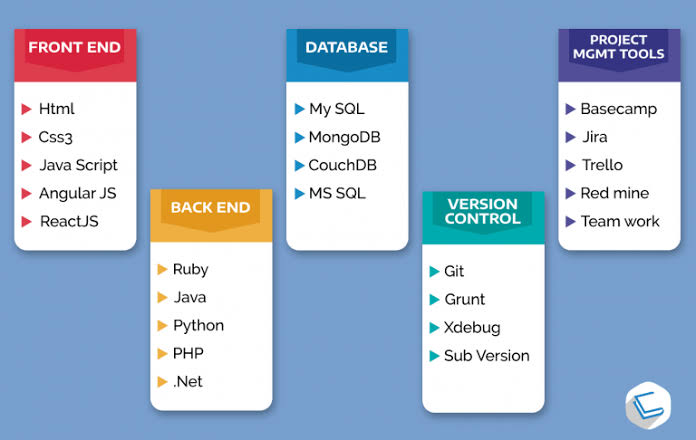
- HTML – gives structure to content on a web page
- CSS – provides styling and layout for that content
- JavaScript – makes web pages interactive
Do not hurry when you get to this step. It happens quite often with many novice developers that they try to move on to learning frameworks and frameworks right away before understanding basic concepts behind HTML, CSS, and JavaScript.
Step 2: Version Control with Git and GitHub
This is a step that people often skip, but don’t make the mistake of skipping it. Git is the tool used for tracking changes to code, and GitHub is the platform where code is housed and shared.
Things to learn:
- Creating repositories
- Committing and pushing changes
- Branching and merging
- Handling pull requests
Version control using Git is essential for all software development teams, and learning this process now will help avoid a ton of headaches in the future.
Step 3: Choose a Front-End Framework
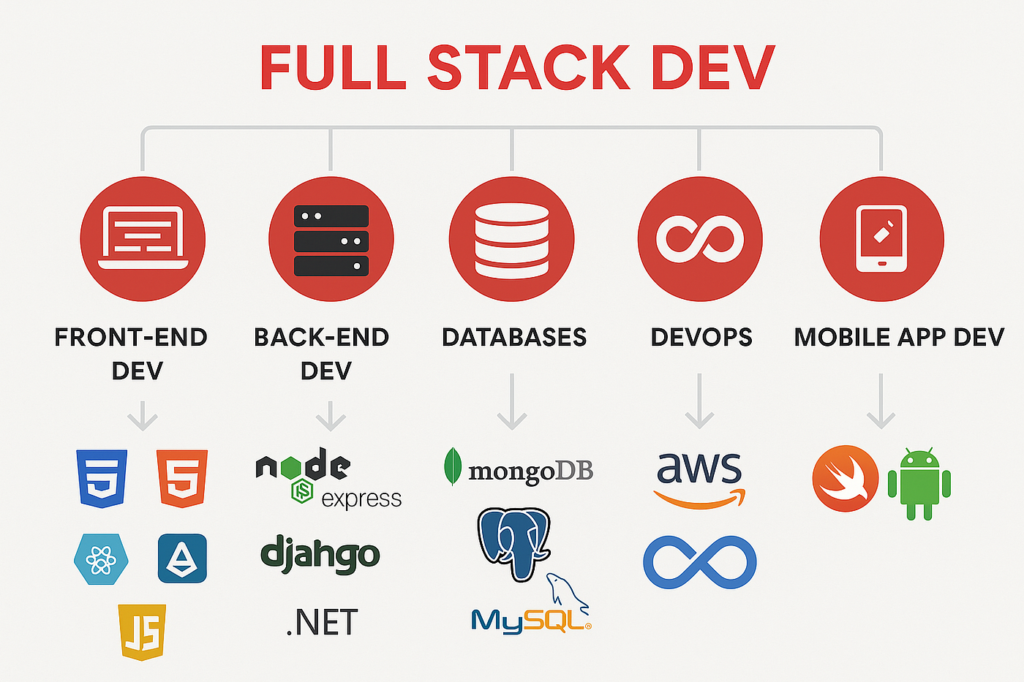
With your foundation in JavaScript established, the next step is to get into a framework or a library for the front end, which would include the following most common frameworks at the moment:
- React – most commonly used, large community, high demand for jobs
- Angular – best for enterprise level applications
- Vue – simple and easy to start with
It looks like React will be a better choice for you if you are planning to become a Full Stack developer in the future, due to its popularity and wide availability of materials to learn from.
Step 4: Learn Back-End Development
This is where it gets exciting. The back end takes care of all the processing, business logic implementation, and database interactions that occur behind the scenes.
Some good back-end technologies to start with include:
- Node.js with Express – JavaScript-based back-end framework which is perfect if you are familiar with JavaScript from the front end
- Python with Django/Flask – has easy-to-understand syntax and is very popular among developers
- Java with Spring Boot – commonly used in enterprise-level projects
There are many developers in India who opt for MERN stack (MongoDB, Express, React, Node.js), only because it allows them to write their code in JavaScript on both back and front end.
At this point, learn how to:
- Create RESTful APIs
- Handle HTTP request/response
- Implement authentication and authorization
- Use middlewares
Step 5: Database Knowledge
Any application will require some sort of storage for data, and therefore, having knowledge about databases becomes essential for a full-stack developer.
Here you need to know about both kinds:
- Structured databases (MySQL, PostgreSQL) – tables, very popular in classic business applications
- Document-oriented databases (MongoDB) – documents, widely used in contemporary JavaScript based stacks
You should have the ability to work with databases by designing schemas, querying, connecting a database to your back-end application. You should know not only how to write queries but also the differences between database kinds and their usage scenarios.
Step 6: Create Real Projects
It is at this stage that theory becomes practice. Learning from tutorial articles and videos will take you only so far creating projects will give all the knowledge meaning.
Start small and then go more complex:
- A to-do list application with full CRUD operations support
- A blog system with user authentication
- An e-commerce website with shopping cart and payment system implementation
- Social media website clone with real-time interaction capabilities Each of the projects should use all your knowledge of front-end, back-end, and databases together to create a fully functional application. It is also what employers look for in candidates.
Step 7: Learn Deployment and DevOps Basics
Application development is only one step; deployment is the next, which entails getting your application out there where it can be used by people.
Be familiar with:
- Deployment platforms such as Vercel, Netlify, or Render.
- Cloud computing basics on AWS or any other cloud platform.
- Docker for containerizing applications (even the basics will do).
- CI/CD for deployment of applications.
You do not have to learn everything about DevOps to become proficient; however, understanding the process involved in deploying your application is very important.
Step 8: Create Your Portfolio and Start Applying
After you have a couple of projects under your belt, you can start building a portfolio that will actually demonstrate your skills:
- Put your projects online, not just on GitHub
- Describe what they do and how they work using README files
- Maintain an organized GitHub account
- Build a basic portfolio website (another good project to demonstrate your skills)
Tailor your resume according to the technology stack used by the company, and do not hesitate to include any internship experiences, freelance work, or open-source contribution.
Common Mistakes Beginners Make
Here is a list of some mistakes you should keep an eye out for during your career development as a Full Stack Developer:
- Chasing tutorials — constantly moving from one tutorial to another without ever getting hands-on experience
- Neglecting basics — starting learning frameworks immediately while not getting basics about programming and JavaScript
- Disregarding databases — considering database knowledge unnecessary when it is crucial
- Neglecting soft skills — soft skills like communication are as important as hard ones
- Making too few projects — recruiters are interested in your experience and skills, not just certificates
Avoiding these mistakes early will save you months of wasted effort.
How Long Does it Take to Become a Full Stack Developer?
The answer to that depends on your experience and how much time you have available, but a practical approach might be something like this:
- 3 to 4 months – front end basics (HTML, CSS, JavaScript)
- 2 to 3 months – front end framework such as React
- 3 to 4 months – back end development, API and database work
- 2 to 3 months – projects and portfolio creation
That’s about 10 to 14 months until you actually reach a professional level of skills.
Conclusion
However, developing a career as a Full Stack developer requires commitment and dedication, as there is no shortcut that does not require going through the whole process of learning how to program, debug and develop applications. However, it is truly one of the most interesting career paths today – there is a real need for it, businesses from all industries seek such specialists, the salaries are high enough even for a beginner and the expertise gained is way beyond “web development”. When you realize how the front end, back end, and databases work, you will be able not only to learn how to develop but also to deploy and debug your application independently.