

Artificial Intelligence (AI) is no longer a futuristic concept reserved for research labs or science fiction. It has become an essential part of modern business, healthcare, finance, education, retail, manufacturing, and countless other industries. As AI continues to evolve, it is fundamentally reshaping data science careers, creating exciting opportunities while also changing the skills and responsibilities expected from professionals in the field.
Just a few years ago, data scientists spent much of their time collecting data, cleaning datasets, building statistical models, and presenting findings. Today, AI-powered tools automate many repetitive tasks, allowing professionals to focus on solving complex business problems, creating intelligent systems, and driving innovation.
Whether you’re considering entering the field, currently working as a data analyst, or already established as a data scientist, understanding how AI is transforming data science careers is essential for long-term success.
In this article, we’ll explore the major ways AI is changing the profession, the skills employers now expect, emerging opportunities, challenges, and what the future holds for aspiring and experienced data scientists alike.
The Growing Relationship Between AI and Data Science
AI and data science have always been closely connected, but the relationship has become much stronger over the past decade.
Data science focuses on extracting insights from data through statistical analysis, machine learning, and visualization. AI extends these capabilities by enabling systems to learn, reason, predict, and automate decision-making processes.
Today, businesses generate enormous amounts of structured and unstructured data. AI helps process this information faster than traditional analytical methods, making it possible to uncover patterns, detect anomalies, and make real-time decisions.
As organizations increasingly adopt AI technologies, data science careers are evolving from traditional analytical roles into strategic positions that combine technical expertise, business understanding, and AI implementation.
AI Is Automating Routine Data Science Tasks
One of the biggest changes AI has introduced is automation.
Many repetitive and time-consuming activities that once required manual effort can now be completed automatically.
These include:
- Data cleaning
- Missing value detection
- Feature engineering
- Model selection
- Hyperparameter tuning
- Data visualization
- Report generation
AutoML (Automated Machine Learning) platforms allow users to train predictive models with minimal coding.
For example, instead of spending several days testing multiple machine learning algorithms manually, a data scientist can use AutoML to compare dozens of models in a fraction of the time.
This doesn’t eliminate the need for data scientists. Instead, it allows them to dedicate more time to solving business problems, interpreting results, and designing better AI systems.
As automation grows, data science careers become less focused on repetitive coding and more centered around strategic thinking.
AI Tools Are Changing Daily Workflows
Modern AI-powered platforms have significantly improved productivity.
Today’s data scientists regularly use intelligent tools that assist with:
- Writing code
- Generating SQL queries
- Explaining datasets
- Building dashboards
- Documenting projects
- Detecting anomalies
- Creating predictive models
AI coding assistants can suggest functions, debug errors, generate documentation, and even recommend optimization strategies.
Similarly, business intelligence platforms increasingly include AI features that automatically identify trends and generate visual insights from large datasets.
Instead of replacing professionals, these tools serve as intelligent assistants that accelerate workflows and reduce manual effort.
This transformation allows professionals pursuing data science careers to deliver better results in less time.
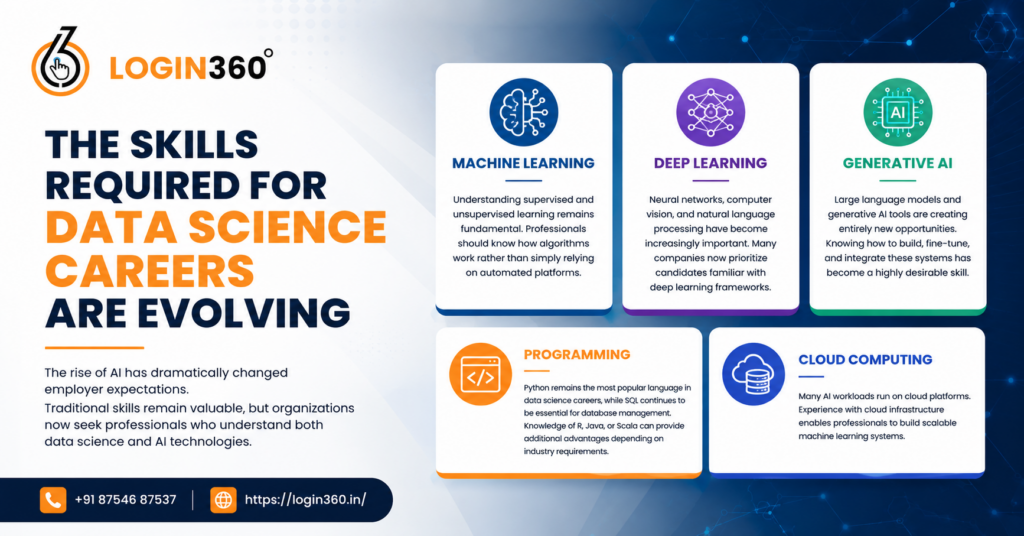
The Skills Required for Data Science Careers Are Evolving
The rise of AI has dramatically changed employer expectations.
Traditional skills remain valuable, but organizations now seek professionals who understand both data science and AI technologies.
Important technical skills include:
Machine Learning
Understanding supervised and unsupervised learning remains fundamental.
Professionals should know how algorithms work rather than simply relying on automated platforms.
Deep Learning
Neural networks, computer vision, and natural language processing have become increasingly important.
Many companies now prioritize candidates familiar with deep learning frameworks.
Generative AI
Large language models and generative AI tools are creating entirely new opportunities.
Knowing how to build, fine-tune, and integrate these systems has become a highly desirable skill.
Programming
Python remains the most popular language in data science careers, while SQL continues to be essential for database management.
Knowledge of R, Java, or Scala can provide additional advantages depending on industry requirements.
Cloud Computing
Many AI workloads run on cloud platforms.
Experience with cloud infrastructure enables professionals to build scalable machine learning systems.
Soft Skills Matter More Than Ever
While technical knowledge is important, AI has increased the value of soft skills.
Organizations need professionals who can connect technical insights with business goals.
Key soft skills include:
Communication
Data scientists must explain complex AI models in language that executives and stakeholders understand.
Critical Thinking
AI can generate predictions, but humans still determine whether those predictions make sense.
Professionals need strong analytical reasoning to validate AI-generated outputs.
Business Knowledge
Understanding industry-specific challenges allows data scientists to create practical AI solutions.
Creativity
AI handles repetitive work efficiently, but innovation remains a human strength.
Creative thinking helps professionals identify new opportunities for applying AI.
As AI continues evolving, these human skills will become even more valuable in data science careers.
AI Is Creating Entirely New Career Opportunities
Rather than reducing employment opportunities, AI is expanding the range of specialized roles available.
Some emerging career paths include:
AI Engineer
Builds intelligent systems and deploys machine learning models into production.
Machine Learning Engineer
Focuses on scalable AI systems and model optimization.
Prompt Engineer
Designs effective prompts for large language models to improve AI performance.
AI Product Manager
Combines technical understanding with business strategy to develop AI-powered products.
AI Solutions Architect
Designs enterprise AI systems that integrate with existing infrastructure.
Responsible AI Specialist
Ensures AI systems remain ethical, transparent, and compliant with regulations.
These specialized positions represent the next generation of data science careers, offering exciting opportunities across industries.
AI Ethics Is Becoming a Core Responsibility
As AI systems influence hiring, healthcare, finance, education, and criminal justice, ethical concerns have become increasingly important.
Data scientists must ensure AI systems are:
- Fair
- Transparent
- Explainable
- Secure
- Privacy-conscious
- Free from harmful bias
Consider a hiring algorithm trained using historical company data.
If previous hiring decisions contained gender or racial bias, the AI may unintentionally repeat those patterns.
Data scientists now play a crucial role in identifying and reducing algorithmic bias before deployment.
Understanding ethical AI is becoming a key requirement in modern data science careers.
Human Expertise Remains Essential
Despite impressive advances, AI cannot replace human judgment.
AI excels at recognizing patterns, processing enormous datasets, and generating predictions.
However, humans remain responsible for:
- Defining business objectives
- Selecting appropriate data
- Evaluating model performance
- Making ethical decisions
- Interpreting results
- Communicating recommendations
For example, AI may predict customer churn with high accuracy, but understanding why customers leave and designing effective retention strategies still requires human expertise.
Successful data science careers increasingly depend on combining AI capabilities with human intelligence.
Industries Driving Demand for AI-Powered Data Scientists
AI adoption is accelerating across nearly every industry.
Some of the fastest-growing sectors include:
Healthcare
Hospitals use AI for disease prediction, medical imaging, patient monitoring, and personalized treatment recommendations.
Finance
Banks detect fraud, assess credit risk, automate trading, and improve customer experiences using AI.
Retail
Retailers forecast demand, personalize recommendations, optimize pricing, and manage inventory with AI.
Manufacturing
Factories use predictive maintenance, quality inspection, and robotics powered by AI.
Transportation
AI improves route optimization, autonomous driving research, and logistics management.
Marketing
Companies analyze customer behavior, optimize campaigns, and automate content recommendations.
The growing adoption of AI across industries continues to expand opportunities in data science careers.
Continuous Learning Has Become Essential
Perhaps the biggest change AI has introduced is the pace of technological evolution.
New frameworks, models, libraries, and AI platforms appear every year.
Professionals who stop learning risk falling behind.
Successful data scientists regularly:
- Learn new programming libraries
- Experiment with AI tools
- Read research papers
- Complete online certifications
- Build personal projects
- Participate in data competitions
- Join professional communities
Lifelong learning is no longer optional—it is one of the defining characteristics of successful data science careers.
Real-World Example: AI Improving Customer Experience
Imagine an online retailer with millions of customers.
Previously, data scientists manually built recommendation systems using historical purchase data.
Today, AI models continuously learn from customer behavior in real time.
The system can instantly recommend products, predict future purchases, detect fraudulent activity, and personalize marketing campaigns.
Instead of manually updating models every few months, data scientists oversee AI systems, monitor performance, and improve business strategy.
This illustrates how AI shifts professionals from repetitive technical tasks toward higher-value decision-making.
Challenges Facing Modern Data Science Professionals
Although AI offers tremendous opportunities, it also introduces new challenges.
Keeping Up With Rapid Innovation
Technology changes quickly.
Professionals must constantly update their knowledge to remain competitive.
Data Privacy
Organizations collect more personal data than ever before.
Protecting customer privacy has become a major responsibility.
Model Interpretability
Many advanced AI models function as “black boxes.”
Explaining predictions to stakeholders can be difficult.
AI Bias
Poor-quality data can produce unfair or discriminatory outcomes.
Careful evaluation is necessary throughout the development process.
Increased Competition
AI-powered tools make certain technical tasks easier, increasing competition among job applicants.
Standing out now requires broader expertise beyond coding alone.
Understanding these challenges prepares professionals for long-term success in data science careers.
The Future of Data Science Careers
The future looks exceptionally promising.
Rather than replacing data scientists, AI is changing the nature of their work.
Future professionals will spend less time cleaning spreadsheets and more time:
- Designing AI systems
- Solving strategic business problems
- Managing AI governance
- Collaborating with cross-functional teams
- Building intelligent products
- Creating ethical AI solutions
Organizations increasingly recognize data as one of their most valuable assets.
As AI becomes embedded into everyday business operations, demand for professionals capable of combining analytics, machine learning, and business strategy will continue to rise.
Future data science careers will be more interdisciplinary, requiring expertise in statistics, software engineering, AI, communication, ethics, and domain knowledge.
Those who embrace continuous learning and adapt to technological change will enjoy strong career prospects for years to come.
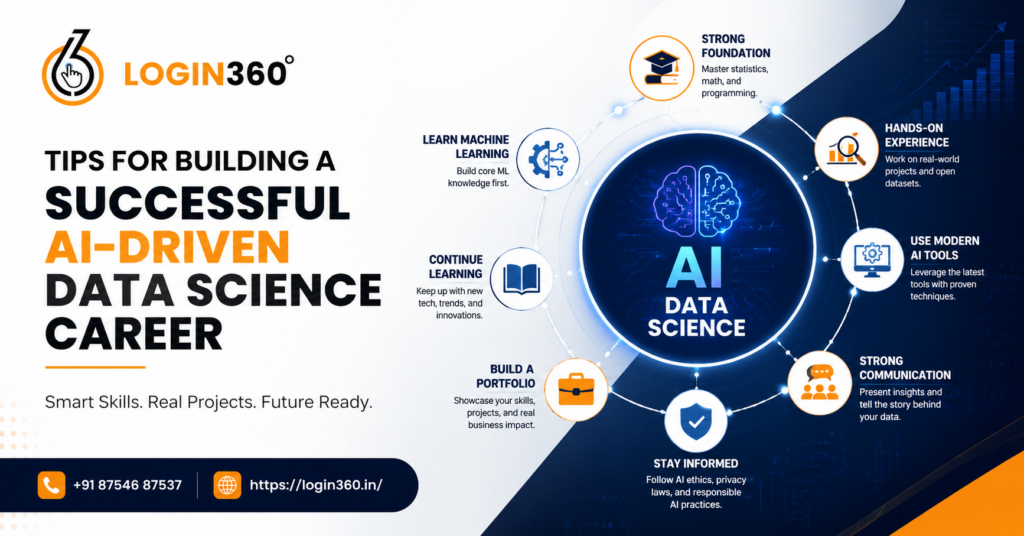
Tips for Building a Successful AI-Driven Data Science Career
If you’re planning to enter the field or advance your current role, consider these practical strategies:
- Build a strong foundation in statistics, mathematics, and programming.
- Learn machine learning before diving into advanced AI topics.
- Gain hands-on experience through real-world projects and open datasets.
- Become comfortable using modern AI tools alongside traditional data science techniques.
- Develop communication and presentation skills to explain technical findings effectively.
- Stay informed about AI ethics, privacy regulations, and responsible AI practices.
- Create a portfolio that demonstrates both technical expertise and business impact.
- Continue learning as new AI technologies emerge.
These habits will help you remain competitive as data science careers continue to evolve.
Conclusion
Artificial Intelligence is transforming the world of data science at an unprecedented pace. Automation is streamlining repetitive tasks, intelligent tools are boosting productivity, and entirely new career paths are emerging across industries. At the same time, the growing importance of ethics, communication, and business understanding highlights that human expertise remains indispensable.
The future of data science careers is not about competing with AI—it’s about collaborating with it. Professionals who embrace AI as a powerful partner, continuously expand their skills, and adapt to changing technologies will be well-positioned to thrive in this exciting and rapidly evolving field.
Whether you’re just beginning your journey or looking to advance your expertise, now is an excellent time to invest in learning AI-driven technologies. The opportunities are expanding, industries are actively seeking skilled professionals, and the demand for innovative thinkers has never been greater. By combining technical excellence with curiosity, adaptability, and ethical responsibility, you can build a rewarding career that remains relevant in the age of AI.