

The cloud engineering landscape has changed more in the past two years than in the decade before it. Artificial intelligence has accelerated deployment cycles. Businesses are running more workloads in the cloud than ever, and expectations around reliability, speed, and security have never been higher. In this environment, cloud engineers who can only provision infrastructure are quickly becoming underqualified. What the market is actually rewarding — and what hiring managers are actively hunting for — is the ability to ship fast, ship safely, and ship continuously.
That’s exactly what Azure DevOps enables. And in 2026, it isn’t just a nice-to-have skill anymore. It’s fundamental.
This blog breaks down why Azure DevOps proficiency has become a non-negotiable capability for cloud engineers, what specific skills matter most, and how mastering the platform positions you for a long, well-compensated career in the cloud space.
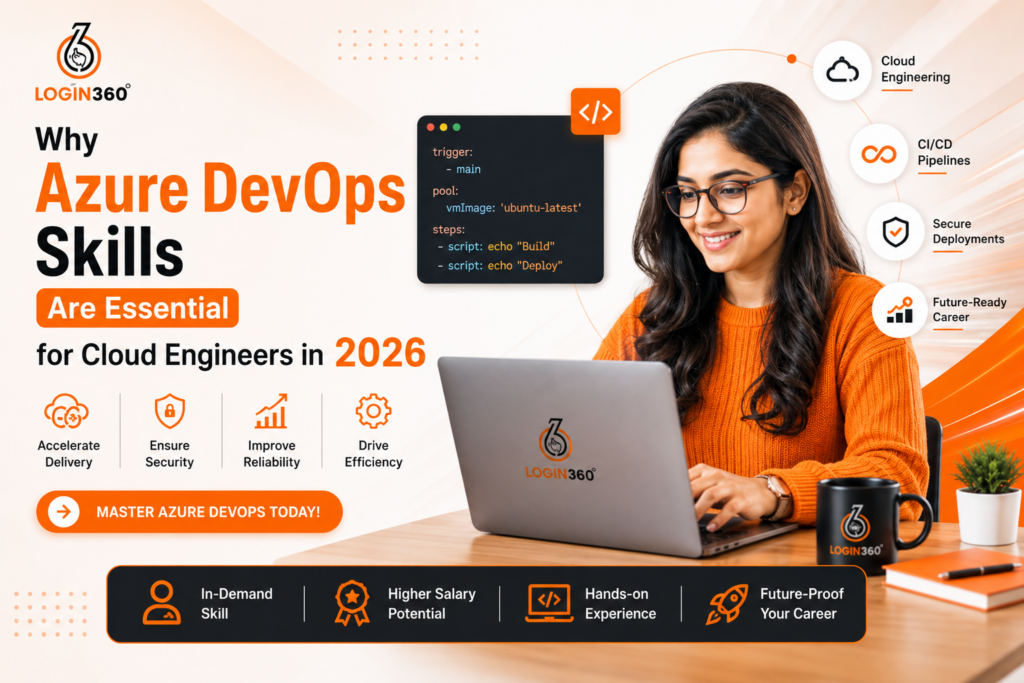
The Shift That Made DevOps Central to Cloud Engineering
To understand why Azure DevOps matters so much right now, it helps to understand what changed in how organizations think about cloud infrastructure.
For most of the 2010s, cloud engineering was largely a provisioning discipline. Engineers stood up virtual machines, configured networks, and managed storage. The heavy lifting was in setup and architecture. Continuous integration and continuous delivery (CI/CD) existed, but they belonged primarily to software development teams. Infrastructure teams worked in a separate lane.
That lane has completely dissolved.
Today, infrastructure is code. Configuration is code. Security policies, compliance rules, and network topology are all expressed in code, versioned in repositories, and deployed through pipelines. The person who configures Azure Virtual Networks is often the same person designing the pipeline that validates and deploys changes to that configuration. Platform engineering teams own both the underlying infrastructure and the developer experience built on top of it.
In this world, being a great cloud engineer without DevOps skills is like being a great writer who can’t use a word processor. The fundamentals matter, but you’re missing the tool that makes them useful at scale.
Azure DevOps sits at the center of this convergence on the Microsoft ecosystem — which, by most enterprise adoption metrics, remains the dominant cloud platform for large organizations globally.
What Azure DevOps Actually Is (And What It Isn’t)
A lot of engineers hear “Azure DevOps” and think only of pipelines. That’s a common misconception worth correcting early, because it undersells the breadth of the platform.
Azure DevOps is an end-to-end development and delivery platform made up of five core services:
- Azure Repos — Git-based version control with branch policies, pull request workflows, and code review tooling.
- Azure Pipelines — CI/CD automation that supports build, test, and release workflows across any platform and language.
- Azure Boards — Agile work tracking, sprint planning, and backlog management.
- Azure Test Plans — Manual and exploratory testing, plus test case management.
- Azure Artifacts — Package management for NuGet, npm, Maven, and Python packages, with upstream source support.
Most cloud engineers will spend the majority of their time in Pipelines and Repos. But understanding the full ecosystem matters — especially in enterprise environments where cloud engineers increasingly sit within platform teams that own the entire developer toolchain.
What Azure DevOps is not is a standalone, siloed tool. It integrates deeply with GitHub, Microsoft Entra ID, Azure Monitor, Azure Policy, and virtually every Azure service. In 2026, many organizations will run hybrid setups — GitHub for code hosting, Azure Pipelines for CI/CD, and Azure Boards for project management. Understanding how these pieces fit together is as important as knowing how to use any one of them in isolation.
The Business Case: Why Organizations Are Doubling Down
Azure DevOps adoption isn’t just growing because developers like the tooling. It’s growing because it solves real, expensive business problems.
Deployment failures are costly. Every time a misconfigured pipeline pushes a broken release to production, organizations absorb downtime costs, customer trust erosion, and emergency engineering hours. Azure Pipelines — when properly configured with gates, approvals, and automated testing — dramatically reduces the blast radius of human error.
Compliance doesn’t wait for release cycles. Financial institutions, healthcare providers, and government contractors operate under strict regulatory requirements. Azure DevOps integrates natively with Azure Policy and Microsoft Defender for DevOps, allowing compliance checks to be baked directly into the CI/CD pipeline. This shift — from auditing compliance after the fact to enforcing it during deployment — is a major reason enterprise organizations are committing deeply to the platform.
Developer velocity is a competitive advantage. Companies that ship faster win more often. Azure Pipelines with YAML-based pipeline-as-code, self-hosted agents, and parallelism capabilities can cut deployment cycle times significantly. Platform teams that build great internal developer platforms on Azure DevOps directly contribute to the company’s ability to ship products.
For cloud engineers, this means that learning Azure DevOps isn’t just a resume move — it’s a way to become someone who visibly improves organizational outcomes.
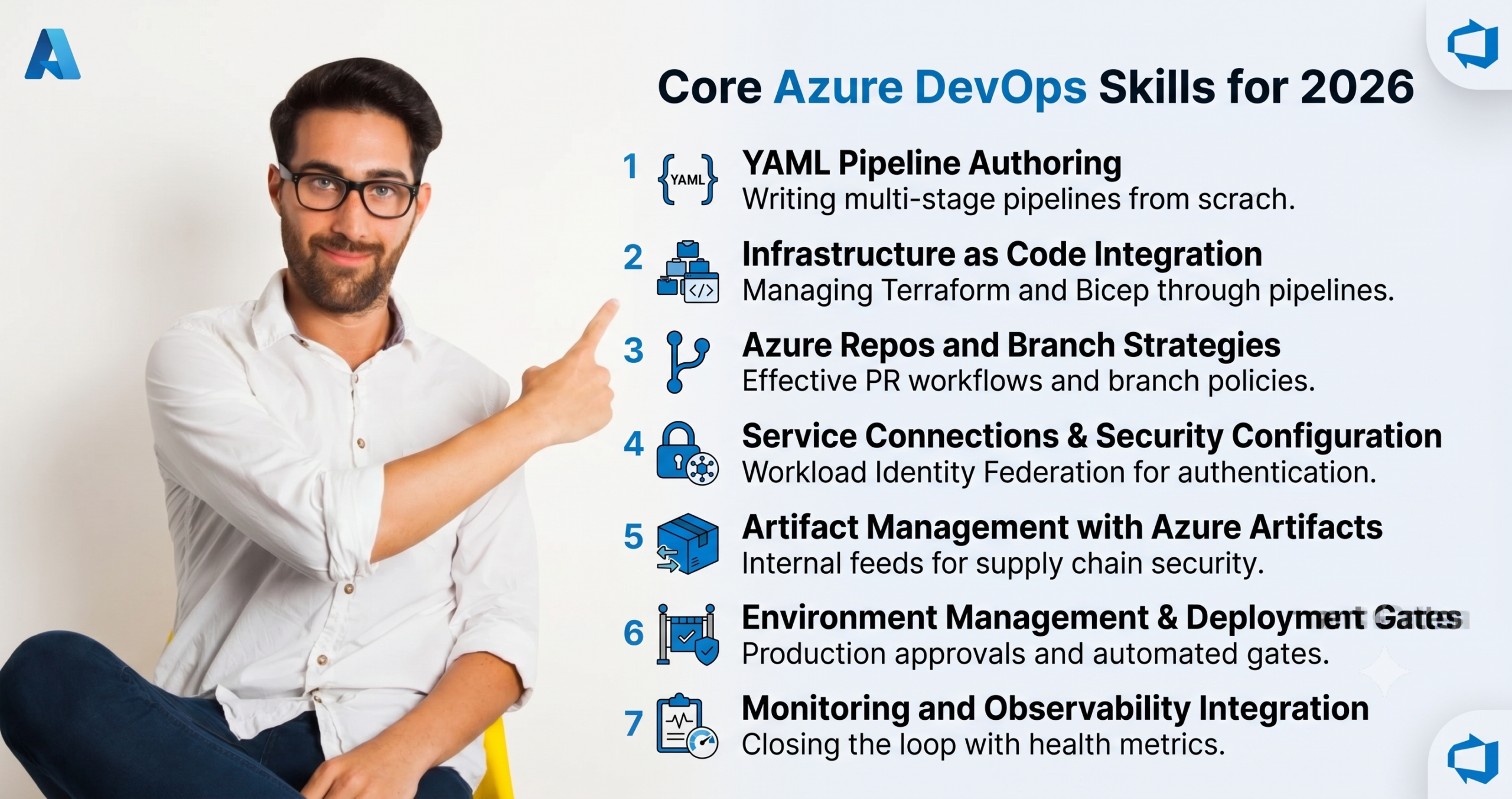
The Core Azure DevOps Skills Every Cloud Engineer Needs in 2026
Let’s get specific. Here are the skills that matter most and why.
1. YAML Pipeline Authoring
The days of clicking through the classic release pipeline editor are largely behind us. YAML-based pipelines are now the standard, and for good reason — they’re versionable, reviewable, and portable.
A strong cloud engineer in 2026 should be able to write multi-stage YAML pipelines from scratch, including defining jobs, steps, dependencies, conditions, and approvals. They should understand how to use templates to promote pipeline reuse across projects, pass variables between stages, and use pipeline triggers intelligently (branch filters, path filters, schedule triggers).
One nuance that separates intermediate from advanced practitioners is understanding the difference between runtime variables and compile-time parameters, and knowing when each is appropriate. Another is building pipelines that are genuinely idempotent — pipelines that can safely be run multiple times without producing unintended side effects.
2. Infrastructure as Code Integration
Azure DevOps doesn’t deploy infrastructure in isolation — it deploys code that defines infrastructure. This means Azure DevOps skills are inseparable from Infrastructure as Code (IaC) skills.
In practice, this means knowing how to run Terraform or Bicep deployments through Azure Pipelines, how to manage Terraform state backends securely within Azure, how to structure IaC repositories for team environments with multiple workspaces, and how to implement plan/apply gates that require human approval before infrastructure changes are applied to production.
ARM templates still exist in many legacy environments, but Bicep has largely replaced them for new projects. Engineers who know both and who understand how to migrate ARM to Bicep are in high demand.
3. Azure Repos and Branch Strategies
Version control is table stakes, but effective use of Azure Repos is a skill in itself. Cloud engineers working in team environments need to understand branch protection policies (required reviewers, minimum approval counts, build validation checks), how to configure branch policies that enforce quality gates before code merges, and how to use the pull request workflow as a communication and review mechanism, not just a merge button.
Beyond the basics, understanding trunk-based development versus feature-branch workflows, and knowing when each is appropriate for an infrastructure codebase, is something many engineers don’t think deeply about until they’ve lived through a painful merge conflict in a large team.
4. Service Connections and Security Configuration
Service connections are how Azure Pipelines authenticate to Azure subscriptions, container registries, Kubernetes clusters, and other services. Getting this right is one of the most security-critical aspects of pipeline configuration — and one of the most frequently botched.
In 2026, best practice is to use Workload Identity Federation for Azure service connections wherever possible, rather than client secrets. This eliminates the need to rotate credentials and removes a common vector for credential leakage. Cloud engineers who understand how to configure federated identity, scope service connections to specific pipelines, and audit connection usage are genuinely valuable in enterprise environments where security teams are scrutinizing every CI/CD system.
5. Artifact Management with Azure Artifacts
As organizations mature their DevOps practices, they move away from pulling packages directly from the public internet during builds. Instead, they route traffic through internal artifact feeds that mirror approved packages, allow security scanning, and ensure build reproducibility.
Azure Artifacts is the platform’s answer to this. Cloud engineers should understand how to create and configure feeds, set up upstream sources from nuget.org or npmjs.com, configure scope and access controls, and integrate artifact feeds into pipeline builds and releases.
In environments with strict supply chain security requirements — which is increasingly most large enterprises — this skill is not optional.
6. Environment Management and Deployment Gates
Azure Pipelines environments represent the logical targets for deployments: dev, staging, production. They’re not just organizational labels — they’re where approval gates, deployment history, and resource tracking live.
Understanding how to configure environment approvals (who can authorize a deployment to production, and under what conditions), how to use pre-deployment and post-deployment gates to query external systems before proceeding, and how to set up automated rollback conditions are skills that directly affect production reliability.
7. Monitoring and Observability Integration
The pipeline doesn’t end at deployment. A complete DevOps mindset includes closing the loop with observability — knowing whether the thing you just deployed is actually working.
Azure DevOps integrates with Azure Monitor and Application Insights, allowing pipeline gates to query health metrics before promoting a release or marking a deployment complete. Cloud engineers who can wire up these integrations — and who understand what signals actually matter for a reliable deployment — are operating at a higher level than those who treat deployment as “done” when the pipeline goes green.
Azure DevOps in the AI-Augmented Engineering Era
It’s worth addressing how AI tooling has changed the Azure DevOps landscape in 2026, because it’s changed it considerably.
GitHub Copilot is deeply integrated into the Microsoft ecosystem, and many Azure DevOps users work in environments where Copilot assists with YAML pipeline authoring, Bicep template generation, and test plan creation. This is a genuine productivity boost — but it’s also a trap for engineers who don’t understand the fundamentals.
Copilot-generated pipelines are often syntactically correct but semantically wrong. They’ll create a working pipeline that doesn’t do what you actually need, uses deprecated task versions, or skips security configuration that your organization requires. Engineers who deeply understand Azure Pipelines can use AI assistance effectively, catching those errors before they reach production. Engineers who rely on it as a crutch are liable to ship vulnerabilities they can’t explain.
The lesson here is that AI augments Azure DevOps skills — it doesn’t replace the need to develop them. If anything, the bar for expertise has gone up, because the average quality of AI-assisted pipelines roughly “works but isn’t great,” and someone needs to be able to distinguish between the two.
Career Impact: What the Market Is Saying
The signal from the job market is consistent. Cloud engineering roles that include Azure DevOps in their requirements have seen strong salary premiums compared to roles focused purely on cloud infrastructure. The reason is straightforward: organizations that have invested in cloud infrastructure need people who can operate it efficiently, and efficient operation at scale means automation, CI/CD, and DevOps tooling.
The AZ-400 certification, Microsoft’s Azure DevOps Engineer Expert certification, has become one of the more respected cloud certifications in enterprise hiring. It’s not a simple exam; it requires genuine hands-on experience to pass, which means holding the certification actually signals something meaningful to hiring managers.
More importantly, engineers who combine strong Azure fundamentals (AZ-104 or AZ-305 level knowledge) with solid Azure DevOps skills position themselves for platform engineering roles, DevOps architect roles, and site reliability engineering roles — all of which command significantly higher compensation than generalist cloud infrastructure positions.
Common Gaps Engineers Need to Close
Based on what’s being discussed in the cloud engineering community in 2026, here are the most common skill gaps that hold engineers back:
Security in pipelines is an afterthought. Many engineers learn to build pipelines that work functionally but don’t think critically about what secrets are being logged, whether service connection scopes are appropriately limited, or what a compromised pipeline runner could access. Treating pipeline security as a first-class concern from the start is a differentiator.
YAML templating is underused. Most engineers write pipelines as single-file monoliths. Understanding how to extract stages, jobs, and steps into reusable templates — and how to design a template library for a team — is a skill that pays significant dividends as pipeline complexity grows.
The feedback loop after deployment is broken. Deployment is treated as the finish line. Building the observability connections that tell you whether a deployment actually succeeded from a business and user perspective is where many engineers stop short.
Documentation for pipelines is nearly nonexistent. In team environments, undocumented pipelines become tribal knowledge — the thing only one person understands. Engineers who invest in commenting on their YAML, documenting pipeline architecture decisions, and maintaining runbooks for common pipeline operations are far more effective in team settings.
How to Build These Skills in 2026
The path to Azure DevOps proficiency is straightforward, though it requires genuine hands-on practice. Here’s a practical roadmap:
Start with the Microsoft Learn paths. Microsoft’s own learning platform offers free, well-structured paths for Azure Pipelines, Azure Repos, and the AZ-400 certification. They’re not exciting, but they’re accurate and comprehensive.
Build a real project. Spin up a personal Azure subscription, create an Azure DevOps organization, pick a side project, and build the entire CI/CD pipeline yourself — including IaC deployment, artifact management, and environment gates. Nothing teaches like doing.
Study other people’s pipelines. GitHub has thousands of public repositories with Azure Pipelines YAML. Reading well-written pipelines from experienced practitioners is one of the fastest ways to learn patterns you wouldn’t discover on your own.
Pursue the AZ-400. The preparation process itself will surface gaps in your knowledge. Even if you don’t plan to take the exam, working through the exam objectives is a useful way to audit your skills.
Engage with the community. The Azure DevOps community on LinkedIn, Reddit’s r/AZURE, and Microsoft Tech Community forums are active. Practitioners share real-world problems and solutions there regularly.
Final Thoughts
Cloud engineering is no longer just about knowing which Azure services exist and how to configure them. It’s about building the systems that make cloud infrastructure reliable, secure, and continuously improvable. Azure DevOps is the platform at the center of that capability in the Microsoft cloud ecosystem.
In 2026, the engineers who stand out are not the ones who know the most services. They’re the ones who can move infrastructure changes from commit to production safely, quickly, and repeatably. They’re the ones who’ve built the pipelines that other engineers depend on. They’re the ones who treat deployment as a system — not a manual chore.
That’s what Azure DevOps skills give you. And that’s exactly why they’ve moved from optional to essential for every serious cloud engineer working in the Microsoft ecosystem today.