

If you’ve been searching for the perfect data science course syllabus to kickstart your career in 2026, you’re already one step ahead. The data science field has exploded over the last few years, and the demand for skilled professionals is only getting stronger. But here’s the challenge — with so many courses out there, how do you know which one actually prepares you for a real job?
The answer lies in the syllabus. A well-crafted data science course syllabus is your complete learning roadmap. It tells you what topics you’ll master, in what order, and whether the course is genuinely built for beginners or just marketed that way. In this guide, we’re breaking down exactly what a beginner-friendly data science course syllabus should look like in 2026 — module by module — so you can make a confident, informed choice.
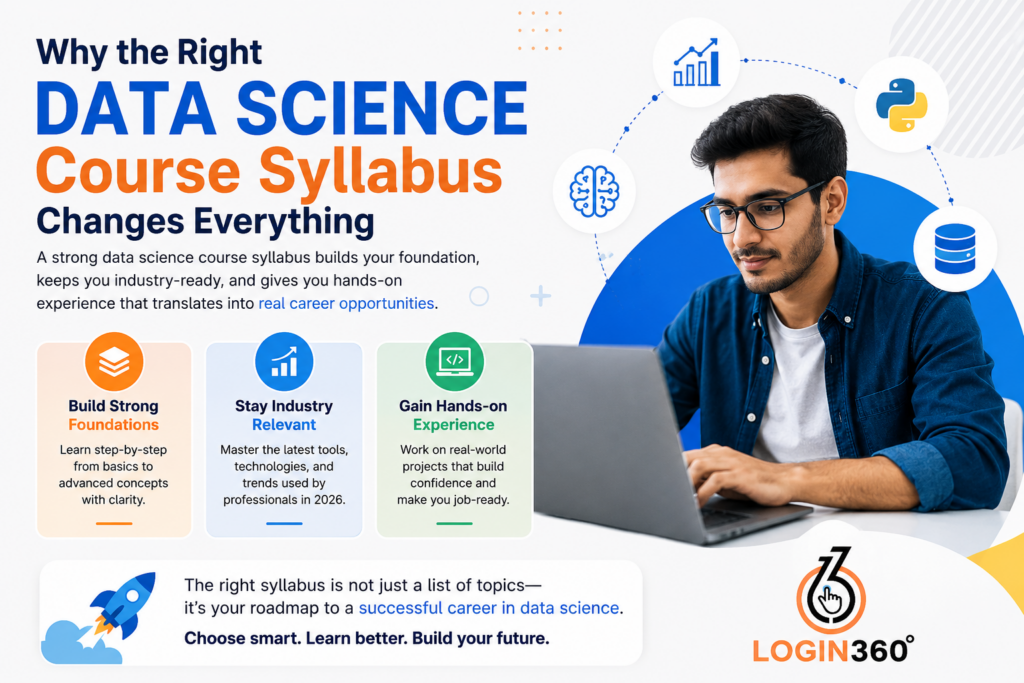
Why the Right Data Science Course Syllabus Changes Everything
Not all data science courses are created equal. Some promise the world but deliver outdated content, while others are so theory-heavy that you finish without a single project to show employers.
A strong data science course syllabus does three things well: it builds your foundation gradually, it keeps pace with what the industry actually uses in 2026, and it gives you hands-on experience that translates directly into job readiness. When you’re evaluating any program, the syllabus is the single most honest signal of its quality.
So, what should a complete, beginner-focused data science course syllabus cover? Let’s walk through every essential module.
Foundations of Data Science
Every beginner-friendly data science course syllabus must start here — and for good reason. This is where you build the mental framework that everything else depends on.
In this foundational module, you should expect to cover:
- What is Data Science? — Understanding the full data science lifecycle, the difference between data analyst, data engineer, and data scientist roles, and how data science drives real business decisions.
- Statistics and Probability — Descriptive statistics, probability distributions, hypothesis testing, confidence intervals, and p-values. This is where you learn to think critically with numbers.
- Mathematics for Data Science — Linear algebra, basic calculus, and matrix operations. You don’t need to be a mathematician, but these concepts power every machine learning algorithm you’ll encounter.
This module is often underestimated by beginners, but it’s what separates data scientists who truly understand their work from those who just copy-paste code.
Programming for Data Science
No data science course syllabus is complete without serious programming coverage. In 2026, Python remains the dominant language, used across startups, enterprises, and research labs worldwide.
A quality data science course syllabus for beginners should include:
- Python Programming Basics — Variables, data types, loops, functions, and object-oriented programming concepts.
- NumPy and Pandas — The two most essential libraries for data manipulation in Python. You’ll rely on these every single working day.
- Data Wrangling — Cleaning messy real-world datasets, handling missing values, merging and reshaping Dataframes.
- SQL for Data Science — Writing queries, joins, subqueries, and aggregate functions. Most companies store their data in relational databases, so SQL is completely non-negotiable.
The best data science course syllabus programs don’t just lecture about code — they make you write it. Look for courses with lots of coding exercises, mini-projects, and live problem-solving.
Data Visualization
Raw data in a spreadsheet tells no story. Visualization is what makes data meaningful — and it’s one of the most valuable skills you can have when communicating with business stakeholders.
A well-rounded data science course syllabus should dedicate a full module to:
- Matplotlib and Seaborn — Python’s core charting libraries for creating bar charts, scatter plots, histograms, heatmaps, and more.
- Plotly and Interactive Dashboards — Dynamic visualizations that users can interact with in browsers or web apps.
- Tableau or Power BI — Industry-standard BI tools used in thousands of companies. Even basic familiarity here can give you a real edge during job interviews.
- Storytelling with Data — How to choose the right chart, what to emphasize, and how to present findings clearly to a non-technical audience.
This is the module where technical skill meets communication — and employers in 2026 are desperate for people who can do both well.
Machine Learning
This is where most beginners get excited — and rightfully so. Machine learning is the heart of modern data science, and a good data science course syllabus should give it plenty of depth.
Here’s what a comprehensive machine learning module looks like:
- Supervised Learning — Linear regression, logistic regression, decision trees, random forests, and support vector machines. These are the everyday tools of predictive modeling.
- Unsupervised Learning — K-means clustering, hierarchical clustering, and dimensionality reduction using PCA.
- Model Evaluation — Accuracy, precision, recall, F1-score, and ROC-AUC curves. Knowing how to measure whether your model is actually good is just as important as building it.
- Overfitting and Regularization — Ridge and Lasso techniques that help your models generalize to new, unseen data.
- Scikit-learn — Python’s most widely used machine learning library, which you’ll work with extensively.
A standout data science course syllabus won’t just cover what each algorithm does — it’ll teach you when to use it and why it works, so you can make smart decisions independently on the job.
Deep Learning and Artificial Intelligence
Not every data science course syllabus dives this deep, but the best beginner programs in 2026 at least introduce these concepts. Deep learning and AI are no longer niche — they’re mainstream, and understanding them even at a surface level gives you a massive advantage.
This module should cover:
- Neural Networks — How they’re structured, how activation functions work, and the basics of backpropagation and gradient descent.
- TensorFlow and Keras — The industry-standard frameworks for building and training deep learning models.
- Convolutional Neural Networks (CNNs) — The technology behind image recognition and computer vision applications.
- Natural Language Processing (NLP) — Text classification, sentiment analysis, and how modern language models process human language.
Even foundational exposure to deep learning in your data science course syllabus sets you up for some of the most in-demand and highest-paying roles in tech right now.
Data Engineering Essentials
This is the most overlooked part of most data science course syllabus designs — and it’s also one of the most important for actually thriving in a real job. Data scientists in the real world don’t just build models; they work with pipelines, cloud platforms, and databases every day.
A practical data science course syllabus for 2026 should include:
- Working with APIs — How to fetch, process, and use data from external web services.
- Big Data Tools — An introduction to Apache Spark, Google BigQuery, or AWS S3 for handling large-scale datasets.
- NoSQL Databases — Understanding MongoDB and other non-relational databases alongside traditional SQL.
- ETL Pipelines — Extract, transform, load — the structured process of moving data reliably from source to destination.
Understanding the engineering side of data makes you someone that entire teams want to work with — not just someone who can run models in a notebook.
Capstone Projects and Portfolio Building
Here’s a truth that no one tells beginners: your portfolio matters more than your certificate. The data science course syllabus that sets you up to actually get hired is one that prioritizes real project work throughout.
Look specifically for courses that include:
- End-to-End Projects — You take a raw dataset, clean it, explore it, build a model, evaluate it, and present your insights. This is exactly what the job looks like.
- Kaggle Competitions — Competing on Kaggle teaches you to think creatively under pressure and exposes you to diverse problem types.
- GitHub Portfolio Building — Your projects should be documented, version-controlled, and shareable — ready to show any employer.
- Industry Case Studies — Real-world scenarios in healthcare, e-commerce, finance, or marketing that mirror actual business problems.
A great capstone project baked into your data science course syllabus can genuinely get you hired even with zero professional experience.
What Else Makes a Great Data Science Course Syllabus in 2026?
Beyond the core modules, a few extras can make a major difference:
Mentor Access — Does the course give you access to real instructors or industry mentors? When you hit a wall (and you will), having someone to guide you is invaluable.
Updated Curriculum — The tools and techniques in data science shift quickly. A data science course syllabus last updated in 2022 may already be missing key frameworks that employers expect in 2026.
Career Support — Resume reviews, mock technical interviews, LinkedIn optimization, and job referrals. If a course promises placement support, make sure it’s real and specific.
Active Community — Peer learning accelerates growth. Courses with Discord servers, live cohorts, or active forums keep you motivated and help you problem-solve faster.
Is This Data Science Course Syllabus Right for Beginners?
Absolutely — if the course is structured properly. A beginner-friendly data science course syllabus should always start with programming fundamentals and statistics before introducing machine learning. Jumping straight to deep learning without understanding linear regression is the fastest route to burnout and confusion.
If you already have a programming or analytics background, you may be able to skip the first module of a data science course syllabus and jump into ML directly. But for true beginners, every single module outlined above is part of your learning roadmap — and that’s a good thing.
Final Thoughts: Your 2026 Data Science Journey Starts with the Syllabus
The data science course syllabus you choose today will shape the professional you become tomorrow. It determines which tools you’re fluent in, which problems you can tackle, and how confidently you walk into your first interview.
Don’t pick a course based on price alone or because an ad kept popping up. Review the data science course syllabus thoroughly. Ask whether it builds foundations, covers current tools, includes real projects, and supports you after the last video ends.
Data science is one of the most rewarding, well-compensated, and future-proof careers available in 2026. Your journey to becoming a data scientist starts with one smart decision — choosing the right data science course syllabus that’s built for beginners and designed for results.
Take your time, do your research, and invest in a learning roadmap that will genuinely transform your career.