
Digital platforms now influence the majority of buying decisions, and businesses are investing heavily in online channels to reach their audiences faster and more precisely than ever before. This rapid digital shift is reshaping the job market in real time.The digital realm is no longer just a supplement to business; it is the primary battleground for customer attention and market share. This brings us to a critical question: what is Digital marketing in 2026, and why is it the indispensable skill that countless students are overlooking, despite its immense earning potential?
This article aims to demystify Digital marketing, projecting its evolution into 2026, and highlight why mastering it is not just an advantage but a necessity for future-proof careers. We will explore its core components, the lucrative opportunities it presents, and how aspiring professionals can effectively enter this dynamic field.
What is Digital Marketing in 2026? A Refined Definition
At its core,Digital marketing encompasses all marketing efforts that use an electronic device or the internet. However, in 2026, this definition is far more nuanced and expansive than ever before. It’s not merely about having a website or running a few social media ads; it’s about creating integrated, data-driven, and highly personalized customer experiences across an increasingly complex digital ecosystem. The focus has shifted from simply reaching an audience to engaging them meaningfully, building trust, and driving measurable outcomes.
By 2026, digital marketing isn’t just “using AI” it’s powered by it at every level. Artificial Intelligence (AI), Machine Learning (ML), and advanced analytics are no longer backend tools; they actively shape strategy, creativity, and customer experience in real time.
For example, instead of basic demographic targeting, brands now use AI-driven behavioral mapping systems like PredictPulse 360 (a hypothetical AI engine) that analyze micro-signals such as scroll speed, pause time on product images, and repeat visits to predict purchase intent before a user even adds an item to their cart. A skincare brand could automatically trigger a personalized video ad the moment the system detects “high hesitation behavior” on a pricing page.The lines between various marketing channels have blurred, demanding a holistic, omnichannel approach where every touchpoint works in synergy.
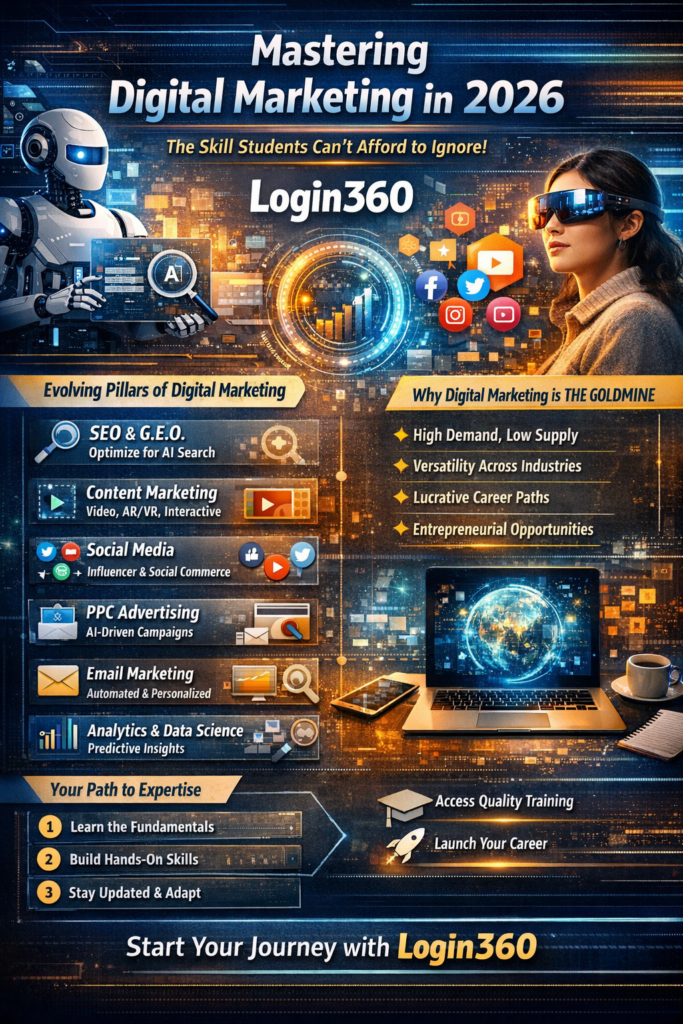
The Pillars of Digital Marketing in the Mid-2020s
By 2026, digital marketing isn’t just evolving it’s fragmenting, automating, and demanding more accountability than ever before. Each pillar is still standing, but the rules have changed.
1. SEO & G.E.O. (Generative Engine Optimization)
SEO in 2026 is no longer just about ranking on search engines it’s about being referenced by AI.
With generative search experiences replacing traditional SERPs, G.E.O. (Generative Engine Optimization) becomes critical. Brands now optimize content not just for keywords, but for AI citation probability. That means:
- Structuring content in answer-ready blocks
- Embedding expert signals and verified data
- Training brand-specific knowledge bases for AI systems
A bold shift? Click-through rates from traditional search are predicted to drop by 25–40% as AI summaries satisfy queries instantly. Instead of fighting this, smart brands optimize for “AI visibility share” how often their brand is cited in generative answers.
Emerging challenge: AI content saturation.
By 2026, over 70% of web content is AI-assisted. Search engines prioritize “experience-backed signals” — real case studies, human insight layers, creator identity verification. Anonymous, mass-generated content? Practically invisible.
2. Content Marketing
Content is no longer about volume. It’s about trust architecture.
Consumers in 2026 are hyper-aware of AI-generated fluff. The differentiator? Perspective. Brands now blend AI efficiency with human authority. Think:
- Founder-led storytelling
- Community-driven co-creation
- Data-backed thought leadership
Micro-communities outperform broad audiences. A 10,000-member niche Slack group can drive more revenue than a 500,000-follower passive audience.
Bolder prediction:
“Zero-click content ecosystems” rise. Brands build closed content loops inside newsletters, apps, and gated communities reducing reliance on unpredictable algorithms.
Ethical dilemma:
Disclosure. Should brands label AI-assisted content? In many regions by 2026, transparency laws require watermarking AI-generated assets.
3. Social Media Marketing
Social media becomes AI-curated entertainment.
Feeds are fully predictive. Algorithms don’t just respond to engagement they anticipate mood. Platforms analyze typing speed, pause duration, and interaction style to detect emotional state.
Short-form video still dominates, but private social spaces grow faster. Community-based platforms, subscription groups, and decentralized networks gain traction as users seek authenticity.
Emerging opportunity:
Synthetic influencers AI personas with hyper-consistent branding generate 3x engagement in some sectors due to perfect audience alignment. However, trust collapses when disclosure is unclear.
Brands in 2026 succeed by balancing automation with raw, unfiltered human presence.
4. Paid Advertising
Paid ads are no longer manually managed they’re machine-negotiated.
AI systems run autonomous A/B/C/D testing in seconds. Campaigns optimize across platforms simultaneously, reallocating budgets dynamically based on predicted lifetime value (LTV), not just clicks.
Forward-looking shift:
Ad platforms begin charging based on conversion probability modeling rather than impressions. You pay for predicted outcomes.
But here’s the tension privacy regulations tighten globally. Cookie-less ecosystems dominate. First-party data becomes the most valuable marketing asset a company owns.
Brands that fail to build direct data relationships struggle to compete.
5. Email Marketing
Email quietly becomes one of the most powerful retention tools again.
In a world of AI-curated feeds, inboxes feel personal. AI-driven segmentation in 2026 predicts churn risk weeks in advance. Instead of generic newsletters, users receive adaptive sequences where tone, visuals, and offers evolve based on behavioral micro-patterns.
Bold evolution:
Emotion-responsive emails. If AI detects lower engagement over time, messaging automatically shifts from sales-focused to value-focused (guides, tools, community invites).
The challenge? Avoiding hyper-personalization creepiness. Ethical personalization becomes a competitive advantage.
6. Analytics & Data Science
Analytics moves from reporting to autonomous decision-making.
Dashboards don’t just show metrics they recommend and execute actions. Predictive modeling identifies:
- Future high-value customers
- Content decay points
- Seasonal revenue dips before they happen
By 2026, companies investing heavily in predictive analytics are expected to outperform competitors in revenue growth by up to 20–30%.
However, bias in AI models becomes a serious issue. Poorly trained systems can unintentionally exclude audience segments or reinforce stereotypes making ethical data governance a board-level priority.
The Bigger Picture
The pillars remain SEO, content, social, paid, email, analytics but they’re no longer isolated tactics. They’re AI-connected systems feeding into each other in real time.
The brands that win in 2026 won’t just adopt AI tools. They’ll build:
- Strong first-party data ecosystems
- Transparent AI policies
- Human-led creative differentiation
- Community-centered brand trust
Because in a world where everything can be automated, authenticity becomes the ultimate competitive edge.
Why Digital Marketing is the Skill Every Student is Sleeping On
In 2026, digital marketing isn’t just “another skill on the resume” it’s a strategic power tool that drives business growth, fuels global ad economies, and opens careers most students aren’t even thinking about yet.
1. High Demand
Digital marketing jobs are no longer niche; they’re central to business success. With companies reallocating huge chunks of their budgets from traditional to online channels, demand for digital marketers continues to skyrocket. According to recent industry insights, more than 70% of companies worldwide are increasing digital marketing budgets, and digital roles consistently rank among the top 10 most sought-after skills on LinkedIn.
In the U.S., marketing occupations driven by digital roles are projected to grow about 10% by 2026, outpacing the average for all careers.
This means students who master these skills aren’t competing in a crowded field they’re entering a fast-expanding one.
2. Versatility
One of the biggest perks of digital marketing is how many different directions you can go:
- SEO Specialist
- Paid Advertising Manager
- Content Strategist
- Analytics & Data Lead
- Email & CRM Automation Expert
- Social Media Growth Strategist
- AI-Driven Marketing Specialist
Each path requires overlapping but distinct expertise, giving students options to specialize based on strengths (creative, analytical, strategic, technical).
Plus, these roles exist across virtually every industry from fintech to healthcare because every business now has a digital presence.
3. Lucrative Career Paths
Let’s talk money because numbers make this real.
By 2026, digital marketing roles are increasingly tied to measurable business outcomes, which means compensation reflects impact. For example:
- Entry-level digital marketers can earn anywhere from roughly ₹3–6 LPA in India, with more competitive packages in metro markets.
- Specialists and mid-level professionals often see ₹8–15 LPA or more.
- Senior specialists and managers particularly in analytics, growth marketing, and performance advertising routinely command ₹18–30+ LPA or higher.
Globally, advanced roles tied to performance and revenue like Growth Marketer or Digital Strategy Lead — are predicted to average well into the $150,000–$180,000+ range by 2026, driven by market demand and skill premiums.
That’s not “future promise.” That’s real earning potential students can bank on.
4. Accessibility and Continuous Learning
The best part? You don’t need a fancy degree for most digital marketing roles. What matters most is skill, not certification and the learning never stops.
Digital marketing pulls from fields like data science, psychology, analytics, automation, and creative strategy, so every new skill you acquire multiplies your value.
Whether you learn through online platforms, internships, project work, freelancing, or even AI-powered tools, digital marketing rewards hands-on experience not just textbook learning.
And because the tools, platforms, and consumer behaviors evolve constantly, staying sharp means staying employable longer.
5. Entrepreneurial Opportunities
Perhaps the most underrated part? Digital marketing isn’t just a job it’s a business engine.
With relatively low startup costs, students can:
- Launch freelance gigs
- Build agency services
- Monetize personal content brands
- Grow e-commerce or side projects
- Serve international clients from anywhere
Many professionals earn multiples of their full-time salaries purely through freelance consulting or niche service offerings especially in areas like SEO automation, funnel optimization, AI-guided campaigns, and analytics strategy.
And that’s not accidental: India’s digital economy is projected to cross $1 trillion by 2026, with digital marketing playing a central role in that growth story.
Bottom Line
Digital marketing in 2026 isn’t a fallback career it’s a strategic advantage. It combines creativity with data fluency, lets you enter the workforce faster than many traditional paths, and unlocks wide-open earning potential and entrepreneurial freedom.
If you’re still sleeping on this skill? You might just be missing one of the most future-proof paths of the decade.
G.E.O. (Generative Engine Optimization) in Action: Optimizing for AI Search
As we project into 2026, the rise of AI-powered search engines and generative AI tools fundamentally changes how content is consumed and discovered. This makes G.E.O. not just a buzzword, but a critical strategic imperative.
To optimize for AI search, content creators must think like an LLM. This means providing clear, unambiguous information that directly answers potential questions. Using structured data formats (like bulleted lists, numbered lists, tables, and FAQ sections) makes it easier for AI to extract and synthesize information. Ensuring high E.E.A.T. signals demonstrating expertise, authoritativeness, and trustworthiness is paramount, as AI models are increasingly trained on and prioritize credible sources. Content should be comprehensive yet concise, providing deep insights without unnecessary jargon, enabling AI to accurately summarize and present information to users. The goal is to be the definitive, go-to source that AI trusts and references.
Conclusion
In 2026,What is digital marketing is not merely a collection of online tactics; it is a sophisticated, data-driven discipline that lies at the heart of modern business success. It represents an unparalleled opportunity.For students in Coimbatore who are ready to actually act on this opportunity (instead of just reading about it), the next step isn’t motivation it’s the right kind of training.
Rather than jumping into random online tutorials, it’s smarter to look for structured programs that combine hands-on projects, real campaign simulations, mentorship, and placement support. A good digital marketing course in 2026 shouldn’t just teach theory like “what is SEO?” it should walk you through running live ads, building funnels, using analytics dashboards, experimenting with AI tools, and solving real business problems.