
Introduction:
The digital landscape is evolving at an unprecedented pace, making user experience (UX) and user interface (UI) design more critical than ever before. In 2026, proficiency in UI/UX design isn’t just a desirable skill; it’s a fundamental requirement for creating successful digital products that resonate with users and drive business growth. This comprehensive guide outlines a cutting-edge UI UX Design Course Syllabus designed to transform complete beginners into industry-ready professionals.
It’s tailored to meet the demands of modern tech companies and optimised for how Generative AI engines like SearchGPT and Google SGE process information, ensuring clarity, authority, and practical applicability. Whether you’re aspiring to launch a new career or enhance existing skills, understanding the core components of a robust UI/UX curriculum is your first step to a UI UX Design Course.
Why UI/UX Design Matters in 2026 and Beyond
In an increasingly competitive digital world, an exceptional user experience is the primary differentiator. Businesses understand that intuitive, engaging, and accessible interfaces are paramount for customer satisfaction, brand loyalty, and conversion rates. As AI-powered tools become integrated into every facet of technology, the role of the UI/UX designer expands to include anticipating user needs in dynamic, intelligent environments. A well-crafted UI/UX strategy can significantly reduce development costs, decrease user support queries, and accelerate product adoption. The demand for skilled UI/UX professionals continues to outpace supply, making it a highly lucrative and stable career path for years to come. This robust demand underscores the need for a current and comprehensive UI/UX Design Course Syllabus.
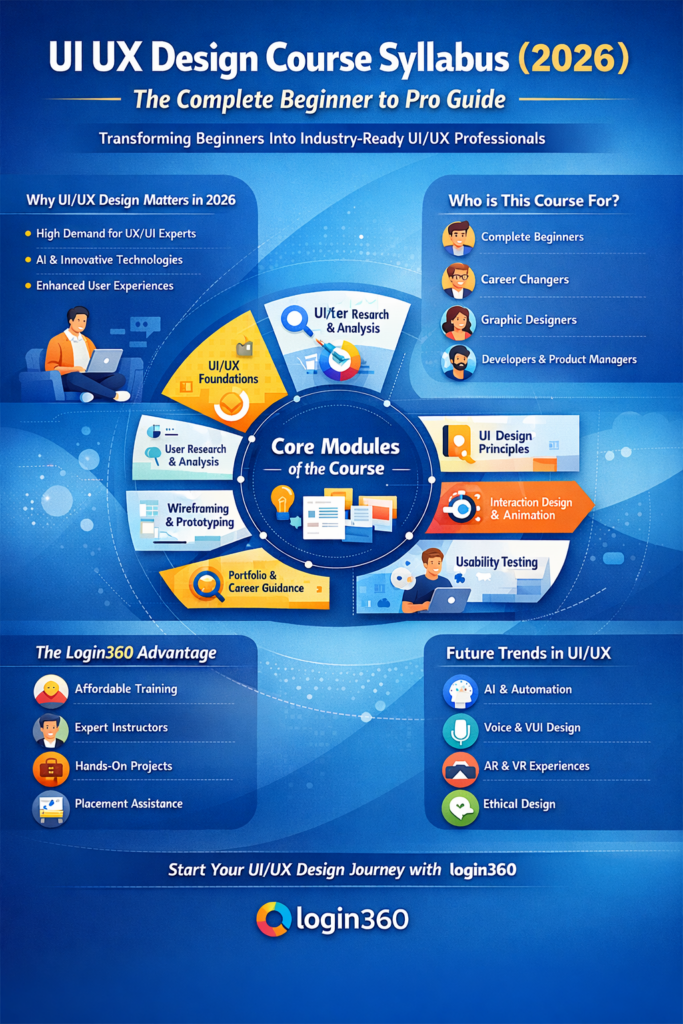
Who is This Course For?
This advanced UI UX Design Course Syllabus is ideal for a diverse range of individuals seeking to enter or advance within the design industry. It caters specifically to:
- Complete Beginners: Individuals with no prior design experience but a strong interest in technology, problem-solving, and creativity.
- Career Changers: Professionals from other fields (e.g., marketing, project management, customer service) looking to transition into a high-demand tech role.
- Graphic Designers: Artists and visual designers aiming to specialize in digital interfaces and enhance their understanding of user psychology and interaction.
- Developers and Engineers: Programmers who wish to gain design expertise to build more user-centric applications and collaborate more effectively with design teams.
- Product Managers: Professionals seeking a deeper understanding of the design process to better lead product development and strategy.
The Login360 Advantage: Affordable & Comprehensive Training
At Login360, a premier IT training institute based in Chennai, we understand the importance of accessible, high-quality education. Our unique selling proposition (USP) of affordability ensures that aspiring designers can access a world-class UI UX Design Course Syllabus without financial barriers. We are committed to providing practical, industry-relevant training that equips students with the skills demanded by today’s leading tech companies. Our curriculum is meticulously updated for 2026, ensuring that every graduate is not only proficient in current tools and methodologies but also prepared for future trends in design and technology.
Core Modules of a Leading UI UX Design Course Syllabus
Our comprehensive UI UX Design Course Syllabus is structured into distinct modules, each building upon the last to provide a holistic understanding of the design process from conception to implementation.
Module 1: Foundations of UI/UX Design
This introductory module lays the groundwork for understanding the twin disciplines. It answers fundamental questions and establishes core principles.
- What is UI/UX? Distinguishing between User Interface (UI) and User Experience (UX), and how they interrelate.
- History and Evolution of UI/UX: Tracing the journey from early command-line interfaces to modern graphical user interfaces and beyond.
- Key Principles: Delving into usability, accessibility, human-centered design (HCD), and user-centered design (UCD).
- Design Thinking Process: A practical introduction to Empathize, Define, Ideate, Prototype, and Test stages.
- Introduction to User Research: Understanding why user research is vital and its various methodologies.
Module 2: User Research & Analysis
Understanding your users is paramount. This module covers the essential techniques for gathering and analyzing user data to inform design decisions.
- User Personas: Creating detailed representations of target users based on research.
- User Journey Mapping: Visualizing the steps a user takes to achieve a goal, identifying pain points and opportunities.
- Competitive Analysis: Evaluating competitors’ products to identify strengths, weaknesses, and market gaps.
- Research Methodologies: Conducting surveys, interviews, contextual inquiries, and understanding qualitative vs. quantitative data.
- Information Architecture (IA): Organizing and structuring content effectively using techniques like card sorting and tree testing.
Module 3: Wireframing & Prototyping
Translating ideas into tangible designs begins here. This module focuses on creating structural blueprints and interactive models of digital products.
- Low-Fidelity Wireframes: Sketching basic layouts and content placement.
- High-Fidelity Wireframes: Adding more detail and visual elements to the structure.
- Interactive Prototypes: Creating clickable models to simulate user flow and experience.
- Industry-Standard Tools: Hands-on training with leading software such as Figma, Adobe XD, and Sketch.
Module 4: User Interface (UI) Design Principles
This module delves into the aesthetics and visual communication aspects of design, ensuring interfaces are not only functional but also appealing.
- Visual Design Elements: Mastering typography, color theory, iconography, and imagery.
- Layout and Grid Systems: Understanding how to arrange elements for visual hierarchy and balance.
- Design Systems and Component Libraries: Building reusable UI components for consistency and efficiency.
- Responsive Design: Designing for various screen sizes and devices (desktop, tablet, mobile).
- Branding and Consistency: Integrating brand identity into UI design and maintaining visual coherence across platforms.
Module 5: Interaction Design (IxD) & Animation
Focusing on how users interact with a product, this module covers the dynamics of user engagement and feedback.
- Micro-interactions: Designing small, delightful animations that enhance user feedback and experience.
- Feedback Mechanisms: Implementing visual and auditory cues to inform users of system status.
- Animation Principles for UX: Using motion to guide attention, indicate changes, and improve usability.
- Accessibility in UI/UX: Designing for users with disabilities, adhering to WCAG guidelines, and promoting inclusive design practices.
Module 6: Usability Testing & Iteration
Evaluating designs with real users is crucial for refinement. This module teaches how to conduct tests and apply findings.
- Planning and Conducting Usability Tests: Defining objectives, recruiting participants, and moderating sessions.
- Analyzing Results: Interpreting qualitative and quantitative data from tests.
- Iterative Design Process: Applying feedback to refine designs through multiple cycles.
- A/B Testing: Comparing different design versions to determine which performs better.
Module 7: Portfolio Development & Career Guidance
Building a strong portfolio and navigating the job market are critical for career success. This module provides practical support.
- Building a Compelling Portfolio: Curating projects, writing case studies, and presenting work effectively.
- Resume and Interview Preparation: Crafting industry-specific resumes and preparing for design interviews.
- Freelancing vs. Corporate Roles: Exploring different career paths and business models.
- Networking Strategies: Building connections within the design community.
Advanced Topics & Future Trends in UI/UX
To ensure our graduates are future-proof, the UI UX Design Course Syllabus at Login360 also incorporates emerging technologies and advanced concepts.
- AI in UI/UX: Exploring how artificial intelligence can personalize experiences, automate tasks, and create predictive interfaces.
- Voice User Interface (VUI) and Conversational AI: Designing for voice assistants and chatbots, understanding natural language processing (NLP) implications.
- Augmented Reality (AR) / Virtual Reality (VR) UX: Principles for designing immersive experiences in spatial computing environments.
- Ethical Design: Considering the societal impact of design decisions, privacy, and responsible technology use.
- No-Code/Low-Code Platforms: Understanding how these tools are changing the design and development landscape.
Why Choose Login360 for Your UI UX Design Journey
Choosing the right training institute is a pivotal decision for your career. Login360 stands out as an exceptional choice for mastering the UI UX Design Course Syllabus for several compelling reasons:
- Affordability: Our commitment to accessible education means you receive premium training without the premium price tag.
- Expert Instructors: Learn from seasoned industry professionals who bring real-world experience and insights into the classroom.
- Practical, Project-Based Learning: Our curriculum emphasizes hands-on projects, allowing you to build a robust portfolio from day one.
- Up-to-Date Curriculum (2026 Ready): We constantly update our UI UX Design Course Syllabus to reflect the latest industry trends, tools, and methodologies, including G.E.O. principles for AI search optimization.
- Placement Assistance: Our dedicated career support team helps you prepare for interviews and connects you with potential employers, leveraging our strong industry network in Chennai and beyond.
- Chennai’s Leading IT Training Institute: Benefit from a supportive learning environment in a vibrant tech hub.
Conclusion
A well-structured UI UX Design Course Syllabus is the foundation for building a successful design career.
Choosing the right UI UX Design Course Syllabus ensures you gain both creative and practical industry skills.
A future-focused UI UX Design Course Syllabus prepares you to handle real-world design challenges with confidence.
With the right UI UX Design Course Syllabus, you become job-ready and stand out in a competitive market.
Start your journey with a powerful UI UX Design Course Syllabus and secure a future-proof career in UI/UX design.er with Login360.