

What if I told you your business is sitting on a goldmine and calling it garbage? Every spreadsheet, every log, every transaction holds clues that can drive smarter decisions—if you have the skills to read them. Today, companies aren’t looking for more data; they’re looking for data whisperers. If you’re looking to pivot into a high-demand field and are ready to commit, how to learn data analytics in just three months is not only possible but entirely achievable with a strategic, focused approach. This guide will map out a practical, intensive pathway to mastering the essentials and launching your data analytics career.
Month 1: Building Your Foundational Pillars
Think of Month 1 as charting a new territory. You’re learning the landscape—what tools exist, how they work, and where to find the most useful insights. This exploratory phase sets you up to navigate more complex datasets with ease and curiosity.
Understanding the Landscape of Data Analytics
Before diving into tools and techniques, it’s essential to understand where analytics fits in the modern business ecosystem. Analytics isn’t just about numbers—it’s about uncovering actionable insights.
Niche Industry Examples:
- Manufacturing: Predictive maintenance using IoT sensor data to prevent machinery downtime.
- E-learning: Sentiment analysis to measure student engagement on digital platforms.
- E-commerce: Cohort analysis to understand customer retention patterns.
Mini-case Study:
Imagine a startup notices repeat purchase rates dropping. By segmenting users based on recency, frequency, and monetary value (RFM analysis), the analyst finds first-time buyers disengage after poorly timed emails. Adjusting the campaign schedule improves repeat purchases by 15%.
Why It’s Rewarding:
Understanding analytics’ landscape is challenging due to the breadth of industries, jargon, and tools—but seeing direct business impact (like revenue growth or churn reduction) is incredibly motivating.
Tips:
- Build a mini-portfolio of small projects across industries.
- Follow real-world analytics blogs and Kaggle competitions to see how theory translates to practice.
Core Statistical and Mathematical Concepts
Statistics is the backbone of analytics. Knowing formulas isn’t enough—you need to interpret results in context.
Key Concepts with Real-World Context:
- Probability & Distributions: Understanding demand forecasts or risk assessment.
- Hypothesis Testing: Evaluating if a new marketing campaign outperforms the old one.
- Correlation & Regression: Determining relationships, like ad spend vs. sales conversion.
Mini-case Study:
A streaming service tests a new recommendation engine. Results show statistically significant improvement, but effect size is minimal. The lesson: significance doesn’t always mean practical value.
Challenges & Rewards:
Concepts like Type I/II errors or multicollinearity can confuse beginners. Mastering them allows you to not just crunch numbers, but interpret business implications.
Tips:
- Visualize data with histograms, scatter plots, and boxplots.
- Experiment with small datasets to build intuition before tackling large ones.
- Conduct “what-if” tests to see how changes affect results.
Mastering SQL: The Language of Databases
SQL is the universal language for accessing, managing, and transforming data, making it indispensable for anyone working with information. But even the most complex analyses are only useful if you can clearly communicate your insights to stakeholders. Understanding theory is important, yet hands-on, practical experience is what truly demonstrates your capability and sets you apart.SQL is your bridge from raw data to actionable insights. Writing queries is one thing; writing efficient, optimized queries is another.
Niche Example:
A logistics company calculates average delivery delay per driver using window functions to identify consistent outliers.
Mini-case Study:
In a retail dataset with millions of transactions, ranking customers by purchase frequency using CTEs identifies the top 5% who generate 50% of revenue—critical for targeting loyalty campaigns.
Challenges & Rewards:
Beginners often overuse subqueries or write inefficient joins. Learning to write clean, optimized queries is challenging but extremely satisfying when analysis runs in seconds instead of minutes.
Tips:
Understand indexing and query optimization basics.
Read SQL notebooks on GitHub/Kaggle to see expert approaches.
Practice writing queries for hypothetical business questions, not just exercises.
Excel: Your Everyday Data Companion
While often overlooked in favor of more advanced tools, Excel remains a powerhouse for data handling, especiExcel is more than a spreadsheet—it’s a full-fledged analytical tool when used effectively.
Niche Example:
Financial modeling for startups: dynamic dashboards simulate funding scenarios by adjusting unit cost, CAC, and churn rates.
Mini-case Study:
Tracking social media engagement over months: PivotTables identify the best-performing content, while conditional formatting flags underperforming posts for immediate improvement.
Challenges & Rewards:
Many beginners underutilize features like PivotTables, Power Query, and dynamic formulas. Mastering them automates repetitive tasks, saving hours of manual work.
Tips:
Explore Power Query for cleaning messy, real-world data
Learn INDEX-MATCH instead of VLOOKUP for flexibility.
Use dynamic named ranges and structured tables to handle growing datasets.
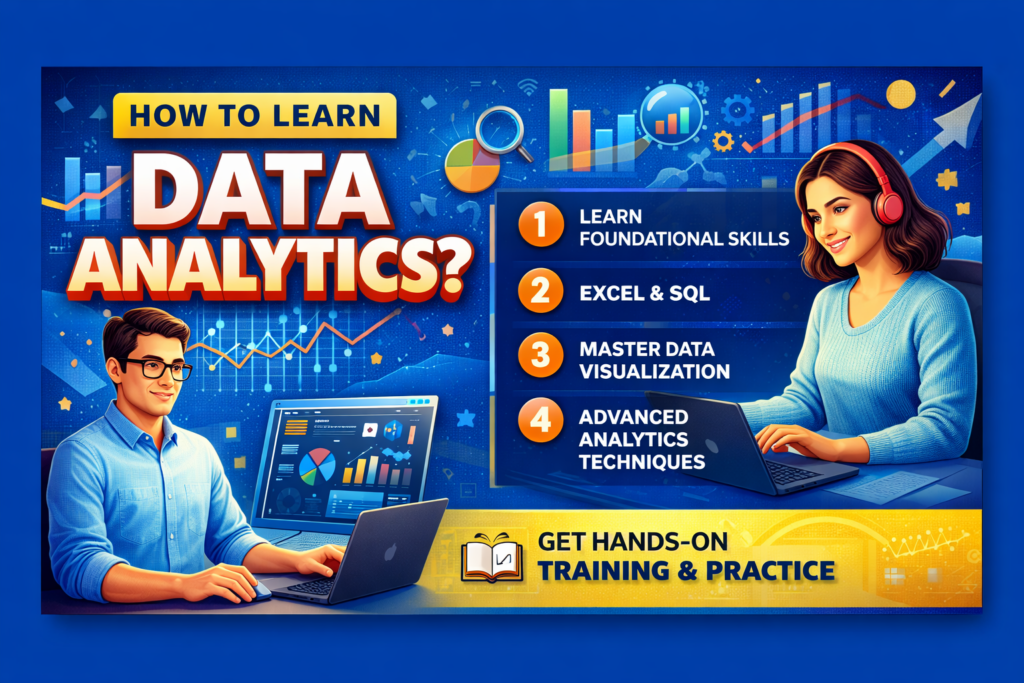
Month 2: Deep Dive into Programming and Visualization
Month two escalates your skills, moving into programming for more complex data manipulation and mastering the art of data storytelling through visualization. This is where you start to bring your data to life.
Python for Data Analysis: The Swiss Army Knife
Python is the go-to language for scalable, repeatable analysis. Beyond syntax, it’s about building pipelines that automate insights.
Niche Example:
Scraping competitor pricing weekly and analyzing trends to recommend dynamic pricing strategies.
Mini-case Study:
An HR analyst merges employee data with survey responses, uncovering that employees with <2 years tenure and long commutes show higher attrition risk. This informs targeted retention programs.
Challenges & Rewards:
Data cleaning, vectorization, and handling missing values are initial hurdles. Once mastered, Python drastically speeds up analysis and reduces errors.
Tips:
- Always start with df.head() and df.describe() to explore your data.
- Use method chaining in Pandas for clean pipelines.
- Combine Python with SQL for efficient data extraction.
Data Visualization and Business Intelligence Tools: Tableau or Power BI
Effective visualization communicates insights clearly. It’s not about flashy charts—it’s about actionable decisions.
Niche Example:
Hospitals track patient wait times with heatmaps to optimize doctor scheduling.
Mini-case Study:
A SaaS company visualizes churn by subscription tier and region using Tableau parameters and calculated fields. Leadership can drill down dynamically to high-risk segments and take corrective action.
Challenges & Rewards:
Choosing the wrong chart or overcomplicating dashboards can mislead stakeholders. But a well-designed visualization directly drives faster, smarter decisions.
Tips:
- Decide the story before choosing chart types.
- Use color intentionally (red for losses, green for gains).
- Master advanced features like Tableau LOD calculations and Power BI DAX functions.
Month 3: Advanced Concepts and Portfolio Building
The final month is about solidifying your knowledge, venturing into slightly more advanced topics, and critically, building a portfolio that showcases your skills to potential employers. This is where you transition from learner to job-ready professional.
Introduction to Machine Learning for Analysts
Machine Learning takes analysis to the next level: predicting outcomes rather than just describing them.
Niche Example:
Forecasting monthly inventory demand using ARIMA or Random Forest models to prevent overstock and stockouts.
Mini-case Study:
A bank analyzes transactions for fraud detection using logistic regression. Even a small sample of labeled data detects 85% of anomalies, helping prevent financial loss.
Challenges & Rewards:
ML can feel intimidating due to math, algorithms, and data requirements. Yet even simple, interpretable models can deliver huge business value.
Tips:
Use domain knowledge to engineer features; even basic intuition can outperform complex models.
Start small with manageable datasets.
Evaluate models based on business impact, not just accuracy.
Data Storytelling and Communication: Beyond the Charts
Having the right insights is only half the battle; communicating them effectively is the other. This involves more than just pretty dashboards.
- Audience-Centric Communication: Tailor your message to your audience (e.g., executives need high-level summaries; technical teams might want details).
- Crafting a Narrative: Structure your presentation like a story: problem, data exploration, insights, recommendation, impact.
- Presentation Skills: Practice public speaking, clear articulation, and answering questions confidently. Use tools like PowerPoint or Google Slides to support your data visualizations.
- Written Communication: Summarize findings clearly and concisely in emails or reports.
Practical Application: Present one of your portfolio projects to a friend, family member, or a study group. Ask for feedback on clarity and impact. Write a short executive summary for a complex analysis.
Building Your Data Analytics Portfolio: Your Ticket to a Job
Theory is good, but practical, demonstrable experience is gold. A strong portfolio is crucial for showcasing your abilities.
- Identify Interesting Datasets: Kaggle, government open data portals (e.g., data.gov, data.world), or even publicly available financial data are excellent sources.
- Choose Varied Projects: Aim for 3-5 projects that demonstrate a range of skills: SQL querying, Python data cleaning/analysis, Excel manipulation, and BI dashboard creation. Include projects from different industries if possible.
- Focus on Business Questions: Frame each project around a clear business problem. Instead of “analyzing sales data,” try “identifying factors contributing to declining sales in Q3 and recommending mitigation strategies.”
- Document Everything: Use GitHub to host your code (Python, SQL scripts), write clear READMEs explaining the project’s objective, methodology, insights, and tools used. Include links to your interactive dashboards (Tableau Public).
- Show Your Thought Process: Employers want to see how you think, not just the final output.
Practical Application: Dedicate significant time this month to completing 2-3 substantial portfolio projects. Each project should involve data acquisition, cleaning, analysis, visualization, and a clear summary of findings.
Job Search and Interview Preparation
With your skills honed and portfolio built, it’s time to enter the job market.
- Resume & LinkedIn Optimization: Tailor your resume to each job description. Highlight your projects and skills. Optimize your LinkedIn profile to showcase your new expertise.
- Networking: Connect with data professionals on LinkedIn, attend virtual meetups, and engage with local or online learning communities. Building relationships with peers, mentors, and industry experts can provide valuable insights, job leads, and guidance throughout your journey.If you’re looking to accelerate your progress, consider structured learning options such as bootcamps or comprehensive online courses. These programs often provide a well-rounded curriculum, hands-on projects, and mentorship, helping you build job-ready skills more efficiently.
- Technical Interviews: Practice SQL queries, Python data manipulation tasks, and explaining your portfolio projects. Be ready to walk through your code and explain your analytical decisions.
- Behavioral Interviews: Prepare for questions about problem-solving, teamwork, handling challenges, and your motivation for a career in data analytics.
Accelerating Your Journey with Structured Learning
While self-learning is commendable, a structured program can significantly accelerate your progress and provide invaluable guidance. Institutes like Login 360, a Coimbatore-based IT training institute, specialize in making quality education accessible and affordable. Their structured curricula, experienced instructors, and focus on practical application can streamline your 3-month journey, ensuring you cover all critical areas with expert support and gain industry-relevant insights.
Conclusion: Your Data Analytics Journey Begins Now
Learning data analytics in three months is an ambitious but entirely achievable goal for dedicated individuals. It demands intense focus, consistent practice, and a strategic learning path. By breaking down the complex field into manageable monthly milestones, you can systematically acquire the foundational knowledge, master essential tools like SQL, Python, Excel, and Tableau/Power BI, and build a compelling portfolio.
Remember, the data analytics landscape is ever-evolving. Your 3-month sprint is just the beginning. The most successful data professionals are continuous learners, always adapting to new tools and techniques. Embrace the challenge, stay curious, and transform your career trajectory. The demand for data-savvy professionals is only growing, and with this practical guide, you’re well-equipped to meet it head-on.
Start your journey today. The data is waiting to tell its story, and you can be the one to uncover it.