
Navigating the burgeoning landscape of data careers can feel like deciphering a complex algorithm. Two terms frequently surface, often interchangeably, yet represent distinct professional trajectories: Data Science vs Data Analytics. For aspiring professionals in Chennai and beyond, understanding the nuances between these fields is not merely an academic exercise; it’s the critical first step in charting a successful and fulfilling career path. This guide cuts through the jargon, offering a clear, actionable framework to help you decide which path aligns best with your aspirations, skills, and interests.
The Data Deluge: Understanding the Core
In an era where data is the new oil, businesses worldwide are scrambling to extract value from the immense volumes of information they collect daily. Both data analysts and data scientists are indispensable in this quest, but they operate at different stages of the data value chain and employ distinct methodologies to achieve their objectives. While data analytics often focuses on understanding the past and present, data science ventures into predicting the future and prescribing actions.
What is Data Analytics?
Data Analytics is fundamentally about examining raw data to discover meaningful insights, draw conclusions about information, and help make better business decisions. Think of a data analyst as a detective, sifting through clues (data) to understand what happened, why it happened, and what the current situation is. Their work is largely descriptive and diagnostic.
Key Responsibilities of a Data Analyst:
- Data Collection and Cleaning: Sourcing data from various databases, spreadsheets, or external APIs, and then cleaning it to ensure accuracy, consistency, and completeness. This often involves handling missing values, standardizing formats, and removing duplicates. A clean dataset is the bedrock of reliable analysis.
- Exploratory Data Analysis (EDA): Using statistical techniques and visualization tools to uncover patterns, anomalies, relationships, and trends within the data. This initial exploration helps in forming hypotheses and identifying key areas for deeper investigation.
- Reporting and Visualization: Translating complex data findings into easily digestible reports, dashboards, and visualizations (charts, graphs, heatmaps). The goal is to communicate insights effectively to non-technical stakeholders, enabling them to grasp the implications quickly.
- Business Intelligence: Providing insights that directly inform business strategy, operational efficiency, and market understanding. This could involve analyzing sales trends, customer behavior, website traffic, or marketing campaign performance.
- Ad-hoc Analysis: Responding to specific business questions with timely data-driven answers, often under tight deadlines.
Essential Tools for Data Analysts:
- Spreadsheet Software: Microsoft Excel, Google Sheets (for data entry, basic calculations, and simple visualizations).
- SQL (Structured Query Language): The foundational language for managing and querying relational databases. Proficiency in SQL is non-negotiable for extracting specific data subsets.
- Data Visualization Tools: Tableau, Power BI, Qlik Sense (for creating interactive dashboards and compelling visual reports).
- Statistical Programming Languages: R, Python (with libraries like Pandas, NumPy, Matplotlib, Seaborn for more advanced statistical analysis and visualization).
Key Skills Required:
- Strong Analytical Mindset: Ability to break down problems, identify patterns, and draw logical conclusions.
- Statistical Knowledge: Understanding of descriptive statistics, hypothesis testing, correlation, and regression.
- Data Wrangling: Expertise in cleaning, transforming, and manipulating raw data.
- Data Visualization: Ability to create clear, impactful, and insightful visual representations of data.
- Business Acumen: Understanding of business operations, objectives, and challenges to contextualize data insights.
- Communication Skills: Ability to articulate complex findings to both technical and non-technical audiences.
Typical Career Paths:
- Data Analyst
- Business Intelligence Analyst
- Marketing Analyst
- Operations Analyst
- Financial Analyst
For students in Chennai looking to enter the data domain, Login 360 offers comprehensive and affordable training programs specifically designed to build these foundational data analytics skills, preparing you for immediate industry relevance.
What is Data Science?
Data Science is a multidisciplinary field that uses scientific methods, processes, algorithms, and systems to extract knowledge and insights from structured and unstructured data. While data analytics focuses on what happened, data science delves into why it happened, what will happen, and what should be done. It’s a more advanced and experimental field, often involving predictive modeling, machine learning, and artificial intelligence.
Key Responsibilities of a Data Scientist:
- Problem Framing: Working with stakeholders to define complex business problems that can be solved with data, translating vague questions into testable hypotheses and measurable objectives.
- Data Engineering: Often involved in designing and building data pipelines, integrating disparate data sources, and ensuring data quality at scale. This can include working with big data technologies.
- Advanced Statistical Modeling: Applying sophisticated statistical techniques, machine learning algorithms, and predictive modeling to build models that can forecast future trends, classify data, or identify complex relationships.
- Algorithm Development: Designing, implementing, and optimizing machine learning algorithms for specific tasks, such as recommendation systems, fraud detection, natural language processing (NLP), or image recognition.
- Experimentation and A/B Testing: Designing and conducting experiments to test hypotheses and evaluate the effectiveness of new features or strategies, often involving rigorous statistical validation.
- Deployment and Monitoring: Taking models from development to production environments, integrating them into existing systems, and continuously monitoring their performance and retraining them as necessary.
- Storytelling with Data: Communicating highly technical findings and the implications of complex models to a diverse audience, ensuring that insights lead to actionable strategies and measurable outcomes.
Essential Tools for Data Scientists:
- Programming Languages: Python (with libraries like Scikit-learn, TensorFlow, Keras, PyTorch for machine learning and deep learning), R (for statistical computing and graphics).
- Big Data Technologies: Apache Hadoop, Apache Spark (for processing and analyzing massive datasets).
- Cloud Platforms: AWS, Google Cloud Platform (GCP), Microsoft Azure (for scalable computing resources and managed machine learning services).
- Databases: SQL and NoSQL databases (e.g., MongoDB, Cassandra).
- Version Control: Git (for collaborative code development and tracking changes).
Key Skills Required:
- Strong Mathematical and Statistical Foundation: Expertise in linear algebra, calculus, probability, advanced statistics, and optimization techniques.
- Machine Learning Expertise: Deep understanding of various ML algorithms (supervised, unsupervised, reinforcement learning) and their applications.
- Programming Proficiency: Advanced skills in Python or R, including object-oriented programming and efficient code writing.
- Data Modeling: Ability to design and implement complex data models.
- Problem-Solving and Critical Thinking: Capacity to tackle ambiguous problems with innovative, data-driven solutions.
- Domain Expertise: Understanding the specific industry or business context to develop relevant and impactful models.
Typical Career Paths:
- Data Scientist
- Machine Learning Engineer
- AI Scientist
- Research Scientist
- Quantitative Analyst
- Big Data Engineer
Login 360 recognizes the growing demand for advanced data skills and provides specialized, affordable training pathways in Data Science, equipping students with the theoretical knowledge and practical experience needed to excel in these cutting-edge roles.
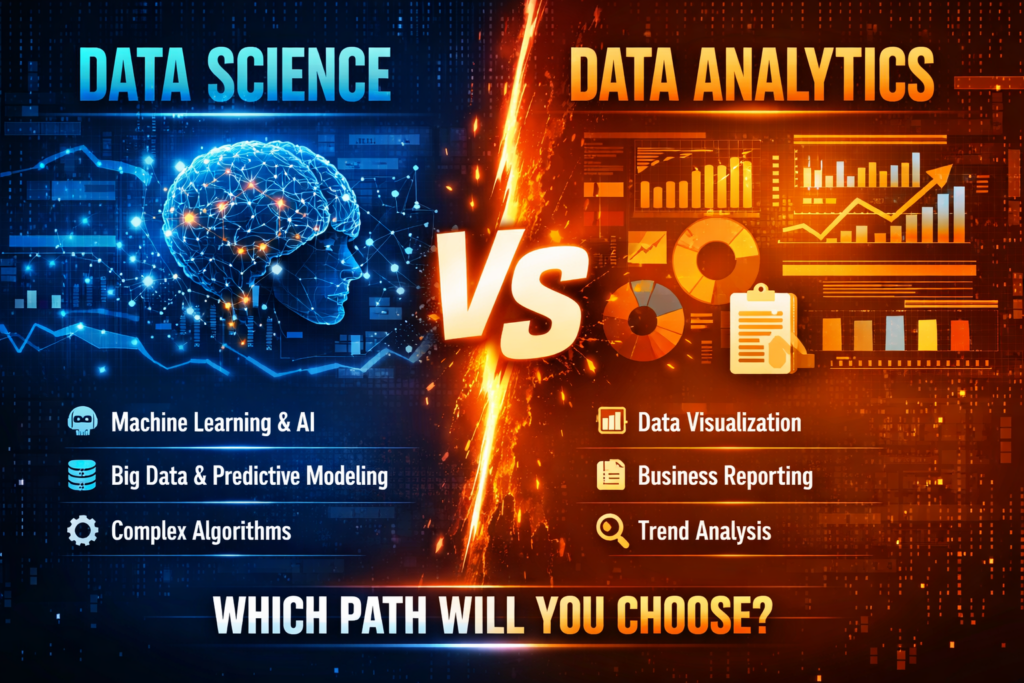
Key Differences: Data Science vs. Data Analytics – A Direct Comparison
While both fields deal with data, their objectives, methodologies, and skill sets diverge significantly. Understanding these distinctions is crucial for making an informed career decision.
1. Focus and Objective:
- Data Analytics: Primarily focused on interpreting historical data to understand past and present business performance. The objective is to provide actionable insights that optimize current operations and strategies. It’s about explaining what happened and why.
- Data Science: Focused on building predictive models and algorithms to forecast future outcomes and prescribe optimal actions. The objective is to discover new questions, build innovative solutions, and drive future strategy. It’s about predicting what will happen and determining what should be done.
2. Methodology and Approach:
- Data Analytics: Employs descriptive and diagnostic analytics. This involves summarizing data, identifying trends, and performing root cause analysis. The approach is often iterative, starting with a business question and using data to answer it.
- Data Science: Utilizes predictive and prescriptive analytics. This involves developing sophisticated statistical models, machine learning algorithms, and AI techniques to identify complex patterns, make predictions, and recommend optimal decisions. The approach is more experimental, often involving model building, testing, and refinement.
3. Tools and Technologies:
- Data Analytics: Heavily relies on SQL for data extraction, Excel for basic analysis, and BI tools like Tableau or Power BI for reporting and visualization. Python/R are used for more advanced statistical analysis but less for model deployment.
- Data Science: Requires proficiency in advanced programming languages like Python or R with extensive libraries for machine learning (Scikit-learn, TensorFlow, PyTorch), deep learning, and big data processing (Spark, Hadoop). Cloud platforms are also frequently used for scalable computing.
4. Required Skill Set:
- Data Analytics: Strong business acumen, SQL proficiency, statistical understanding (descriptive), data visualization, and excellent communication skills are paramount. Emphasis on translating data into business language.
- Data Science: Requires a robust foundation in mathematics (calculus, linear algebra), advanced statistics, machine learning algorithms, strong programming skills, data modeling, and often domain expertise. Emphasis on algorithm development and model deployment.
5. Educational Background:
- Data Analytics: Often pursued by individuals with backgrounds in business, economics, statistics, marketing, or information systems. A Bachelor’s degree is common, though certifications are increasingly valuable.
- Data Science: Typically attracts individuals with advanced degrees (Master’s or PhD) in highly quantitative fields such as computer science, mathematics, statistics, physics, or engineering. A strong theoretical understanding is often emphasized.
6. Problem-Solving Paradigm:
- Data Analytics: Solves well-defined business problems by providing insights from existing data. The questions are often clear, and the analyst seeks data-driven answers.
- Data Science: Tackles ill-defined or novel problems, often requiring the scientist to formulate the problem itself before developing a solution. It’s about innovation and discovering new ways to leverage data for competitive advantage.
7. Impact on Business:
- Data Analytics: Provides immediate, tangible value by optimizing current processes, identifying inefficiencies, and supporting tactical decision-making. It ensures the business runs smoothly and efficiently based on data.
- Data Science: Drives strategic, long-term value through predictive capabilities, automation, and the creation of new data-driven products or services. It shapes the future direction and innovation of the business.
Overlap and Synergy: A Collaborative Ecosystem
It’s crucial to understand that data science and data analytics are not mutually exclusive; rather, they are often complementary and frequently collaborate within organizations. A data analyst might identify a recurring pattern or a significant business problem that could benefit from a predictive model. They would then hand off this challenge to a data scientist, who would develop the sophisticated algorithms needed. Once the model is built and deployed, the data analyst might then use its outputs to generate reports and monitor its impact on business metrics.
For instance, an analyst might report on declining customer retention (descriptive). They might then diagnose that specific customer segments are churning due to a particular product feature (diagnostic). This insight could then prompt a data scientist to build a predictive model to identify customers at high risk of churn before they leave and develop a prescriptive recommendation engine for personalized retention strategies. The success of these strategies would then be monitored by analysts.
This collaborative ecosystem highlights that a deep understanding of analytics is often a stepping stone or a foundational skill set even for aspiring data scientists. The ability to interpret results, communicate findings, and understand business context is invaluable in both roles.
Choosing Your Path: A Decision Framework
Deciding between data analytics and data science requires introspection and an honest assessment of your interests, strengths, and career aspirations. Here’s a framework to guide your decision:
1. What are Your Core Interests?
- If you are fascinated by understanding past trends, explaining current situations, and translating data into clear business recommendations: Data Analytics might be your calling. You enjoy creating compelling dashboards and helping stakeholders make sense of performance metrics.
- If you are captivated by building predictive models, exploring complex algorithms, and uncovering hidden patterns to forecast the future: Data Science is likely a better fit. You thrive on experimentation, mathematical challenges, and developing innovative solutions.
2. What are Your Strengths?
- If you excel at communication, storytelling, business problem-solving, and have a good grasp of basic statistics and SQL: Data Analytics leverages these strengths directly. Your ability to bridge the gap between technical data and business strategy will be highly valued.
- If you possess strong mathematical aptitude, advanced programming skills, a deep understanding of statistics and probability, and enjoy complex problem-solving: Data Science will challenge and reward these abilities. You’re comfortable with abstract concepts and enjoy the rigor of scientific methodology.
3. What are Your Career Aspirations?
- For immediate impact and a clear path into business roles: Data Analytics often offers quicker entry points and direct contributions to operational efficiency and tactical decisions. Roles often involve working closely with various business units.
- For long-term innovation, research, and developing cutting-edge solutions: Data Science positions you at the forefront of technological advancement. These roles often involve more R&D, model deployment, and the creation of new data products.
4. What is Your Educational Background?
- If you have a Bachelor’s degree in a business-related field, economics, or statistics: Data Analytics is a natural progression. Further specialized training or certifications can solidify your expertise.
- If you have a strong academic background in computer science, mathematics, engineering, or physics, potentially with a Master’s or PhD: Your quantitative rigor aligns well with the demands of Data Science. You might already possess many of the foundational skills required.
5. Consider the Market Demand and Evolution:
Both fields are in high demand, but the specific skill sets required are constantly evolving. Data analytics roles are foundational and widespread across industries. Data science roles, while often requiring more specialized expertise, are growing rapidly as more companies seek to leverage AI and machine learning for competitive advantage. Researching job descriptions in Chennai for both roles can provide valuable real-time insights into specific requirements and opportunities.
Login 360’s Role in Your Data Journey
At Login 360, Chennai’s premier IT training institute, delivers real results—not just promises. 85% of our data analytics students secure jobs within 4 months, supported by hands-on projects with real datasets and personalized mentorship.
As one student shared, “I transitioned from a non-IT background to a data analyst role in just 5 months.”
With one-on-one guidance, mock interviews, and portfolio building, Login 360 ensures your career growth is practical, proven, and affordable.
Our unique selling proposition of affordability ensures that financial constraints don’t hinder your career aspirations. We offer tailored programs designed to equip you for success in both Data Analytics and Data Science:
- For Data Analytics Aspirants: Our comprehensive courses cover SQL, Excel, Python for data analysis, and leading BI tools like Tableau and Power BI. You’ll gain hands-on experience in data cleaning, exploration, visualization, and reporting, preparing you for immediate entry into analytical roles.
- For Data Science Enthusiasts: Our advanced programs delve into Python for machine learning, deep learning frameworks (TensorFlow, Keras), statistical modeling, and big data technologies. You’ll work on real-world projects, building predictive models and understanding their deployment.
We pride ourselves on:
- Expert Faculty: Industry professionals with years of practical experience guide you through complex concepts.
- Hands-on Training: Our curriculum emphasizes practical application, ensuring you gain the skills employers are looking for.
- Affordable Fees: High-quality education shouldn’t break the bank. Our commitment to affordability makes data careers accessible to everyone.
Career Guidance: From resume building to interview preparation, we support your journey from student to successful professional.
Conclusion: Your Data-Driven Future Awaits
The choice between Data Science vs Data Analytics is a pivotal one, shaping not just your daily tasks but your entire career trajectory. Don’t just choose based on trends—choose based on the problems you want to solve. Pick your path, build your skills, and start creating impact today. While data analysts illuminate the past and present, helping businesses optimize operations, data scientists build the future, developing models that predict trends and prescribe actions. Both are invaluable, but they demand different skill sets, mindsets, and levels of technical depth.
By carefully considering your interests, strengths, and career goals, you can make an informed decision that sets you on the path to success. Whether your passion lies in uncovering actionable insights from existing data or in pioneering new predictive capabilities through complex algorithms, Login 360 is here to provide the affordable, high-quality training you need to thrive in Chennai’s dynamic data landscape. Don’t let confusion hold you back; decide fast, train smart, and build your data-driven future with us.