

Table of Contents
Introduction
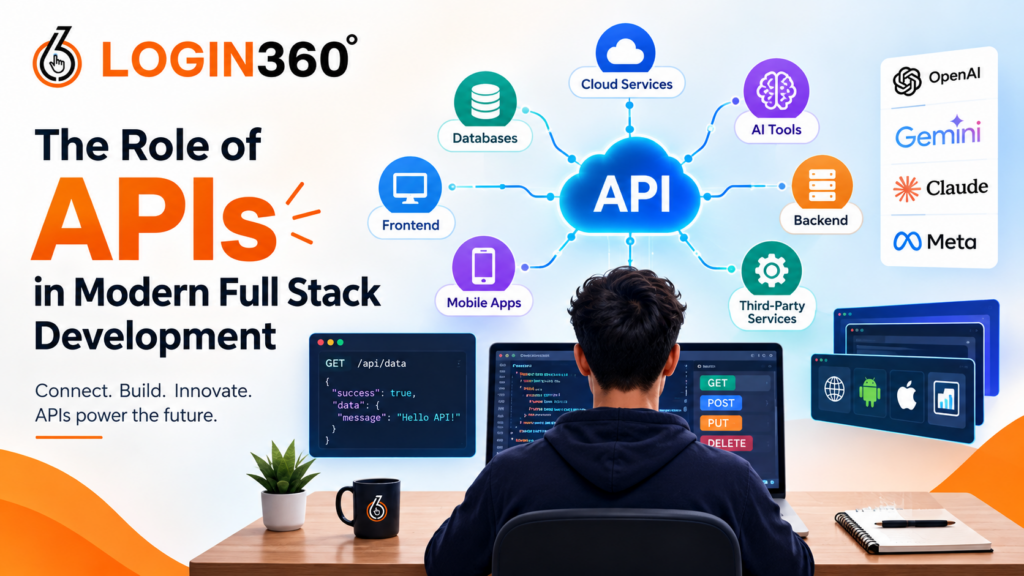
Modern websites use various pieces of technology that work together. The frontend connects with the backend, the backend works with databases, and web applications communicate with third-party services such as payment processors, maps, cloud platforms, and artificial intelligence tools. APIs in Full Stack Development serve as the communication layer that connects these different technologies and allows them to exchange data efficiently. They act as intermediaries that enable one software system to communicate with another, exchange information, or perform specific actions. For full stack developers, APIs are critical when creating modern applications. User authentication, online payments, maps, notifications, cloud services, and AI-powered features all depend on APIs to communicate with the required systems. payments, integration with third-party systems, and AI capabilities all depend on API usage.
What Is an API?
API serves as an efficient method that enables different applications to communicate with one another. Consider a food delivery application where a user searches for a restaurant and the application needs to retrieve information from the server. This process is handled through APIs in Full Stack Development, where the frontend sends a request through an API, the backend processes it, retrieves the required information, and sends a response. The user simply sees a list of available restaurants on the screen, while the API works behind the scenes to connect different parts of the application. APIs in Full Stack Development are not limited to websites and are also widely used in mobile applications, cloud platforms, and other modern digital services, payment gateways, social media platforms, business applications, and AI applications.
How APIs Work in Full Stack Development
An example of a full stack application consists of three layers:
- Frontend – The layer that the users interface with and see.
- Backend – Deals with business logic, processes requests, and runs application functionalities.
- Database – Keeps data like the users, products, orders, and other application data.
APIs facilitate communication between these layers.
For instance, when a user logs in to an application through a website, the frontend communicates login credentials to a backend API. The backend processes the request and checks against the data on the database before sending a response.
The process can be explained as follows:
User –> Frontend –> API –> Backend –> Database
Then, the response goes from:
Database –> Backend –> API –> Frontend –> User
The whole process takes place in milliseconds and enables modern applications to become interactive.
Why APIs Matter in Full Stack Development
Connecting Frontend and Backend
One of the critical purposes of an API is to establish the connection between the frontend and the backend. Frontend apps must not make any direct database requests. Rather, the frontend makes requests to the backend via the API. Let’s imagine that a customer enters a product page in an ecommerce application. The frontend asks for product details from the API, and then the backend takes the data from the database and sends it to the frontend. In this way, the apps remain structured, and the frontend and backend developers may work separately from each other.
Integrating Third-Party Services
Most modern apps rely on some services offered by other platforms. This is made possible through the use of APIs.
The typical uses include:
- Payment gateway
- Maps and location
- Email and SMS platform
- Social media login
- Cloud Storage
- Analytics
- AI services
For instance, a web store can use a payment API without creating their payment system from scratch. Similarly, a travel app can use a maps API to show locations and directions.
This helps save on development time and allows companies to use specific technologies.
Supporting Multiple Platforms
APIs also allow different platforms to use the same backend. A business may have a website, Android application, iOS application, and internal dashboard. All of these platforms can communicate with the same backend API. This reduces duplicated development work and keeps important business logic in one central system.
REST APIs and HTTP Methods
REST is one of the most common strategies used for developing web APIs. REST APIs often employ different HTTP methods in order to operate on data.
GET
GET is used for fetching data.
GET /api/products
It can fetch a list of products available.
POST
POST is commonly used for creating new data.
POST /api/products
This is used for creating new products.
PUT
PUT is used for updating existing data.
PUT /api/products/101
It will update the product with the ID of 101.
DELETE
DELETE is used for deleting data.
DELETE /api/products/101
This is used for deleting the selected product.
It is important for developers to know about these HTTP methods when starting off with API development.
APIs and JSON
APIs require some standards to exchange information among systems. One of the most common standards is JSON or the JavaScript Object Notation.
For instance, an API response can be:
{
“name”: “John”,
“email”: “john@example.com“,
“role”: “customer”
}
Information will be consumed by the frontend, and will be used to display customer data.
JSON became very popular since it is lightweight and easy to read, not to mention that it works well with JavaScript based technologies.
APIs in MERN Stack Development
APIs are key in the MERN stack development process.
The MERN stack consists of the following components:
- MongoDB – The database
- Express.js – The backend framework
- React.js – The frontend library
- Node.js – The JavaScript runtime
APIs in Full Stack Development are especially important in MERN applications because they connect React with Node.js, Express.js, and MongoDB.
A usual sequence looks like:
React → Express.js API → Node.js → MongoDB
React requests the backend API, the backend processes the request and gets the needed information from MongoDB, and then responds to React with the result.
It is easy to develop fully-fledged apps using such structure.
APIs and Authentication
Another significant domain that uses APIs extensively is authentication.
Once the user enters his/her email and password, the information is sent from the frontend to the backend API. The API validates the information and decides whether the user is authorized to use the application.
The functionality of authentication APIs includes:
- User registration
- User login/logout
- Password reset
- Verification of the account
- Sessions handling
- Secure resources
It is necessary to distinguish between authentication and authorization, although these two concepts are connected to each other.
Authentication involves identification of the user. In turn, authorization concerns defining what actions can be performed by the user.
For instance, the customer is able to see his/her orders only, whereas the administrator can control all the orders.
API Security
However, APIs process a lot of confidential information, making security a crucial aspect of APIs in Full Stack Development. The use of HTTPS helps protect information transmitted from the client to the server. Developers must also validate user inputs before processing the information to prevent invalid or potentially harmful data from reaching the backend.
Some other vital aspects of API security include:
- Secure authentication
- Appropriate authorization
- Securing API keys and passwords
- Preventing secrets exposure in the frontend
- Handling sensitive information
A good API security must be incorporated into development from the beginning.
API Testing and Documentation
Tests help developers check whether an API works properly before integration into the frontend.
API testing allows to check:
- End points and HTTP methods
- Status codes
- Authentication
- Input validation
- Error handling
- Response data
- Performance
Postman tools help developers to make requests and analyze API responses.
However, documentation is no less significant. The good API documentation should describe available end points, request methods, parameters, authentication, request and response format, errors, etc.
Documentation makes it easier for developers to work with the API without analyzing all the backend code base.
APIs, Microservices, and AI
Instead of developing a single monolithic backend application, one could develop several services for a system. These could be user services, product services, order services, payment services, and notification services in an e-commerce application.
These services would talk to each other using APIs.
Microservices allow better scalability and maintainability for big applications, though they bring extra complexity with them. In small projects, a simpler architecture might make sense.
Apart from microservices, APIs are becoming increasingly relevant in AI applications as well.
The developers can connect AI services that provide functionality such as:
- AI Chat
- Text Generation
- Content Recommendations
- Document Analysis
- Image Processing
- Automated Customer Support
- Personalization
Rather than building their own AI systems, developers can just connect their existing services to
Common API Challenges
Although there are many benefits of using APIs, developers also have to face some challenges in their work. Performance: Many requests, large responses, or bad database queries may cause application performance problems. Security: Lack of API security may result in leakage of confidential data or even unauthorized access to application data. Error Handling: An API has to return proper error responses. Versioning: Modification of an API may influence applications using older versions of the same API. Versioning allows making changes to an API without breaking dependent applications. External Dependencies: An application that uses APIs of other services may be influenced by their modification or malfunction. Dealing with these challenges is crucial for development of reliable applications.
Skills Full Stack Developers Should Learn
Every candidate aiming for a job in full-stack development should know about:
- HTTP and HTTPS
- RESTful APIs
- HTTP methods and status codes
- JSON and data transfer
- Authentication and Authorization
- Security in APIs
- Testing of APIs
- Documentation of APIs
- Integration of Database
- Integrating third-party APIs
The ideal approach to learning these aspects is through practical projects. Begin by building a simple CRUD application, create an API in the backend, integrate it with the database, and build a frontend that interacts with the API. Working with APIs in Full Stack Development will help you understand how different application components communicate in real-world projects. Once you have learned the basics, you can advance to areas such as authentication, security, third-party integrations, performance tuning, and API optimization.
The Future of APIs in Full Stack Development
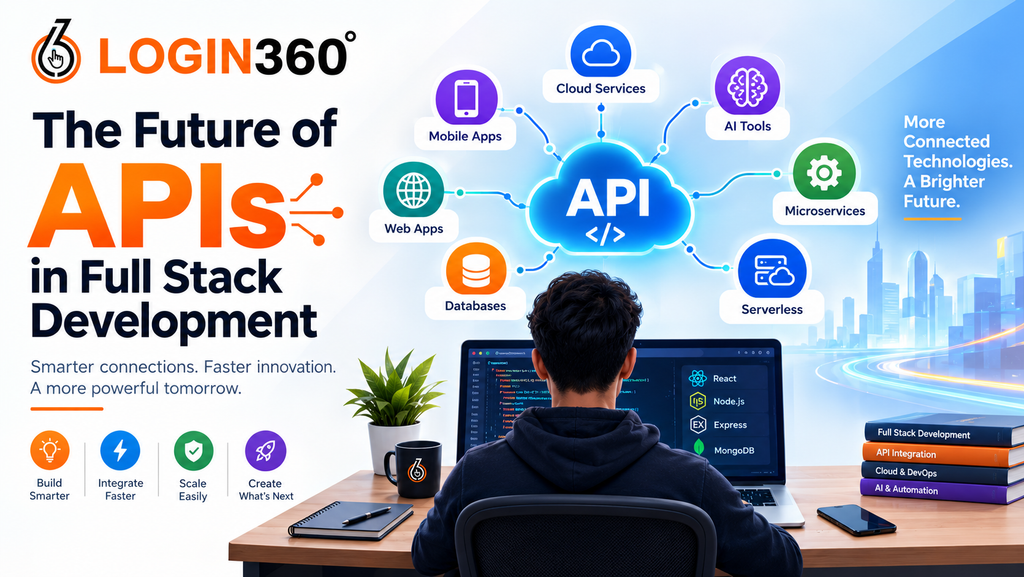
With the increasing interconnectivity of apps, APIs will remain a key component in software development. Mobile applications, cloud applications, artificial intelligence platforms, serverless architectures, and microservices rely on effective communication between various technologies. There are also other technologies being used by developers like GraphQL, that have their own way of requesting and managing application data. In the case of full stack developers, understanding of APIs is not a supplementary but a crucial aspect of the development process.
Conclusion
An APIs in Full Stack Development plays an extremely crucial role in any modern full-stack developer’s toolkit. It helps developers bridge frontend applications with backend systems, databases, mobile apps, third-party services, cloud platforms, and AI technologies. Learning about APIs in Full Stack Development goes far beyond understanding GET, POST, PUT, and DELETE methods, as developers also need to understand communication, authentication, authorization, security, testing, documentation, and error handling. No matter what application you are creating, it may be your own personal project, an e-commerce platform, some business application or an AI-based system, APIs act as the medium through which all these technologies can talk. API knowledge is one of the essential components of becoming a good full-stack developer for aspirant programmers. Learn Full Stack Development with Login360.