

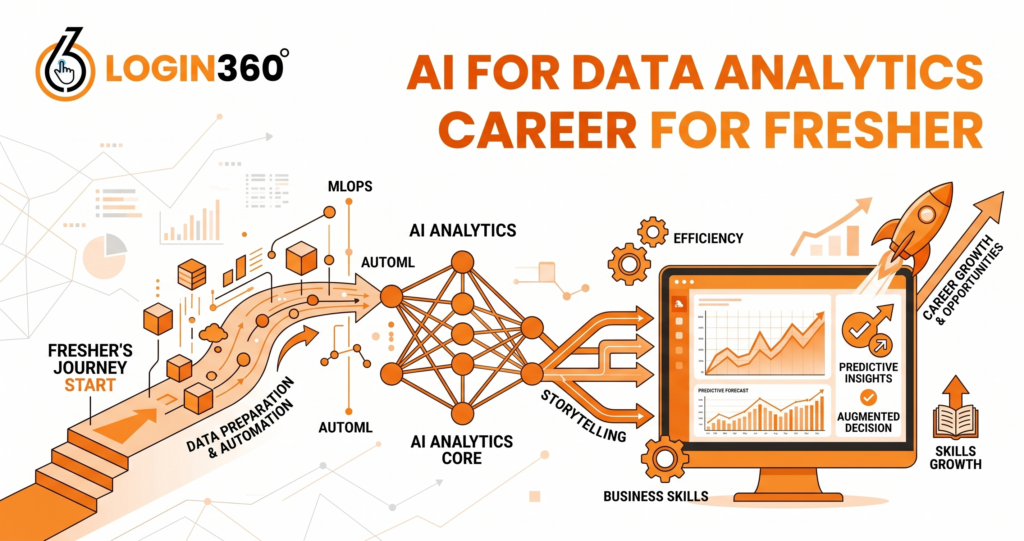
Introduction of AI for Data Analytics
Artificial intelligence is no longer a futuristic idea meant for tech giants; it is now a vital part of everyday business practices. This change is most evident in the data realm. AI analytics is altering how organizations gather, process, and understand data, which is fundamentally changing the role of data professionals.
For years, data analysts and scientists spent most of their time cleaning datasets, writing repetitive queries, and manually creating reports. Today, smart algorithms can take on much of this work in a fraction of the time. This shift goes beyond efficiency; it is transforming entire career paths, job descriptions, and the skills employers look for.
In this article, we will examine the key trends driving this change, the advantages AI for data analytics offers to professionals and businesses, the challenges that accompany this rapid evolution, and how analytics professionals can prepare for long-term success in an AI-driven environment.
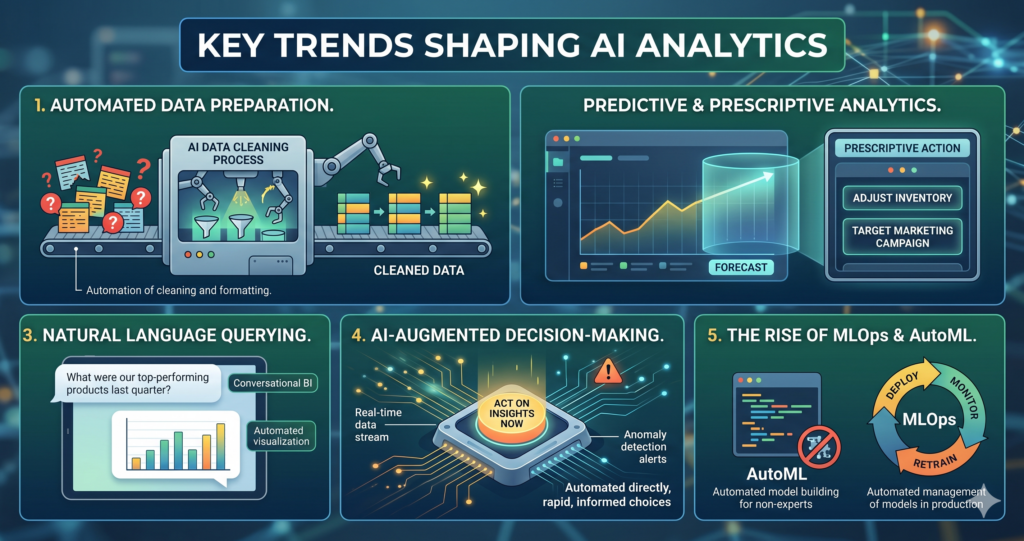
Key Trends Shaping AI Analytics
1. Automated Data Preparation and Cleaning
Data preparation has traditionally taken up to 80% of an analyst’s time. AI-powered tools now automate much of this process, detecting anomalies, filling in missing values, standardizing formats, and flagging duplicate records. This allows analysts to transition from “data janitors” to strategic thinkers much faster than before.
2. Predictive and Prescriptive Analytics
While traditional analytics answered “what happened,” AI analytics increasingly addresses “what will happen” and “what should we do about it.” Machine learning models can forecast customer churn, predict equipment failures, or estimate demand with an accuracy that traditional statistical methods often struggle to achieve. Prescriptive analytics goes a step further by recommending specific actions based on projected outcomes.
3. Natural Language Querying and Conversational BI
One of the most noticeable trends is the growth of natural language interfaces in business intelligence tools. Instead of crafting complex SQL queries, business users can now simply ask, “What were our top-performing products last quarter?” and receive immediate visualizations. This change in data access is transforming how analytics teams communicate with the rest of the organization.
4. AI-Augmented Decision-Making
AI is increasingly integrated into decision-making workflows. Recommendation engines, anomaly detection systems, and real-time dashboards powered by machine learning enable decision-makers to act on insights as they come in, rather than waiting for a weekly or monthly report.
5. The Rise of MLOps and AutoML
As organizations expand their machine learning use, new fields have emerged to manage it. MLOps (Machine Learning Operations) makes sure models remain accurate and reliable in production. At the same time, AutoML platforms allow even non-data scientists to build functioning predictive models with little coding. This is making AI for data analytics accessible to a much larger group of professionals than ever before.
Benefits of AI for Data Analytics Careers
Increased Efficiency and Speed
One of the main benefits of AI analytics is speed. Tasks that used to take days, like building a forecasting model or finding outliers in a large dataset, can now be done in minutes. This allows analysts to concentrate on interpretation, storytelling, and strategic recommendations instead of manual computation.
Deeper and More Accurate Insights
AI is great at finding patterns in large, complex, or unstructured datasets that would be hard for humans to spot manually. This includes detecting subtle correlations among multiple variables, identifying fraud patterns, or segmenting customers based on detailed behavioral data. The outcome is analysis that is not only faster but often more precise.
New and Expanded Career Paths
Rather than eliminating data careers, AI is creating new specializations. Roles like machine learning engineer, AI ethics analyst, data storyteller, and analytics translator didn’t exist in their current forms a decade ago. Professionals who understand both the technical and business aspects of AI analytics are now especially in demand.
Greater Accessibility for Non-Technical Stakeholders
With AI-powered dashboards and natural language tools, decision-makers in various departments, such as marketing, finance, and operations, can access insights without needing to know SQL or statistical modeling. AI and machine learning changes the analyst’s role to focus on more valuable work like designing systems, validating outcomes, and ensuring the right questions are asked.
Stronger Career Resilience Through Specialization
As routine analytical tasks become automated, professionals who gain expertise in areas that AI cannot easily replicate, such as domain knowledge, ethical judgment, stakeholder communication, and strategic thinking, will become more valuable.
Challenges and Risks
Skill Gaps and the Pressure to Reskill
As AI and machine learning tools take over routine tasks, the standard for what counts as a “valuable” analytics skill set is rising. Professionals are now expected to grasp machine learning concepts, model interpretation, and even basic AI ethics—skills that weren’t part of traditional analytics training. This creates pressure for ongoing learning, and not everyone has equal access to reskilling resources.
Job Displacement Concerns
While many experts say that AI enhances rather than replaces analytics roles, some entry-level positions focused solely on manual reporting and data cleaning are genuinely declining. This is a real concern for professionals early in their careers and emphasizes the need to develop skills beyond basic technical execution.
Data Quality, Bias, and Governance Issues
AI systems depend on the quality of the data they are trained on. Poor data quality, historical bias, or incomplete datasets can lead to flawed predictions, sometimes resulting in serious issues like biased hiring algorithms or inaccurate financial forecasts. Analytics professionals must understand not only how to build models but also how to audit and govern them responsibly.
Over-Reliance on Automated Outputs
There’s a growing risk of “automation complacency,” which is trusting AI-generated insights without enough scrutiny. Analysts need to maintain critical thinking skills to validate model outputs, question assumptions, and recognize when an algorithm’s recommendation doesn’t fit with real-world context.
Rapid Pace of Technological Change
The tools and platforms used in AI analytics evolve quickly. What is considered a relevant skill today may change within a year or two. This requires ongoing investment in learning and adaptation, which can be both time-consuming and costly for individuals and organizations.
How Analytics Professionals Can Adapt
Given these trends, professionals wanting to succeed in an AI-driven analytics landscape should think about the following strategies:
– Build a solid understanding of AI and machine learning. You don’t need to become a data scientist, but knowing how models work, their limitations, and how to interpret their outputs is increasingly important.
– Develop strong business and communication skills. As technical tasks become automated, the ability to turn data into actionable business strategies becomes a key advantage.
– Focus on data governance and ethics. Understanding bias, fairness, and responsible AI use is becoming a critical skill set, especially in regulated industries.
– Embrace lifelong learning. Online courses, certifications, and hands-on work with AI tools can help professionals stay up to date as the field evolves.
– Specialize strategically. Whether in healthcare analytics, financial modeling, or marketing intelligence, deep domain expertise combined with AI knowledge creates a strong competitive edge.
Conclusion
The impact of artificial intelligence on data analytics careers is significant, but it’s not just a story of replacement—it’s about transformation. AI analytics is automating repetitive tasks, speeding up insight generation, and making data access available to more people. At the same time, it’s raising the standard for essential skills, creating new specializations, and raising important questions about governance and ethical use.
For data professionals, the way forward is not about competing with AI, but working alongside it. By leveraging AI for data analytics to manage the load of data processing, they can focus their expertise on interpretation, strategy, and responsible decision-making. Those who adapt by gaining AI literacy, improving communication skills, and committing to lifelong learning will not only survive this shift but thrive because of it.