
Introduction
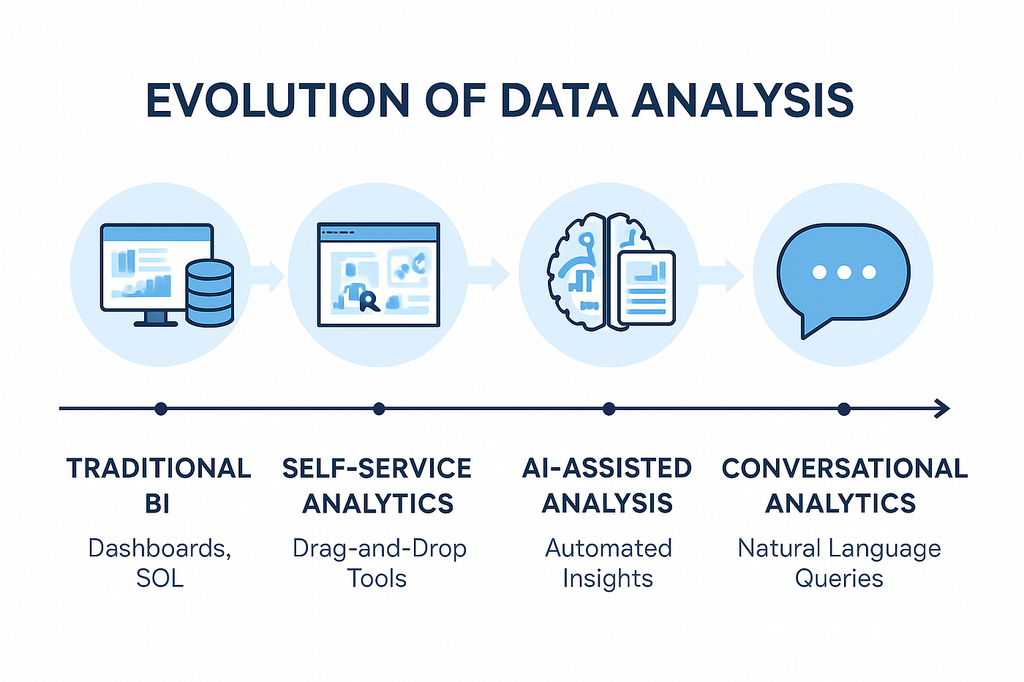
Today, data is often used within businesses, and can be utilised for many different aspects including analysing consumer behaviour and advising on strategy for example. Throughout the years, there have been significant developments in relation to how organisations are able to analyse data. This area of progression is called the Evolution of Data Analytics.Previously, businesses analysed data using methods including hand-written and spreadsheet-based analysis. Artificial Intelligence has also been increasingly adopted and therefore enhanced the speed and efficiency of a company’s data analysis. Individuals can further refine and enhance their skills and knowledge by studying the Best Data Analytics courses in Chennai .The shift from conventional data analysis to Artificial Intelligence has revolutionised organisation processes.
1. Traditional Data Analytics
Traditionally, data was analysed using predominantly hand-written and spreadsheet-based techniques.A retailer for example, may collate sales data on a monthly basis and then analyse it in Excel to ascertain which goods sell most successfully. Staff can then analyse and analyse the data and display it in graphical form.
Common features of traditional data analysis include:
- Manual data collection
- Spreadsheet analysis
- Graphical representation
- Historical analysis
- Basic analysis
Whilst traditionally based data analysis was valuable, it was time consuming and staff also had to manually analyse information – thus raising the likelihood of human error.Whilst traditional analysis was good for retrospect, it was not always as suited for fast or forward-looking analyses.
2. Spreadsheets and Traditional Reporting
During the initial stages of data analysis, spreadsheets were widely used. These, such as Microsoft Excel, facilitated data analysis and report production and did not necessitate staff to have high levels of technical knowledge.They were extensively used for financial, staff and stock management as well as sales analysis. As data collection expanded, database management became a key component of data analysis.
Typically, traditional data analysis comprised of:
- Collection – data can be compiled from a range of sources, for example, sales data, customer data and financial data.
- Analysis – data can then be analysed by ordering, cleansing and analysing it so that it is easily utilised.
- Reporting – analysis can then be showcased in tabular, graphical and/or written format.
Although traditional reporting provided a good basis for data analysis, as businesses became more intricate, traditional data analysis was no longer sufficient.
3. Business Intelligence
As organisations began to analyse larger quantities of data, there was a requirement to enhance data analysis. This has led to the rise of Business Intelligence (BI).BI encompasses various technologies that aid organisations to analyse and display data. Alongside traditional reporting, digitalised dashboards and visualisation options can now be utilised.
Popular BI tools include:
- Microsoft Power BI
- Tableau
- Qlik Sense
- Microsoft Excel
Such tools can be used to construct digital dashboards. These facilitate staff to effectively analyse a company’s performance and recognise valuable trends.For instance, members of a marketing team can utilise a dashboard to analyse an online presence, advertising expenditure, leads and conversion statistics. Individuals can thus access key data regarding a company’s performance in one location, rather than referring to numerous spreadsheets.BI enhanced the structure and accessibility of data analysis. It also provided a robust basis for progressing to further data analysis methods.
4. Big Data and Advanced Data Analysis
As internet, smart phone, social media and digital technologies have continued to proliferate, there has been a huge rise in the volume of data being produced. Organisations are now gathering data in relation to people’s web browsing, mobile phone application and online behaviour as well as business transactions.This has in turn emphasised the value of big data analysis.Big data comprises highly extensive and intricate data. Conventional data analysis may not be especially effective in efficiently analysing such information. Advanced data analysis can therefore be deployed to analyse big data and recognise valuable trends.
Key elements of big data are:
- Volume – the vast amount of data that is now regularly produced.
- Velocity – the rate data is both produced and analysed.
- Variety – data can exist in a multitude of forms for example textual, visual and numeric data.
- Veracity – the trustworthiness of data.
- Value – the valuable information that can be gleaned from data.
Advanced data analysis can therefore be used to analyse consumers’ behaviour and to assess and enhance a company’s performance.This signified an important Data Analytics Transformation; organisations can now undertake not only retrospective but also more in-depth data analyses and in turn make more informed decisions.
5. Artificial Intelligence
Artificial intelligence has introduced a novel method for analysing and analysing data. Rather than solely analysing data via hand analysis and traditional reporting, organisations can now utilise smart technology to analyse and recognise trends within data.Artificial Intelligence in Data Analysis integrates Artificial Intelligence and data analysis. This allows data to be analysed in a more efficient manner and also supports companies to analyse complex data. Furthermore, it can automate processes.
Important areas where AI can be utilised within data analysis are:
- Automated data cleansing – AI can detect gaps, duplicates and anomalies in data.
- Trend analysis – smart technology can analyse data to recognise trends which may not initially be apparent to humans.
- Predictive analysis – AI can analyse historical data to forecast likely future outcomes.
- Natural language processing – data can be interacted with using common language and comprehensible responses can then be generated.
- Automated reporting – AI can produce, analyse and report on data.
For example, an on-line retail business can analyse consumers’ prior buying behaviour to recognise what people are interested in. It can therefore offer tailored suggestions, thus facilitating companies to both enhance customers’ experiences and formulate well-informed marketing strategies.
6. Machine Learning and Data Analysis
Machine learning is another key technological element which has contributed to contemporary data analysis. Computer systems can utilise this technology to analyse data and enhance their performance, without each process needing to be individually coded.Whilst traditionally staff analysed data to assess business performance, computer systems can currently analyse extensive data and recognise trends. They can also analyse historical information to forecast likely future outcomes.
Examples of where machine learning can be implemented are:
- Analysis of consumer behaviour – organisations can recognise what their customers are interested in, how they behave and what they purchase.
- Identification of fraudulent behaviour – financial companies can detect irregularities in business transactions and draw attention to potentially fraudulent behaviour.
- Sales prediction – businesses can analyse historical sales data alongside seasonal variations and market trends to make sales forecasts.
- Retention – companies can recognise individuals that may disengage from a service and work to increase customer satisfaction.
Machine learning has therefore enhanced data analysis. Organisations can now not only analyse past business performance but also prepare for potential future scenarios.
7. Comparing Traditional Reporting and AI-based Data Analysis
Both traditional and AI-based data analysis can be employed to analyse data. There are however, differences regarding the data analysis process and how analysis outcomes are displayed.
Traditional Reporting AI-based Data Analysis
- Primarily relies on manual analysis Facilitates automated data analysis
- Analyzes historical data and enables prediction and advice to be provided
- Utilises standard reports Can establish more sophisticated analysis
- Requires more manual input Automates processes
- Does not recognise complex trends Recognises intricate trends
- Primarily shows ‘what has been’ Assists in analysing ‘what may occur’
Whilst a traditional sales report may illustrate that a company’s sales fell by 15% in a given month, an AI-based data analysis system can then analyse factors such as consumer behaviour, product popularity and seasonality to help to determine why this has occurred.Despite AI-based data analysis, traditional reporting is still valuable. The two can therefore often be integrated. Traditional analysis can be used to assess company performance and AI-based analysis can further enhance data analysis.
8. Commonly Utilised Data Analysis Tools
Depending on the nature of a company’s data and its requirements, varied data analysis tools can be employed. Acquiring knowledge of these is valuable for both students and professionals.
- Microsoft Excel – is frequently used to analyse data and to conduct mathematical operations. Reports can also be produced.
- SQL – this structured query language facilitates searching, managing and filtering of information within databases.
- Python – is extensively used in data analysis for data cleansing and statistical analysis. It is also used for automating processes and for machine learning. A variety of Python libraries, for example, Pandas, NumPy and Matplotlib can be utilised to address different data analysis needs.
- Power BI – can be used to convert data into digital dashboards, graphs and reports.
- Tableau – is a visual data analysis tool. It enables staff to analyse data and to then showcase this information in digital dashboards.
AI-based tools – contemporary AI can aid data analysis, report creation, trend analysis and predictive analysis.Structured education, for example, data analytics Training in Coimbatore and data analytics courses which practically apply Excel, SQL, Python and Power BI, can be undertaken to further develop relevant skills.
9. Benefits of AI-based Data Analysis
As AI is increasingly adopted, there are a number of benefits that can be realised by companies from a range of sectors. It has enabled businesses to more efficiently analyse data and to recognise key business related developments.
- Fast data analysis – AI can analyse data swiftly. It can also automate data analyses which can therefore save time.
- Well-informed decision making – data analysis can be used to assess and advise on various options and so facilitate good decision making.
- Increased accuracy – whilst automation can help to avoid some human-based errors, appropriately validating outcomes should still be undertaken.
- Time and cost effectiveness – automation can allow staff to dedicate more time to assessing business needs as opposed to carrying out time-consuming processes.
- Tailored consumer experience – by analysing consumer behaviour, companies can offer more relevant advice, products and services.
- Future preparation – predictive data analysis can be utilised to assess likely demand and to recognise and prepare for potential business challenges and issues.
A retailer for example, can analyse historical sales data and determine which products may prove to be in greater demand at festive periods. This can in turn allow a business to effectively manage its stock.
10. Future Data Analysis
Future data analysis is expected to further automate procedures and also incorporate more smart technologies. As organisations continue to accrue data relating to digital technologies, interlinked devices and online activity, there will continue to be an increasing necessity for strong data analysis.
Notable future data analysis advancements are:
- Generative AI – this can be used to analyse data and to produce concise summaries and reports in natural language.
- Real-time data analysis – companies can effectively monitor business processes and respond to evolving situations in a timely manner.
- Predictive analysis – can be used to analyse demand, as well as consumer and challenge related data.
- Automated machine learning – can simplify and facilitate the construction and administration of specific machine learning processes.
- Data storytelling – can be used to effectively explain and visually showcase complex data analysis outcomes.
Alongside these developments, future data analysis will also need to centre around appropriate data management. Organisations should ensure that data is appropriately private, secure and of good quality. Furthermore, they should also monitor for any AI-related prejudices. Humans will still play a key role in evaluating data and in decision making.
Conclusion
Those wishing to pursue a career in this continually expanding sector can benefit from studying for example, the best data analytics course in Kochi. Programmes which offer practical work as well as modules on Excel, SQL, Python and Power BI, can be especially beneficial in enabling students to practically apply their knowledge and so in turn, prepare for future job prospects.To effectively adapt to evolving industry needs, professionals should ideally possess knowledge of both traditional and AI-based data analysis. Although previously data analysis was largely numerical orientated, it is now fundamentally about recognising valuable information from data and using this to generate improved prospects.