
The digital world isn’t slowing down—it’s speeding up. According to U.S. Bureau of Labor Statistics, software development jobs are growing much faster than average, with companies actively seeking developers who can handle both front-end and back-end. As one full stack developer put it: “If you can build the whole product yourself, you’re always in demand.” By 2026, this demand will only increase, making the Best Full Stack Developer Course feel like a smart investment. But the real question is—is it actually worth it? Let’s break down the career scope, salary potential, and what truly makes a course valuable.
The Evolving Landscape of Full Stack Development: A 2026 Perspective
Full stack development, at its core, is about mastery across the entire software application spectrum – from the user-facing interface (frontend) to the server-side logic and database (backend). This comprehensive skill set has always been highly prized, but 2026 brings new layers of complexity and opportunity.
Key Technologies Dominating in 2026
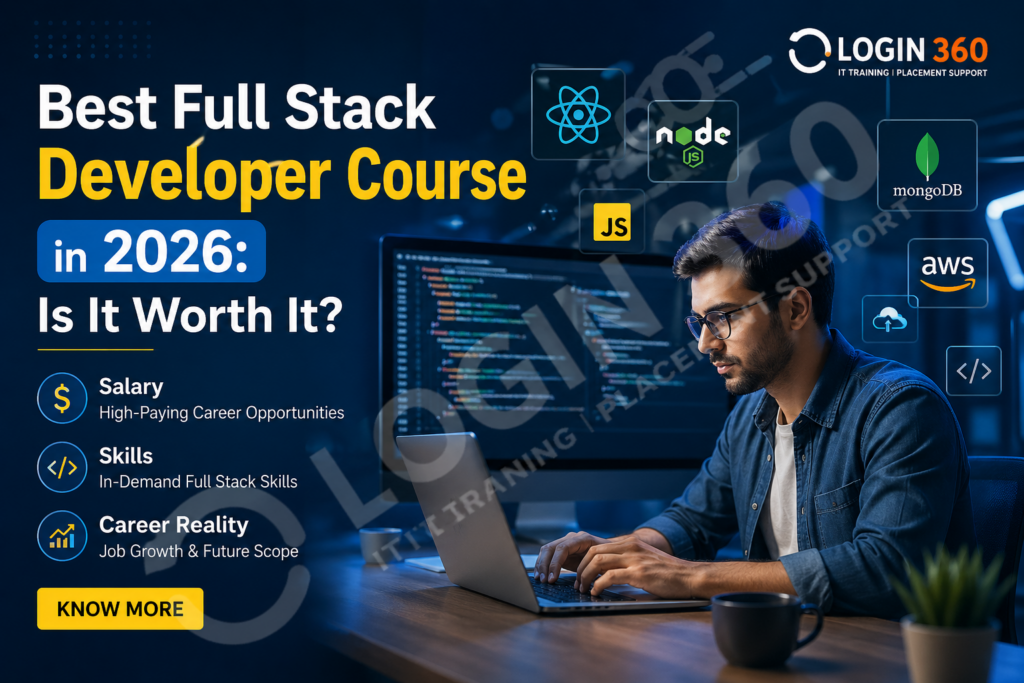
Full stack development in 2026 extends beyond foundational tools into a performance-driven, cloud-native ecosystem. On the frontend, frameworks like React, Angular, and Vue.js continue to lead. The Stack Overflow Developer Survey consistently ranks React as the most widely used framework, reflecting industry demand for scalable, component-based architectures and improved user experience.
Backend development remains centered around technologies such as Node.js, Python frameworks like Django and Flask, as well as Go and Spring Boot. According to Gartner, enterprises are prioritizing scalable, cloud-native backends to support microservices and distributed systems.
Data management has evolved into a hybrid approach. Relational databases like PostgreSQL and MySQL are now complemented by NoSQL solutions such as MongoDB and Apache Cassandra. Forrester highlights growing adoption of specialized databases, including graph systems for complex data relationships.
Serverless platforms like AWS Lambda and Azure Functions are now mainstream, enabling efficient event-driven architectures. At the same time, AI integration has become standard. As Sundar Pichai noted, AI is transforming how applications are built, pushing developers to integrate intelligent features into modern systems.
Overall, full stack developers are expected to unify these technologies into scalable, intelligent applications.
Why Full Stack Skills Remain Critical
The defining strength of a full stack developer lies in their ability to operate across the entire application architecture with contextual awareness. In 2026, organizations—from early-stage startups to large-scale enterprises—prioritize developers who can navigate both frontend interfaces and backend systems without losing sight of the overall product objective.
Consider a typical product sprint: a feature rollout is delayed because frontend and backend teams are misaligned on API behavior. A full stack developer in this scenario doesn’t just identify the disconnect—they resolve it by adjusting the API structure, updating the UI logic, and ensuring both layers integrate seamlessly. This reduces dependency bottlenecks and shortens delivery timelines.
This cross-functional capability directly impacts business outcomes. As Satya Nadella, CEO of Microsoft, has emphasized: “The most impactful engineers are those who understand the end-to-end experience, not just isolated components.” That mindset is exactly what full stack development brings into practice.
Rather than functioning as isolated specialists, full stack developers contribute with a systems-level perspective—aligning technical execution with product strategy, improving collaboration across teams, and accelerating iteration cycles. In increasingly complex development environments, this ability isn’t just valuable—it’s operationally critical.
Decoding “The Best” Full Stack Developer Course
The term “best” is subjective, especially when it comes to education. However, in the context of a Full Stack Developer Course for 2026, certain objective criteria emerge as non-negotiable for delivering genuine value and career readiness.
Essential Components of a Top-Tier Curriculum
- Up-to-Date Technologies: The course must actively track industry trends, incorporating the latest versions of frameworks, libraries, and tools. An outdated curriculum is a direct path to irrelevance.
- Project-Based Learning: Theory is good, but practical application is paramount. The best courses will feature numerous hands-on projects, culminating in a robust portfolio that showcases real-world problem-solving abilities.
- Comprehensive Coverage: It’s not enough to just teach a framework. A truly valuable course covers foundational computer science concepts, data structures, algorithms, version control (Git), API design, testing methodologies, and deployment strategies.
- Soft Skills Integration: Communication, teamwork, problem-solving, and critical thinking are as crucial as coding skills. The best courses will foster these through collaborative projects and feedback sessions.
- Cloud Fluency: Understanding how to deploy, manage, and scale applications on major cloud platforms (AWS, Azure, GCP) is no longer optional.
- Security Best Practices: With cyber threats constantly evolving, a strong emphasis on secure coding practices and understanding common vulnerabilities is essential.
Avoiding Common Pitfalls
Beware of courses that promise quick riches with minimal effort. Red flags include:
- Outdated Content: Check the curriculum’s last update. If it’s more than a year old, proceed with caution.
- Lack of Practical Experience: If the course is purely theoretical with no significant coding assignments or projects, it won’t prepare you for the job market.
- Hidden Costs: Ensure all costs (tuition, materials, software licenses) are transparent upfront.
- Poor Instructor Quality: Research instructors’ industry experience and teaching effectiveness.
- No Career Support: A good course doesn’t just teach; it guides you to employment.
The Role of Accreditation and Recognition
While formal university degrees hold their own weight, many of the Best Full Stack Developer Courses come from private bootcamps or online platforms. What matters more than traditional accreditation is industry recognition. Look for courses whose alumni are successfully employed at reputable companies, and whose curriculum is validated by industry experts. Testimonials, employer partnerships, and a strong alumni network speak louder than a piece of paper alone.
Career Prospects for Full Stack Developers in 2026
The outlook for full stack developers in 2026 remains exceptionally strong. As digital transformation continues across all sectors, the need for individuals who can build and maintain comprehensive software solutions will only grow.
Demand Outlook: High and Sustained Growth
Industry reports consistently predict a robust demand for software developers, and full stack developers are at the forefront due to their adaptable skill set. Companies are increasingly seeking efficiency and agility, and a full stack developer can contribute across multiple project phases, reducing bottlenecks and fostering innovation. From FinTech to healthcare, e-commerce to entertainment, every industry relies on sophisticated software, ensuring a wide array of opportunities.
Diverse Roles and Industries
A full stack developer isn’t confined to a single job title. You might find yourself as a:
- Full Stack Engineer: Building and maintaining entire web applications.
- Software Architect: Designing the structure and flow of complex systems.
- DevOps Engineer (with Full Stack skills): Bridging development and operations for seamless deployment.
- Freelance Developer: Offering end-to-end solutions to various clients.
- Startup Founder: Bringing your own product ideas to life.
Industries range from tech giants to government agencies, non-profits, and small businesses. The versatility means you can pivot your career path as your interests evolve.
The Importance of Specialization within Full Stack
While general full stack knowledge is crucial, 2026 will see an increased value in developers who can also demonstrate a deeper specialization. This might be mastery of a particular stack (e.g., MERN – MongoDB, Express.js, React, Node.js; or MEAN – MongoDB, Express.js, Angular, Node.js), expertise in specific cloud platforms (e.g., AWS Full Stack), or a focus on niche areas like Web3 development or real-time applications. The Best Full Stack Developer Course will provide a strong foundation while allowing for elective paths or deeper dives into specific technologies.
Future-Proofing Your Career
The tech world never stands still. To future-proof your career, continuous learning is non-negotiable. This means staying updated with new frameworks, understanding emerging paradigms like quantum computing’s potential impact, and adapting to new tools. Beyond technical skills, cultivating strong problem-solving abilities, adaptability, and communication skills will ensure you remain valuable regardless of technological shifts.
Salary Insights: What to Expect in 2026
One of the most compelling reasons to pursue a full stack development career is the attractive salary potential. By 2026, this trend is expected to continue, with compensation reflecting the high demand and specialized skill set.
Entry-Level vs. Experienced Salaries
- Entry-Level (0-2 years experience): Graduates of a top-tier Full Stack Developer Course can expect competitive starting salaries. In a global context, this could range from $60,000 to $90,000 USD annually in major tech hubs, with variations based on location and company. In India, particularly in cities like Chennai, entry-level full stack developers might start in the range of ₹4,00,000 to ₹7,00,000 per annum, depending on the institute’s placement record and the hiring company.
- Mid-Level (3-5 years experience): With a few years of experience, demonstrating proficiency and project leadership, salaries can jump significantly, often reaching $90,000 to $130,000+ USD globally, and ₹8,00,000 to ₹15,00,000+ in India.
- Senior-Level (5+ years experience): Senior full stack developers, often taking on architect or lead roles, command salaries upwards of $130,000 to $200,000+ USD internationally, and ₹15,00,000 to ₹30,00,000+ per annum in India, especially with expertise in cutting-edge technologies and a strong track record.
Factors Influencing Salary
Several factors play a crucial role in determining a full stack developer’s salary:
- Location: Major tech hubs (e.g., Silicon Valley, New York, London, Bengaluru, Chennai) typically offer higher salaries due to higher cost of living and concentration of tech companies.
- Company Size and Type: Large enterprises and well-funded startups often offer better compensation packages than smaller businesses.
- Specific Tech Stack Expertise: Niche or highly sought-after skills (e.g., expertise in a particular cloud platform, specific AI frameworks, or blockchain) can command a premium.
- Experience and Portfolio: A strong portfolio demonstrating complex projects and practical experience is a key negotiation tool.
- Certifications: While not always mandatory, specialized certifications (e.g., cloud certifications, specific framework certifications) can boost earning potential.
Geographical Variations: A Chennai Perspective
For those considering a Best Full Stack Developer Course in India, particularly in a vibrant tech city like Chennai, the salary landscape is promising. Chennai is a growing IT hub, attracting both multinational corporations and innovative startups. While salaries might differ from global benchmarks, the cost of living is also significantly lower, offering a high quality of life. Institutes like login360, based in Chennai, are specifically geared towards equipping local talent with global-standard skills, ensuring their graduates are well-positioned for the regional job market and beyond.
Case Studies and Success Stories (Hypothetical)
Instead of abstract promises, consider a career switcher with a non-technical background. Within six months of structured training, they build and deploy a full-stack application using React and Node.js, showcasing real-world problem-solving. According to the Stack Overflow Developer Survey, developers with hands-on project experience are significantly more likely to secure interviews than those with only theoretical knowledge—highlighting the direct ROI of applied learning.
Now consider a junior frontend developer aiming to move into a full stack role. By gaining backend expertise through frameworks like Django, they reduce dependency on backend teams and take ownership of complete features. This aligns with insights from Gartner, which emphasizes that cross-functional developers improve delivery speed in agile environments.
Finally, take a startup founder with limited resources. Instead of hiring separate specialists, they leverage full stack skills to build an MVP independently—using tools like MongoDB and serverless platforms such as AWS Lambda. Forrester notes that such lean development approaches significantly reduce time-to-market and operational costs.
These scenarios make one thing clear: a well-structured full stack course doesn’t just teach skills—it enables faster execution, broader ownership, and tangible career or business outcomes.
Priya’s Transition from Marketing to Code
Priya, a marketing professional in her late 20s, felt unfulfilled and sought a career with more direct impact. She enrolled in an intensive, project-driven Full Stack Developer Course that emphasized MERN stack development. Within six months, she had built three robust web applications for her portfolio. Her course also provided extensive interview preparation and networking events. Post-graduation, she secured an entry-level Full Stack Developer role at a growing e-commerce startup in Chennai, exceeding her previous marketing salary within two years. Her ability to understand both user experience and backend logic, a direct result of her full stack training, made her an invaluable asset to the product team.
Arjun’s Accelerated Career Path
Arjun was a fresh computer science graduate but felt his academic knowledge lacked practical industry relevance. He chose a specialized Full Stack Developer Course known for its rigorous curriculum and strong industry partnerships. The course pushed him to master not just coding but also DevOps principles and cloud deployment on AWS. This comprehensive training allowed him to bypass typical junior roles and secure a mid-level Full Stack Engineer position at a FinTech company, where his understanding of secure coding and scalable architectures was immediately put to use. His salary progression was significantly faster than his peers who followed traditional paths, thanks to the practical edge provided by his chosen course.
The Freelancer: Sarah’s Global Opportunities
Sarah, a stay-at-home parent looking for flexible work, invested in a self-paced yet highly interactive Best Full Stack Developer Course that focused on the JAM stack (JavaScript, APIs, Markdown) and serverless functions. The course’s emphasis on building modular, performant applications allowed her to quickly build a portfolio of small but impactful projects. She leveraged her new skills to become a successful freelance full stack developer, taking on projects from clients across the globe. Her ability to single-handedly develop and deploy complete web solutions made her highly sought after, providing her with both financial independence and the flexibility she desired.
The login360 Advantage: An Affordable Path to Excellence
For learners in Chennai and beyond, Login360 serves as a useful case study in how full stack education can be both accessible and outcome-focused—without positioning itself as a premium-only offering.
What differentiates institutes like Login360 is not just pricing, but how the curriculum is structured around real development workflows. For instance, their programs typically include dedicated modules on the MERN stack, REST API development, and deployment practices using cloud platforms. Instead of isolated theory sessions, learners are guided through building end-to-end projects such as e-commerce platforms or task management systems—mirroring real product environments.
Another notable aspect is the emphasis on iterative, project-based learning. Students often work in simulated agile setups, where they handle version control, debugging, and feature integration collaboratively. This reflects recommendations from the Stack Overflow Developer Survey, which consistently highlights hands-on experience as a key factor in employability.
Additionally, some training providers—including Login360—incorporate interview preparation modules, portfolio reviews, and exposure to hiring networks or startup ecosystems. While outcomes vary by individual effort, this structured support can bridge the gap between learning and actual job readiness.
Positioned this way, Login360 is less about marketing claims and more about illustrating what a well-rounded, practical full stack course can look like: accessible, project-driven, and aligned with current development practices.
Bridging the Gap Between Quality and Cost
login360 understands that a significant barrier for many aspiring developers is the high cost of premium education. Their approach focuses on delivering a comprehensive Full Stack Developer Course that aligns with 2026 industry demands, covering essential frontend and backend technologies, databases, and deployment strategies, all within a fee structure that makes it attainable for a broader audience. This commitment to affordability ensures that talent isn’t overlooked due to financial constraints.
Industry-Relevant Curriculum and Practical Focus
The curriculum at login360 is meticulously designed to mirror current industry needs, ensuring students learn the technologies and methodologies that employers are actively seeking. A strong emphasis on hands-on projects, live coding sessions, and real-world case studies ensures that graduates are not just theoretically sound but also practically proficient. This project-centric approach helps students build a robust portfolio, a critical component for job placement.
Dedicated Placement Support in a Growing Tech Hub
Being based in Chennai, a burgeoning IT hub, login360 benefits from proximity to numerous tech companies. They leverage this advantage to provide dedicated placement assistance, connecting students with potential employers. Their focus extends beyond just technical training to include resume building, interview preparation, and soft skills development, ensuring a holistic approach to career readiness. For students in and around Chennai, login360 offers a localized yet globally competitive pathway to becoming a successful full stack developer.
Making Your Decision: Key Questions to Ask
Before committing to any Best Full Stack Developer Course, a thorough self-assessment and course evaluation are essential.
Self-Assessment: Are You Ready for the Commitment?
- Passion for Problem-Solving: Do you enjoy dissecting problems and finding elegant solutions?
- Dedication and Discipline: Are you prepared for rigorous study and consistent practice?
- Love for Learning: The tech world changes rapidly; are you committed to lifelong learning?
- Comfort with Ambiguity: Can you navigate challenges where solutions aren’t immediately obvious?
Course Evaluation Checklist
- Curriculum Transparency: Is the full syllabus readily available? How frequently is it updated?
- Instructor Credentials: What is the industry experience of the trainers? Are they active developers?
- Alumni Network and Testimonials: What do past students say? Where are they working now?
- Placement Support: What specific services are offered (resume review, mock interviews, job fairs)? What is their placement success rate?
- Community and Support System: Is there an active student community, mentors, or TAs available for help?
- Trial Periods/Demo Classes: Can you experience a part of the course before fully committing?
- Flexibility: Does the course format (online, offline, hybrid, self-paced, live) suit your lifestyle?
Conclusion: Is It Worth It? The Verdict for 2026
By 2026, the answer to “Is the Best Full Stack Developer Course worth it?” will be a resounding yes for those who choose wisely and commit fully. The full stack developer remains a pivotal role in the digital economy, commanding excellent salaries and offering diverse career paths. The value lies not just in learning to code, but in acquiring a holistic understanding of software development, coupled with critical problem-solving and adaptive learning skills.
Investing in a high-quality, up-to-date, and practical full stack development course is an investment in a future-proof career. For institutions like login360 in Chennai, the focus on affordability combined with industry-relevant training provides an accessible entry point into this lucrative and exciting field. The “best” course is ultimately the one that aligns with your learning style, career aspirations, and financial realities, equipping you with the skills to not just build applications, but to build a successful and fulfilling career in the dynamic world of technology.
Start your research today, evaluate your options carefully, and prepare to embark on a journey that promises innovation, challenge, and significant rewards in 2026 and beyond.