
Table of Contents
Introduction
Data has become an essential part of almost every industry. Businesses will collect vast amounts of data from their websites, mobile apps, customers, sales and social media. Understanding the data and using it to make better decisions is key.However, with the help of AI this can be done more efficiently by using Artificial Intelligence (AI) to help gather, process, analyse and understand the data.Now days companies are using AI in data analytics to help understand customer behaviours, predict trends, improve marketing, understand risks and improve productivity. Industries such as healthcare, banking, retail and education are using AI to help professionals gain some useful insights.
What Is Data Analytics with AI?
Data Analytics with AI is when you use Artificial Intelligence technologies to analyse your data, understand patterns and gain insights.Traditional data analysis can be a long process. You may have to clean data, create reports and manually look for trends. However, with the help of AI it can be much easier.Using technologies such as machine learning, natural language processing and predictive analytics.For example, an online shopping company may have thousands of orders from customers each day. Manually analysing this would take a lot of time but using AI they can understand which products are popular, what customers like and predict future purchasing trends.The purpose of using AI is to help data analysts by making the process more efficient. This means professionals can spend less time doing repetitive tasks and more time understanding business issues and making meaningful recommendations.
How Is AI Changing Data Analytics?
There are many processes involved in data analytics. Using AI can help almost every step of the process.
Automated Data Cleaning:One of the most important steps to data analytics is cleaning the data. This could involve duplicates, missing data, spelling mistakes or incorrect information.AI systems can help identify these issues and provide suggestions on how they can be fixed. This reduces the need for manual work.For example, if a company has customer data from a range of platforms they can use AI to identify any duplicates and point out any missing data.
Predictive Analytics:Using historical data and machine learning, you can predict future outcomes.This can help businesses understand potential sales trends, customer demand and financial risks.For example, a retail company can use past sales data to predict which products may become popular during the festive period.
Real Time Data Analysis:Many businesses need to make decisions quickly. Using AI helps analyse live data and spot any unusual activity.For example, banking organisations can use AI to analyse financial data and identify any suspicious activity.
Improved Data Visualisations:This can be a difficult task for someone without any technical knowledge. Using AI supported analytics platforms helps professionals create dashboards, charts, graphs and reports to help understand key information.
Customer Behaviour Analysis:AI can help analyse customers searches, browsing, purchases and feedback to help understand what customers like.For example, an online shopping platform can use AI to recommend products based on previous purchases and interests.
Real World Examples Of AI In Data Analytics:More and more industries are using AI within their Data Analytics. They are using AI to help with everyday business issues, improve efficiency and understand their customers.
Healthcare Industry:Healthcare organisations produce lots of data. This can include patient data, medical reports, lab reports and treatment history.Using AI helps healthcare professionals to analyse this data and spot patterns.
Examples include:
- Analysing medical images to identify any unusual patterns.
- Predicting admission needs.
- Monitoring patients health data.
- Spotting potential health risks.
- Improving hospital planning.
Hospitals can analyse past patient admissions to predict when they may need more beds, doctors and nurses.AI can help healthcare professionals by providing useful insights. However, medical decisions will still need to be made by qualified professionals.
Banking & Finance: Banks process thousands of transactions each day. Manually monitoring this can be difficult.Using AI helps financial organisations to analyse transactions, understand spending patterns and identify any unusual activity.
Examples include:
- Detect fraud.
- Credit risk.
- Customer spending.
- Financial predictions.
- Suspicious activity.
If an account suddenly starts having high value transactions an AI based system can alert to this issue.This helps banks improve security and reduce financial risk.E-Commerce & Retail-Online shopping platforms can collect data on customers searches, views, shopping baskets and purchases.
Retail businesses can use AI to understand customer purchasing behaviour.
Examples include:
- Personalised recommendations.
- Customer segmentation.
- Sales predictions.
- Stock management.
- Customer purchasing behaviour.
If a customer searches for a laptop an online shopping site can recommend related products based on their browsing history and past purchases.Retailers can also predict product demand.
Digital Marketing:Digital marketing is another industry that AI Powered Data Analytics can be very useful.Marketing professionals will collect data from Google Ads, Meta Ads, websites, social media and email marketing. This can all be analysed to help understand how well their campaigns are performing.Using AI can help by identifying trends and areas to improve.
Examples include:
- Analysing advertising performance.
- Identify high performing audiences.
- Predict customer conversion trends.
- Understand website visitor behaviour.
- Improved advertising budget.
- Customer engagement.
If a digital marketing team are using Facebook and Instagram adverts they can analyse the impressions, reach, clicks, leads and conversions.This allows them to understand which campaigns are producing better results and improve their targeting.
Education Industry:Educational institutions are also using AI to help understand student performance.AI can analyse student attendance, exam results, completion rates and engagement.
Examples include:
- Student performance.
- Identify learning issues.
- Completion rates.
- Personalised learning recommendations.
- Student engagement.
An online learning platform can identify which subjects students are getting wrong a lot and provide recommendations for extra learning.This helps educators understand what their students need and improve their teaching.
Popular AI Tools For Data Analytics
It is important to use the right tools. There are many platforms available to help with data analytics.
- Microsoft Power BI-A popular business intelligence tool. It allows users to create interactive dashboards and reports.
- Tableau-A widely used data visualisation tool. It helps professionals to understand complex data by creating charts, dashboards and visual reports.
- ChatGPT-Can help with understanding your data, explaining concepts, writing SQL, Python code and summarising. Any calculations or outputs should be checked.
- Python-An important programming language. Using libraries such as Pandas, NumPy and Scikit-learn will help you clean your data, calculate and create machine learning models.
- Google Gemini-Can help with exploring your data, summarising and analysing. Can help understand complex data and provide ideas for analysing your data.
These are useful tools for anyone starting out with Ai tools for data analytics. However, it is important to understand the basics of data analytics.
Benefits Of AI Powered Data Analytics
There are many benefits to using AI within your analytics.
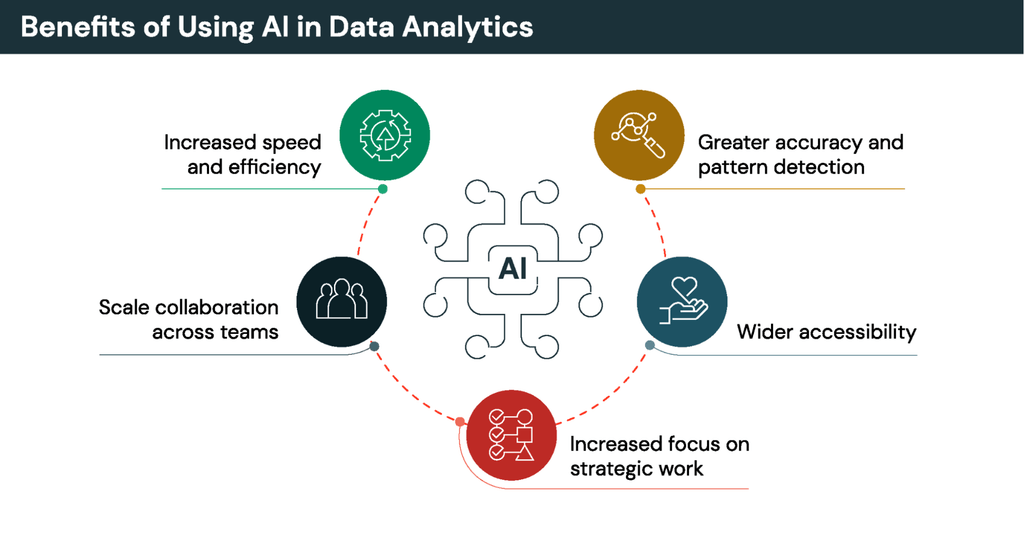
- Saves Time – AI can help automate repetitive tasks such as preparing data, creating reports and identifying trends.
- Better Decision Making – Businesses can use the insights provided by AI to understand their performance and plan for the future.
- Predict Future Trends – Using machine learning models can help businesses predict customer demand, sales performance and potential risks.
- Improves Productivity – Data analysts can spend more time analysing their data and solving business issues.
Whilst there are many advantages to using AI within your business, you need to ensure you are considering data privacy, security, quality of data and potential incorrect/biased results. It is important to have humans verify the results.Skills Needed To Build A Career In AI Based Data Analytics-With more organisations using AI technologies there is an increased demand for professionals with analytical and technical knowledge.
The Future Of Data Analytics With AI
The future of data analytics with AI looks bright. Businesses are using more intelligent technologies.AI powered platforms are making it easier for those without advanced technical knowledge to analyse their data. Users can ask simple questions and get summaries, charts and insights.For example, if a business owner asks “Which product generated the highest sales this month?” an AI supported data analytics platform can help find this data and create a report.Automation, predictive analytics and real time insights will become more important.However, data analysts will still play an important role. Companies will need professionals who can understand their business needs, verify the results provided by AI, interpret data and make decisions based on the insights.
Conclusion
Data analytics with AI is changing the way businesses gather, process and understand their data. From healthcare, banking to retail, digital marketing and education AI is helping organisations solve real world issues and make better decisions.Learning AI within data analytics can help beginners to understand modern data analytics technologies. Gaining knowledge in Excel, SQL, Python, Power BI and machine learning will help give a strong foundation.The best way to develop these skills is to keep learning and working on projects. Combining analytical knowledge with AI technologies will help prepare you for the ever changing requirements of data analytics.