

Introduction
Every day, businesses collect a large volume of data via websites, mobile apps, online purchasing, feedback and social media. However, this is only the beginning. To gain real value from your data you need to understand what it means and how to help your business make better decisions.
This is where Artificial Intelligence (AI) can help.
With AI, businesses are using data analytics in 2026 to make processes faster. Tasks that would have taken hours of manual labour can now be done far quicker. This helps to gain insight into customers’ preferences, identify trends in sales and make better predictions.
Opportunities are also opening up for students, freshers and professionals to build a career around data analytics.
By understanding AI and how it ties in with data analytics, individuals can help build practical skills.
What is AI in Data Analytics?
Data analytics is the process of collecting, cleansing and analysing data to get useful insights. Businesses use these insights to understand their performance, identify issues and make informed decisions.
When using AI in data analytics, you can use technologies like machine learning, natural language processing and generative AI to help with data analytics.
An example of this could be if an online shopping company receives thousands of orders daily. Using AI, they can analyse the purchase trends to understand what their customers like. This allows them to make predictions on which products could perform well in the next few months. This is useful for businesses wanting to understand their large amount of data.
AI helps to speed up data processing and helps analysts to identify trends within their data.
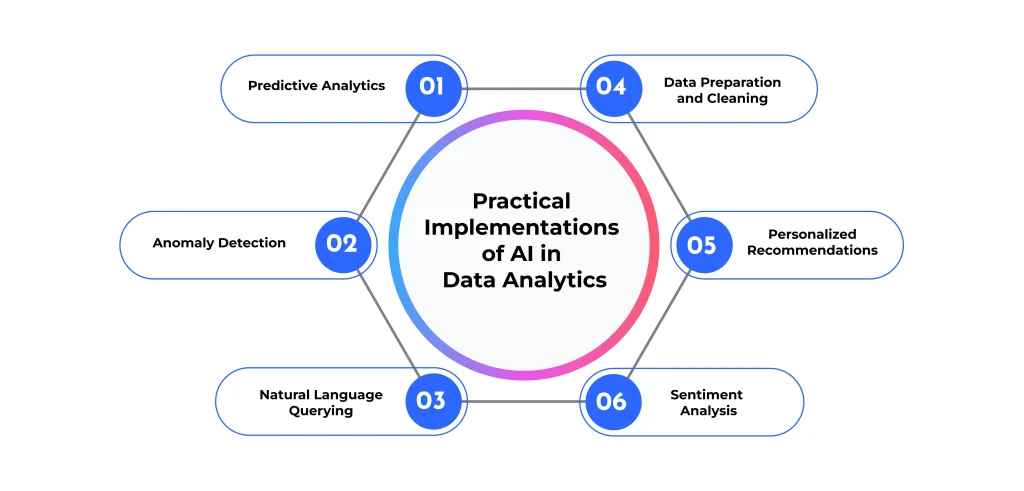
Automated Data Cleansing
One of the main points of data analytics is getting your data ready.
Your data won’t always be perfect. There could be duplicated data, missing data, typos, incorrect formatting and errors. All of which will need to be identified and corrected.
AI tools can help you:
Identify duplicated data and outliers
Identify missing data
Identify incorrect formatting
Identify possible errors
Suggest ways to clean your data
A company may collect data from their customers however there could be different date formats and missing information. AI can help highlight these issues and suggest ways to fix them.
This helps to reduce the amount of repetitive work and lets analysts spend more time understanding business issues.
However, even with automated data cleansing you will still need to check the data has been cleaned correctly.
Natural Language Data Analytics
In the past, data analytics would require some knowledge of SQL, Python or other technical tools.
Now with AI, data analytics is becoming easier to do with natural language. You can ask questions and receive answers based on your data.
An example of this could be a marketing manager asking:
What were our top performing campaigns last month?
AI analytic tools can help generate the query to find the information and provide a summary.
This helps non technical employees to explore their business data.
It can also help analysts to generate SQL queries, understand unfamiliar formulas and analyse complex data.
However, the accuracy will rely on the quality of your data and how well it understands the question being asked. Important results should always be checked.
Predictive Analytics
One of the main benefits of AI is that it can help with predictions.
Traditional data analytics focuses on understanding past performance. With predictive analytics you can use historical data, statistical methods and machine learning models to make predictions on what could happen in the future.
AI can help businesses to:
- Predict future sales
- Predict customer demand
- Identify customers who may leave
- Predict inventory needs
- Understand potential changes in the market
- A retail company may want to prepare for the festival season. They can analyse historical sales, customer preferences, seasonal trends and current demand.
- An AI model can help them predict which products could sell more in the upcoming season.
- This helps to let businesses plan their inventory, resources and reduce unnecessary costs.
Whilst AI can make forecasting more efficient, it isn’t guaranteed. Unforseen events and customer behaviours can impact the accuracy.
Real Time Data Analytics
You no longer have to wait until the end of the month to understand what is happening within your business.
AI can help organisations to analyse their data in real time. This is useful for businesses who need to make decisions quickly.
An e-commerce business can analyse their website traffic, sales and customer activity. If a certain product suddenly starts to get more orders, the company can identify the change and act accordingly.
A digital marketing team could analyse their campaign performance to see if there are any unusual changes in cost, clicks and conversions.
Real time data can help with making quicker decisions, such as:
- Online retail & e-commerce
- Banking & finance
- Healthcare
- Digital marketing
- Manufacturing & logistics
Having timely insights can help businesses to identify issues quicker and see new opportunities.
AI Data Visualisation & Reporting
Data visualisation helps to make sense of your data using charts, graphs, dashboards and reports.
AI is helping to change how data is visualised.
Rather than manually creating reports, AI can help you create charts, identify trends and see any unusual changes.
For example, if there is a drop in revenue for a specific region in your sales dashboard, an AI assistant can highlight this for you to investigate further.
Tools such as Microsoft Power BI, Tableau and other analytics tools have features to help with automated insights, natural language and AI.
This can help both beginners and experienced analysts to create reports.
However, knowing which chart to use and making sure it relates to your business is an important skill. A pretty dashboard won’t help if it is communicating the wrong message.
AI Tools in Data Analytics in 2026
There are a variety of tools that can help analysts to use traditional data analytical skills alongside AI.
Below is a list of commonly used tools for different analytics. Depending on the version, subscription and configuration the AI features may differ.
Tool | Help
Microsoft Excel | Data cleansing, formulae, analysis & AI insights
Power BI | Interactive dashboards, reporting & AI
Python | Data processing, machine learning & predictive
ChatGPT | Explaining data concepts, code generation & analysis
Tableau | Data visualisation, dashboards & analytics
Google Looker Studio | Reporting & visualising marketing/business data
Excel is a good place to start for beginners. It helps you get to grips with organising data, formulae, charts and basic analytics.
Once you have learnt the basics, you can try learning SQL, Power BI, Python and machine learning to develop more advanced skills.
Understanding how different AI tools can be used for data analytics will help you choose the right technology for different issues within your business.
How is AI changing the role of a Data Analyst?
Whilst AI is changing the role of a data analyst, you will still need analytical skills.
Previously analysts would spend a lot of time creating reports, queries and cleansing data. Now with AI many of these repetitive tasks can be helped with.
This means analysts can focus on:
- Understanding business needs
- Choosing the right metrics
- Interpreting the results
- Identifying business opportunities
- Communicating the findings
- Checking the accuracy of the AI results
For example, if an AI tool identifies a drop in customer engagement, a skilled analyst will need to investigate why, make sure the result is accurate and make recommendations.
Having an understanding of business issues and being able to communicate your findings is still an important skill.
One of the main data analytics trends 2026 is the increasing importance of having technical knowledge alongside business knowledge.
Analysts who can use AI effectively and use their own judgement may be better equipped for changing requirements in the workplace.
Challenges of using AI in Data Analytics
Whilst there are many benefits to using AI, there are some things to consider.
Data Quality
AI relies on the data it receives. If the data isn’t accurate or complete the results may not be accurate.
Data Security & Privacy
Often businesses will have customer details, financial data and confidential information. You need to make sure your data is secure and that the AI tools are following the correct privacy policies.
Inaccurate Results
Sometimes AI can produce misleading explanations, incorrect calculations and unsupported conclusions. Important results should be checked.
No Human Understanding
Whilst AI can identify trends, it may not fully understand the situation in your business. Humans still need to use their judgement.
To have a successful AI analytics strategy you need to strike a balance between automation, data quality, security and human knowledge.
As businesses continue to look at the future of data analytics you will need to consider these challenges.
Learning Data Analytics with AI as a beginner
As a student or fresher you don’t need to be an AI expert to start learning data analytics. By taking it step by step it can make it easier.
Step 1 – Understand the basics of data analytics
Understand what data analytics is, why businesses use it and how data helps make decisions.
Step 2 – Excel Skills
Learn the key functions of Excel including sorting, filtering, pivot tables and charts.
Step 3 – Learn SQL
SQL is widely used to pull information from databases. Learn SELECT, WHERE, GROUP BY, JOIN and aggregate functions.
Step 4 – Power BI
Learn how to create interactive dashboards, prepare data and communicate your findings.
Step 5 – Understand Python & AI
Once you are confident with the basics, learn about Python libraries such as Pandas & NumPy. This can then lead onto machine learning & predictive analytics.
Step 6 – Real life projects
Try some projects such as sales analysis, customer behaviour analysis, marketing campaign reporting and product demand forecasting.
Using AI can help you to understand the concepts, however it is important to complete the analysis yourself to build practical skills.
Career Opportunities in AI Data Analytics
As AI is becoming more popular in business analytics there are opportunities for those with data skills.
Some roles include:
- Data Analyst
- Business Analyst
- Business Intelligence Analyst
- Marketing Data Analyst
- Data Analytics Consultant
- Junior Data Scientist
- As a fresher it can be useful to build a good foundation in Excel, SQL, Power BI & Python.
Many technology companies, IT services organisations, financial institutions and businesses across various industries in Chennai use data to understand their performance and make decisions.
Students looking for data analyst jobs for freshers in Chennai can build up their profile by gaining practical skills and creating projects to show they can solve business issues.
Employers may be looking for someone who can work with data, communicate findings and understand business needs. Knowing about AI can be a great added bonus if you have the fundamentals.
The Future of Data Analytics with AI
The future of data analytics is moving towards being more intelligent, automated and accessible.
AI agents are playing an important role. They can help with multi-step analytics such as pulling data, identifying trends and creating summaries.Conversational analytics are also becoming more popular. This means you can explore your data using natural language questions.
Businesses are also looking to bring together different data sources.
These are all part of the data analytics trends 2026. Organisations are looking for ways to make their data more useful.However, not everything will be fully automated. AI can help you to work more efficiently with your data.
The most valuable thing is to understand the fundamentals of analytics and how to use AI as a support.
Conclusion
AI is transforming data analytics in 2026. It can help to speed up data cleansing, make data analysis more accessible, enable advanced forecasting and make reporting more efficient.
Businesses can use AI to understand customer behaviour, identify trends, make predictions and make better decisions. However, data quality, privacy, accuracy and human judgement are essential.
This is a great opportunity for beginners to develop their skills.
By learning Excel, SQL, Power BI, Python & AI assisted analytics students can build a good foundation.
If you are looking to get into data analytics start with the basics, practice with real data and gradually explore AI powered tools.
Understanding data and being able to turn it into meaningful insights for your business will be an important skill going forward.
