

Introduction
Table of Contents
Introduction
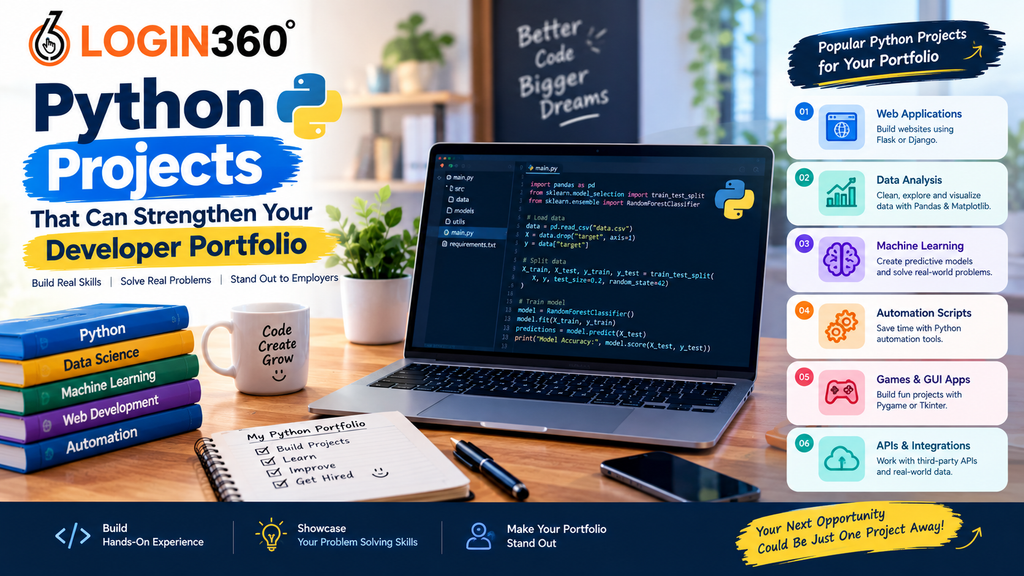
Python projects for developer portfolio for anyone aiming to establish a career in software development, web development, automation, data science, artificial intelligence, or machine learning, learning Python is an excellent first step. Yet merely finishing a Python course or including Python as a skill on your resume won’t suffice when it comes to showing off your capabilities to potential employers. It is essential that a solid developer portfolio illustrates the kind of things you can build, the way you deal with problems, and how well you can apply programming concepts to real-world situations. This is precisely why Python projects are so valuable.
Why Python projects for developer portfolio
A developer’s portfolio isn’t just a set of certificates or a list of programming languages. Recruitors and employers usually want to know how you apply your knowledge in real-life situations. A thoroughly developed Python project can show that you are able to write clean code, work with databases, use APIs, deal with errors, create user interfaces, and solve actual problems. Such projects also provide you with something specific to talk about in interviews. Rather than just stating that you know Python, you can describe what you built, the reason for building it, the challenges you encountered, and how you overcame those challenges.
Python projects for developer portfolio One important benefit of carrying out projects is that they enable you to understand programming concepts on a deeper level. Although tutorials can explain syntax and theory, constructing an application forces you to put together a number of different concepts. You might have to deal with functions, classes, file handling, databases, APIs, libraries, authentication, testing, and deployment all within one project. The practical experience gained in this way can make your learning more significant and assist you in becoming a more confident developer.
- 1. A personal expense tracker
A Personal Expense Tracker is a very simple but highly useful program for a novice developer. This application allows the user to track all expenses, classify them, edit information, and view a summary of their spending for a particular year or month. The project can be implemented both at the level of command line applications and subsequently extended to web applications.
The language for implementing such a project can be Python. The database can be stored in SQLite or another database, which will contain all the information about the expenses that the user of the application will enter. In addition, for data analysis and visualization, libraries such as Pandas, Matplotlib can be used. This type of application demonstrates knowledge of Python, databases, and data analysis skills. A working example of the program would allow the user to see a visual display of spending on various categories of goods, for example, food, transport, shopping, and entertainment.
- 2. The To-Do List Application
creating a To-Do List application can be a worthy project for developers who are starting their journey into Python programming because it allows users to create, edit, mark as done, or delete tasks, as well as arrange them according to their priority or due date.
Python projects for developer portfolio, you can create a version that only utilizes Python with some simple file storage, while more advanced solutions include graphical interface with Tkinter or web application developed with Flask or Django. You can also think about adding some functionalities such as user profiles/accounts, task categories, deadlines, search, and alerts.
- 3. The Use of a Weather Application via an API
A weather application based on an API shows that you know how software can communicate with external services; it enables users to input a city and obtain information including temperature, humidity, weather conditions, and forecasts.
Python is able to send requests to a weather API and work with the JSON data that is returned. You can either create a simple command-line application or develop an appealing web interface. It is also necessary to include appropriate error handling for cases such as invalid locations, missing API responses, or connection problems. This project is especially useful for illustrating the integration of APIs, the processing of JSON, HTTP requests, and the handling of user input.
- 4. A web application using Flask or Django
A Python web application can considerably enhance a developer’s portfolio since it shows off abilities that go beyond simple programming; Flask is appropriate for use with small applications, whereas Django offers a more complete framework for bigger ones.
Python projects for developer portfolio You might create a blog platform, a student management system, an appointment booking application, an inventory management system, or a simple e-commerce website. Possible features would be registration, login, database integration, forms, search, and an administrative dashboard. Such a project would show that you understand backend development, databases, authentication, routing, templates, and web application architecture.
- 5. Data Analysis Project
Python is widely used in the field of data analysis, so including a Data Analysis Project in your portfolio is a good idea. For this project you may select a dataset that is available publicly and which relates to areas such as sales, customer behaviour, movies, transportation, sports, or online shopping.You can use Pandas to clean and organise the data prior to analysing it, and libraries such as Matplotlib can help you to produce charts and spot patterns. Your project must explain the questions you intended to answer, the methods you employed, and the insights that you obtained. A well-done data analysis project shows that you are able to work with real-world data rather than just carrying out simple Python calculations.
- 6.Project on Machine Learning Prediction
If someone is interested in artificial intelligence, then a Machine Learning Project will make your portfolio appear more technically impressive. You might produce a system for predicting house prices, a model for predicting customer churn, a spam classifier, a predictor of student performance, or a recommendation system.It is possible to use libraries such as Scikit-learn in order to prepare the data, train the models, assess performance, and make predictions. A good project should include an explanation of the dataset, a description of the preprocessing steps, the algorithm that was chosen, the method used to evaluate it, and a presentation of the results. You really don’t have to develop an incredibly complex model. A project that is well documented and shows the entire machine learning workflow is in fact more valuable than one that is complicated but not well explained.
- 7. Projects involving Python automation
Automation undertakings are ideal ways for demonstrating practical programming skills. Python allows for automation of many monotonous tasks – sorting files, creating reports, processing spreadsheets, renaming docs, extracting data, sending notifications, etc. You can create a File Organization Tool which will sort files into folders depending on their extensions, or make a program which will read an Excel sheet and generate a report. These projects show your future employers that you are aware of programming being beneficial for increasing productivity and solving regular office tasks.
- 8. Chatbot Development
A Python chatbot is a great project to showcase logic, text processing, and user interaction skills. Whereas an entry-level chatbot would simply reply to predefined questions, a more advanced one would utilize natural language processing techniques. A customer-support chatbot could be developed, which would reply to the most common questions regarding a fictitious company. Features such as a conversation history, keyword detection, fallback responses, and a database integration could be added. If one is studying AI, the project could be expanded upon by applying machine learning or natural language processing methods. A chatbot would improve a portfolio showcasing it to potential employers since a visitor would be able to interact with it.
- 9. URL Shortener
A URL shortener is a small-scale project which shows off a number of key backend development concepts. It allows users to input a long URL and in return gives them a shorter link; when a person goes to the shortened link the application directs them to the original URL. The application can be developed with either Flask or Django and the URLs can be stored in a database; extra features might be user accounts, click tracking, expiration dates, and analytics. This project illustrates routing, database management, unique identifiers, HTTP requests, and backend logic within a fairly manageable type of application.
- 10. E-Commerce Application
If a Python developer carries out the development work properly, an E-Commerce Application can be one of the strongest projects in his or her portfolio. Features such as product listings, product search, categories, shopping carts, user registration, login, order management, and an administrator dashboard can be included. Django can be used to organise the application and to deal with databases and authentication; furthermore, payment services can be incorporated into a test environment where it is appropriate. The project doesn’t require hundreds of products or any advanced features. The important point is to show a clear understanding of how the various components of an online shopping system work together.
- 11. REST API Project
It is a good idea to create a REST API with Python if you want to show off your skills in backend development, since APIs enable various applications and services to talk to one another. It is also possible to include authentication, validation, error handling and documentation. This kind of project is especially useful for developers interested in pursuing a career in backend or full-stack development since APIs are a vital component of modern applications.
- 12. Python for Game Development
Python can be put to use in creating simple games .Game development can be used to illustrate programming logic, event handling, object-oriented programming, collision detection, score management, and user interaction. Even if a simple game does not show off enterprise-level development, it can make a beginner’s portfolio more interesting and demonstrate creativity as well as problem-solving ability.
How to Make Your Python Projects Portfolio-Ready
Python projects for developer portfolio Just uploading code to GitHub isn’t sufficient for creating a impressive portfolio. Each project should have a clear README file in which it explains what the application does, what technologies were used, how to install it and how to run it. It’s advisable to include screenshots or a demonstration video if possible. The rewrite should also explain the main features and the challenges you came across during development.
You must also make sure that your code is well organised and easy to read. Choose variable and function names that are meaningful, divide your project into the correct files, and add comments only when they are really useful. Do not include unnecessary files such as passwords, private API keys or temporary files. The use of Git and GitHub shows that you understand basic version-control practices.
How to Choose the Right Python Projects
Python projects for developer portfolio Select projects according to the career path you wish to pursue. If your aim is data science, then focus on Pandas, data visualization, statistics, and machine learning. In the case of automation, make scripts that deal with real business or personal problems. If you are interested in AI, study machine learning, natural language processing, and intelligent applications.
Conclusion
Python projects for developer portfolio Building practical Python projects is an excellent way to expand one’s portfolio and display their programming competency. Advanced applications, such as expense trackers, To-Do apps, API tools, web apps, automation programs, data analysis solutions, machine learning models, chatbots, games, and e-commerce platforms, could be built in Python. Moreover, such projects allow the coders to fix errors, seek solutions to issues, and learn the language better. One should create a portfolio with Python apps, debug it constantly, update programs’ code, and document each project. The key point is to choose the types of applications based on one’s professional preferences and goals, upload them to GitHub with appropriate comments, and describe the acquired skills and achievements in each project’s documentation. If done correctly, Python coding will become an essential asset in one’s profession.
BOOST YOUR SKILLS WITH LOGIN360.