

Table of Contents
Introduction
Artificial Intelligence (AI) vs Data Science, they are two of the fastest growing fields in technology today. They are transforming industries, creating new career opportunities, and changing how businesses make decisions. Because these terms are often used together, many people assume they mean the same thing. However, AI and Data Science are different fields with different goals, tools, and applications. If you’re planning a career in technology or simply want to understand these concepts better, knowing the difference between AI and Data Science is essential. This guide explains both fields in simple language, compares their features, and helps you decide which one may be the right choice for your career.
What is Artificial Intelligence (AI)?
Artificial Intelligence is a branch of computer science that focuses on building machines capable of performing tasks that normally require human intelligence. Instead of simply following fixed instructions, AI systems can learn from data, recognize patterns, solve problems, understand language, and even make decisions. Think about the virtual assistants on your smartphone. When you ask a question, they understand your voice and respond intelligently. Streaming platforms recommend movies based on your viewing history. Online shopping websites suggest products you might like. These are all examples of AI working behind the scenes.
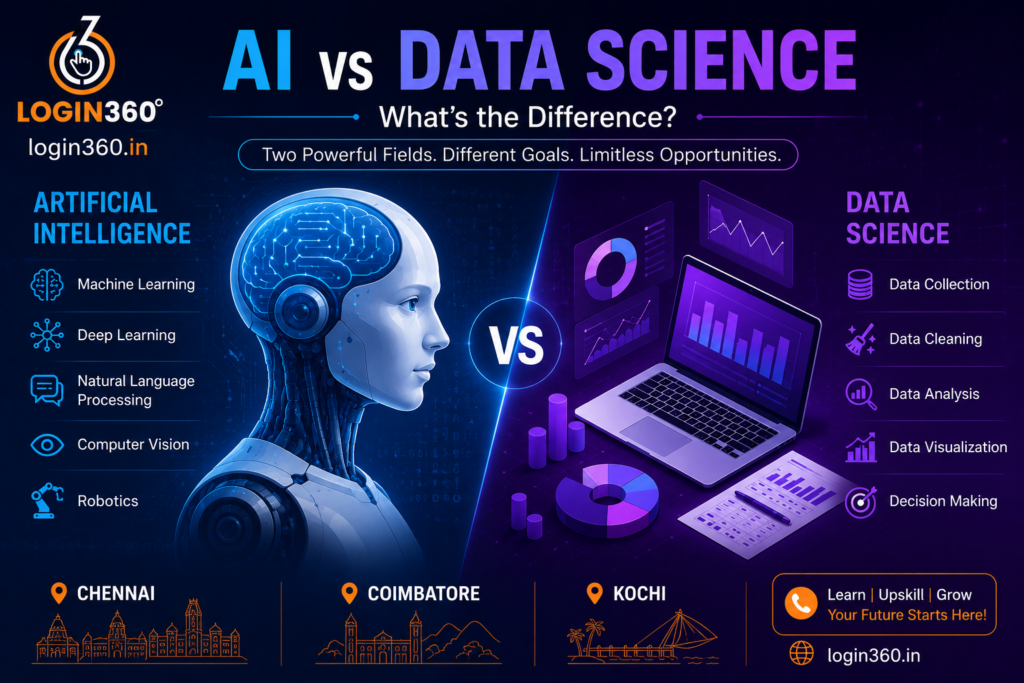
Common AI Technologies
- Machine Learning
- Deep Learning
- Natural Language Processing (NLP)
- Computer Vision
- Robotics
- Reinforcement Learning
What is Data Science?
Data Science is the process of collecting, organizing, analyzing, and interpreting data to solve business problems and make informed decisions. Every day, organizations generate massive amounts of data through websites, mobile apps, customer transactions, social media, and sensors. Data Science helps convert this raw information into valuable insights. Unlike AI, which focuses on making machines intelligent, Data Science focuses on understanding data and discovering patterns that help businesses make better decisions. For example, an online retailer can analyze customer purchasing behavior to identify which products sell best during holidays. A hospital can analyze patient records to improve healthcare services. Banks use Data Science to detect fraudulent transactions before they cause financial loss.
How AI and Data Science Work Together
Although AI and Data Science are different disciplines, they often complement each other. Data Science prepares and analyzes data, while AI uses that data to build intelligent systems. A Data Scientist collects user viewing history, cleans the data, removes duplicates, and identifies customer preferences. An AI Engineer then uses this prepared data to train a recommendation model that suggests movies each user is likely to enjoy. Without quality data, AI systems cannot learn effectively. Similarly, Data Science becomes even more powerful when AI automates predictions and decision making.
Key Differences Between AI and Data Science
| Artificial Intelligence | Data Science |
|---|---|
| Focuses on creating intelligent systems | Focuses on analyzing and interpreting data |
| Uses algorithms that learn automatically | Uses statistical methods and data analysis |
| Goal is automation and intelligent decision making | Goal is finding insights from data |
| Includes Machine Learning and Deep Learning | Includes data collection, cleaning, visualization, and analysis |
| Commonly used in robotics, chatbots, and automation | Commonly used in business analytics and reporting |
Skills Required for Artificial Intelligence
1. Programming Languages
- Python
- Java
- C++
- R
2. Mathematics
- Linear Algebra
- Probability
- Statistics
- Calculus
3. AI Concepts
- Machine Learning
- Deep Learning
- Neural Networks
- Computer Vision
- Natural Language Processing
4. Tools and Frameworks
- TensorFlow
- PyTorch
- Keras
- OpenCV
- Scikit learn
Skills Required for Data Science
1. Programming
- Python
- R
- SQL
2. Data Analysis
- Data Cleaning
- Exploratory Data Analysis (EDA)
- Statistical Analysis
3. Visualization Tools
- Tableau
- Power BI
- Matplotlib
- Seaborn
4. Databases
- MySQL
- PostgreSQL
- MongoDB
5. Big Data Technologies
- Apache Spark
- Hadoop
Applications of Artificial Intelligence
- Healthcare: AI assists doctors by analyzing medical images, detecting diseases earlier, and recommending treatment options.
- Banking: Banks use AI to detect fraudulent transactions, automate customer support, and evaluate loan applications.
- Retail: Online stores recommend products based on browsing history and purchasing behavior.
- Transportation: Self driving vehicles use AI to recognize roads, traffic signs, pedestrians, and surrounding vehicles.
- Manufacturing: Factories use AI powered robots to automate repetitive tasks and improve production quality.
Applications of Data Science
- Marketing: Businesses analyze customer behavior to create personalized marketing campaigns.
- Finance: Financial institutions assess investment risks and predict market trends.
- Healthcare: Hospitals analyze patient records to improve treatment quality and optimize resource allocation.
- Sports: Teams analyze player performance to improve strategies and recruit talent.
- E-commerce: Companies study customer behavior to improve sales, pricing strategies, and inventory management.
Which One Has Better Career Opportunities?
Both AI and Data Science offer excellent career prospects because organizations across industries rely heavily on technology and data driven decision making. AI professionals typically work on building intelligent systems, automation tools, robotics, and machine learning models. Their work often involves developing solutions that can learn from data and perform tasks without constant human intervention. Data Scientists, on the other hand, focus on analyzing data, identifying trends, and helping businesses make informed decisions. Their insights support marketing, finance, healthcare, manufacturing, and many other sectors. As digital transformation continues to grow, demand for skilled professionals in both fields is expected to remain strong.
AI vs Data Science Salary Comparison
- Artificial Intelligence: professionals often earn higher salaries because they specialize in advanced technologies like Machine Learning, Deep Learning, and Natural Language Processing. These skills are in high demand across industries such as healthcare, finance, robotics, and autonomous systems.
- Data Scientists: also enjoy competitive salaries because businesses rely on data driven decisions. They help organizations analyze customer behavior, predict trends, improve operations, and increase profits.
AI vs Data Science: Which Is Easier to Learn?
- Artificial Intelligence: If you enjoy mathematics, statistics, and analyzing large datasets, Data Science may feel easier to understand. Much of the work involves exploring data, creating reports, and finding insights that support business decisions.
- Data Scientists: If you are interested in teaching computers how to learn, recognize images, understand speech, or make decisions, Artificial Intelligence may be a better fit. However, AI usually requires a stronger understanding of mathematics, programming, and machine learning algorithms.
AI vs Data Science: Which Career Should You Choose?
Choose Artificial Intelligence if you:
- Enjoy programming and software development.
- Want to build intelligent applications.
- Are interested in robotics, automation, or chatbots.
- Like solving complex technical problems.
- Want to work with Machine Learning and Deep Learning models.
Choose Data Science if you:
- Love working with data and numbers.
- Enjoy finding patterns and trends.
- Like creating dashboards and reports.
- Want to help businesses make better decisions.
- Prefer data analysis over building intelligent systems.
Future Scope of AI and Data Science
Artificial Intelligence is driving innovation in areas such as autonomous vehicles, smart assistants, cybersecurity, personalized healthcare, and advanced robotics. AI is also becoming an essential part of customer service, manufacturing, and financial services. Data Science is becoming increasingly important as organizations generate more data every day. Businesses need skilled professionals who can transform raw information into valuable insights and support strategic decision making. Emerging technologies like Generative AI, predictive analytics, cloud computing, and big data are creating even more opportunities for professionals with AI and Data Science expertise.
Common Myths About AI and Data Science
Myth 1: AI and Data Science are the Same
This is one of the biggest misunderstandings. Data Science focuses on analyzing data, while AI focuses on building systems that can learn and make decisions.
Myth 2: You Need to Be a Math Genius
Although mathematics is important, you don’t need to be an expert before getting started. Many concepts become easier through practice and real world projects.
Myth 3: AI Will Replace Every Job
AI is more likely to automate repetitive tasks than replace every profession. It also creates new career opportunities in AI development, machine learning, and data analysis.
Myth 4: Data Science Is Only About Coding
Coding is only one part of Data Science. Professionals also work with statistics, business understanding, communication, and data visualization.
Myth 5: Only Computer Science Students Can Learn AI or Data Science
People from engineering, mathematics, commerce, business, physics, and many other backgrounds have successfully built careers in these fields by learning the required skills.
Frequently Asked Questions (FAQs)
Is AI better than Data Science?
Neither is better than the other. AI and Data Science solve different types of problems. The best choice depends on your interests, career goals, and skill set.
Can a Data Scientist become an AI Engineer?
Yes. Many Data Scientists transition into AI roles by learning Machine Learning, Deep Learning, and Artificial Intelligence concepts.
Does AI require coding?
Yes. Most AI roles require programming knowledge, especially in languages like Python. Coding is essential for developing, training, and deploying AI models.
Is Data Science a good career?
Yes. Data Science is one of the most in demand career paths across industries such as finance, healthcare, retail, manufacturing, and technology.
Which has a better future: AI or Data Science?
Both have excellent long term prospects. AI is advancing automation and intelligent systems, while Data Science continues to drive business decisions through data analysis. Learning skills from both fields can give you a competitive advantage.
conclusion
Artificial Intelligence and Data Science are closely connected but serve different purposes. AI focuses on building intelligent systems that can learn and make decisions, while Data Science turns raw data into valuable insights for better decision making. The right choice depends on your interests and career goals. Whether you choose AI, Data Science, or both, developing these in demand skills can open the door to exciting career opportunities and a successful future in technology.